Maximize your Recruitment Focuses on Football Manager 26!
Success in Football Manager isn’t just won on match days. It begins months or even years in advance through smart, strategic scouting and recruitment. While match day decisions influence results, recruitment choices define your ceiling. When building a dynasty how you set up your club’s recruitment focuses in Football Manager will be as important as building a successful tactic, or developing your best young players. You need a well-planned recruitment strategy where scouting assignments enhances your club’s world knowledge, and identifies players who can improve the quality of your squad, either immediately, or within the next few seasons.
Succeeding in the transfer market can quickly turn a mid-table side into a continental contender, while a few poor transfer windows can trap even the best managers in cycles of stagnation. However, recruitment in Football Manager isn’t just a transfer window activity, it’s a season-long strategic process.
Whether you’re restoring a fallen giant or guiding a lower-league underdog toward unexpected glory, the choices you make in the transfer market shape everything from tactical identity to long-term sustainability. With countless scouting assignments, potential signings, and hidden gems waiting to be uncovered, understanding where to concentrate your recruitment efforts often becomes the difference between lifting trophies and drifting in mediocrity.
Read More | Scouting in Football Manager: The Beginners Guide
To build a winning squad and dominate your save, you need a recruitment strategy that is deliberate, well-structured, and tightly connected to your club’s tactical approach and long-term vision. Your tactical identity acts as the engine of your scouting process, providing clarity on the types of players you should target – though this naturally varies between saves and managerial styles.
Once that foundation is set, the real work begins: applying search filters, setting recruitment focuses, analyzing scout reports, and combing through the vast player database in search of individuals who can elevate your squad. With this in mind, I want to give you a few tips at how you can scout smarter in Football Manager 26.
In this article, we’ll explore the most essential recruitment focuses you need to create on Football Manager 26 to identify potential new signings – from building a balanced, future-proof squad to transforming your scouting department into a powerful engine of long-term success. These recruitment priorities will help you build a stronger scouting network, uncover hidden gems, and identify potential future club legends with confidence.
So let’s take a closer look at how to scout for players on Football Manager to identify suitable players. Here are the six essential recruitment focuses every Football Manager player should master.
In Our Guide to Football Manager’s Recruitment Focuses
The Recruitment Focuses Overview
Recruitment focuses is a key part of scouting for players in Football Manager. It enables you to search for specific players under certain conditions, or just build up a knowledge of players around you, for instance in France, Brazil or regions known to produce wonderkids such as South America.
In FM26, the Recruitment focuses overview is found at: Recruitment > Recruitment Focuses
The screen features a messaging system with the Chief Scout that enables you to edit or create new recruitment focuses, a list of focuses and a section which lists all players found in a specific recruitment focus.
Once you’ve created some Recruitment Focuses in Football Manager, the page will show you a list of all focuses. In FM26, the ‘ALL’ list is default, enabling you to see all recruitment focuses you’ve got either in progress or are completed.
By clicking on the drop down menu named ‘ALL’ you’ll be able to see only recruitment focuses that are ‘In Progress’ or are ‘Completed’.
Personally, I would advice you to change the list of focuses to show only those In Progress. Then, you can head back to browse through players from completed scouting assignments later on.
Scouting Assignments
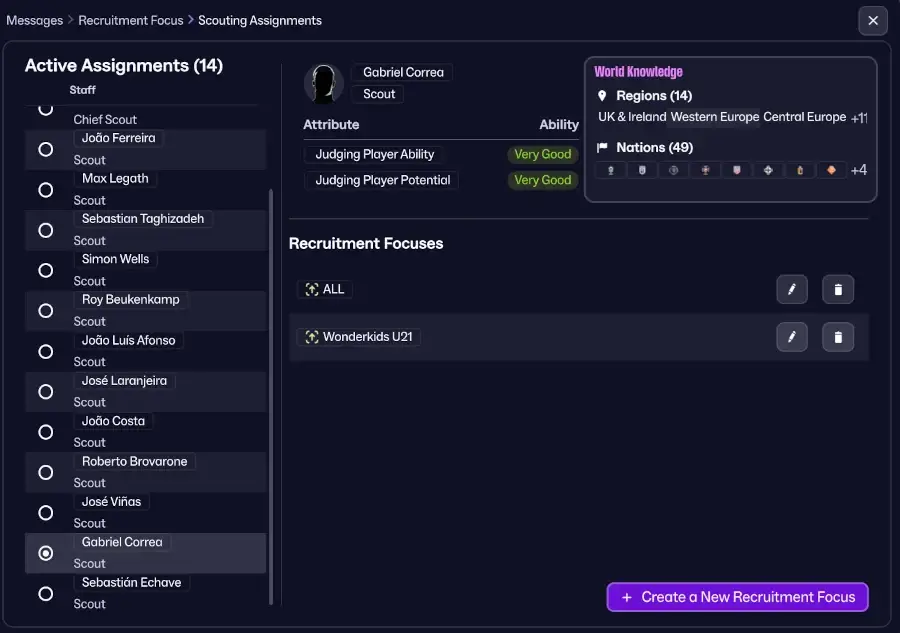
In the upper right of the overview, you’ll show a clickable Tile named Assignments. This feature enables you to see a list of all active assignments for each of the scouts you got at your disposal. Here you’ll better see the scouts abilities, their knowledge of regions and nations and what scouting mission(s) they are currently doing.
Here you can discover potential issues with your scouting assignments more easily. In fact, when you create recruitment focuses you should ensure the scout got at minimum Very Good knowledge of a region or a nation before sending him on a mission to that country, or that he has Elite Adaptability.
If you send out a scout with minimal knowledge of a region or nation, it will take a lot longer time before results from your scouting assignments starts popping in.
The overview of active scouting assignments will also let you discover those scouts who doesn’t got an active scouting mission and may be free to get scout reports of individual players.
Taking Charge of Assigning Scouts
If you want 100% control of what scouting missions your scouts are sent out on, you should first and foremost take charge of assigning scouts. This ensures that you get better control of what type of recruitment focuses are created and which scouts are scouting where.
To take control, you need to go to the Staff Responsibilities section, found under Club > Responsibilities > Delegation > Scouting
Click Take Control if it’s not already activated.
You are now ready to create recruitment focuses in Football Manager – so let us take a closer look at how to set it up and what scouting assignments I prefer to set up in a new save to quickly find potential signings. Whichever you select, or prefer to create, will depend on your vision for your save.
Matched vs Nearly Matches or In Progress
A key element of the Recruitment Focus overview is the list of players found within a scouting mission. At default, you’ll see every player that Matches the current conditions and parameters through the Matched overview.
However, we also got the opportunity to see Nearly Matched players, or those In Progress.
The Nearly Matched list of players includes all those players who doesn’t quite matches your criteria but the scout believes should be mentioned. They might be slightly out of the age range, the potential ability range or got an higher transfer value than what you’ve set as max.
Or, they may have a recommendation rating that falls outside the minimum recommendation score e.g. D rather than C+.
In Progress list will give you an overview of players the scout is currently generating a scout report of, or is watching.
It enables you to get a low-down of the number of players that the scout(s) are in process of recommending.
How to Create Recruitment Focuses in FM26?
Creating recruitment focuses in Football Manager 26 can be done from either the Squad Planner or from the new and improved Recruitment hub. Within that screen you’ll need to find the sub-menu Recruitment Focuses.
Here you’ll get an overview of all existing, in progress, recruitment focuses at your club featuring a list of players matching the conditions and parameters you select.
You’ll even get the chance to edit your club’s scouting range, or see upcoming players being scouted.
From the list of Focuses you can quickly edit or create new recruitment focuses.
The interface is quite intuitive and easy to understand.
Step 1: Select Position / Player Role
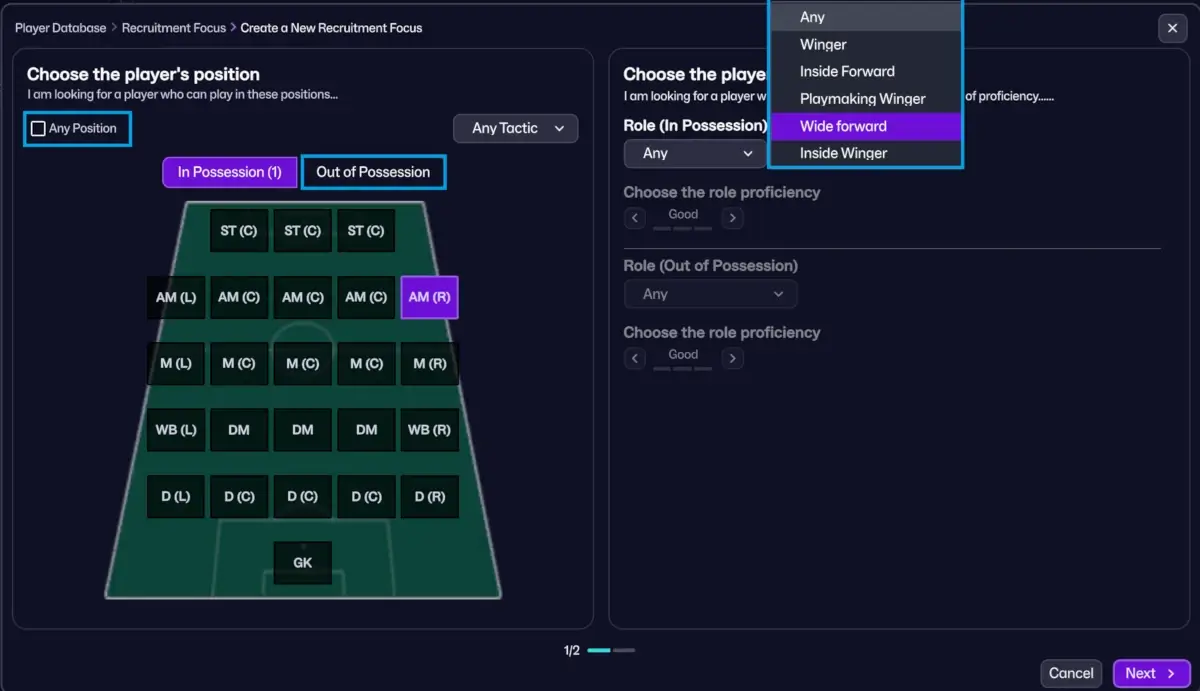
In step one you’ll determine whether you wish to scout for players in a specific position, or fits a specific tactic, or generate a rather broad scouting assignments where any position or role is preferred. If you select a position, you will have the option to select what type of player role you wish to match for a potential signing.
New in FM26, you’ll be able to determine whether you wish to look for a player who is proficient in a player role for in possession, or out of possession and his proficiency to do so.
Step 2: Customizing Main Details
In the next screen you’ll be customizing the scouting assignment – providing additional conditions or parameters that makes the recruitment focus as broad or narrow as you wish.
Regardless of the number of recruitment focuses you got, I recommend to keep ‘Include results found in other Recruitment Focuses’ enabled. This ensures that you can identify potential signings that match your criteria and increase the number of players matched.
Most of the sections within this screen is rather self-explanatory.
Minimum Current Ability will limit the search to players with the exact star ratings or higher.
Minimum Potential Ability will limit the search to players with more than your specified star ratings for PA. Putting the star ratings at minimum 4 golden star will reduce the scouting mission to only elite players if you’re managing at a top club. If you’re lucky, you might find a handful of players. At a lower club, choosing minimum 4 golden star may deliver a larger pool of players since the number of players around the world is most likely to have a significant higher potential ability levels than existing players within your squad.
You can broaden or narrow your search by lowering the threshold between minimum and maximum current and potential ability. Keep in mind that star ratings will be based on your squad’s qualities and how your backroom staff assess their players, as well as the scout’s abilities relating to Judging Player Ability and Judging Potential Ability.
If you’ve just entered a new club, bought a new assistant manager or coaches, it may take some time before they build up knowledge of your players to accurately determine your team’s qualities. The same applies to your scouts. If they got lower JCA or JPA, their assessment of players may be less accurate than if they got elite levels.
Step 3: Further Details
On top of the main details that makes out your entire recruitment focus, you can add further conditions, parameters and key metrics to narrow the number of matched players.
From selecting players with a certain transfer status, player trait, transfer value or nationality, to performance data – stats and other key metrics e.g. limit the search to players with an higher average ratings, or who makes many assists, goals or stands out for statistics such as key passes or expected goals.
You can even tailor a scouting mission to match the club’s vision – for instance if you’re managing at a club where it’s preferred to sign players of a certain nationality, only sign high-reputation players, or favours to develop young players.
Short-Term Needs vs. Long-Term Planning
Regardless of who you are managing, the level you are on, or what’s your club vision, when establishing a recruitment plan, it has to take into account both short-term needs and long-term planning. You need to consider how the squad may look like for the next two transfer windows as well as what happens if injury crises should occur.
In the matter of a recruitment process you need to balance your scouting network according to short-term needs and provide a foundation for consistent and sustainable scouting plan that does not only identify good players who can improve the squad now, but you also need to look ahead two, or even three seasons, to ensure you can monitor the development and process of future international stars.
In Football Manager there are three types of Recruitment Focus Priorities:
Top Priority
The Top priority recruitment focus can be seen as a short-term scouting focus where two or more scouts will be send out on an assignment to identify players according to your conditions to return the fastest possible results. A top priority recruitment focus is advantageous when you’re in dire need to improve the squad, perhaps due to lack of depth in a position, injury crisis or a key player might head out the doors rather soon and you got limited time to strengthen that area.
Selecting this option will mean that this focus will be priorities ahead of any other recruitment focuses. At a club with a limited scouting network with few scouts, other scouting missions may be put on hold until the top priority recruitment focus is finished. Normally, such a scouting assignment will last for around 1-2 weeks.
Which scouts that are selected will depend on their knowledge of an area, their attributes and availability. At a minor club with 3 or fewer scouts, it may mean that your entire scouting team will be busy with this type of scouting mission.
Standard Priority
The standard priority recruitment focus will be started on once a top priority is complete and gathering results may take a bit longer time than a top priority. It can be used to identify potential signings and replacements for a position either as a scouting assignment where the scouts will roam any area, or build up a knowledge of players within a competition or league.
Ongoing Priority
An ongoing recruitment focus has the lowest priority and has no end date. It continues until you decides to edit it or end it. This long-term scouting focus is often used to enhance your club’s scouting knowledge of a region or a nation – meaning you can build up knowledge of an area of the world and thereby gather data that takes into account development and progress of the players around you.
The Squad Planner in Football Manager
In Football Manager, recruitment of players starts with the squad planner. It’s here you can assess your squad, your needs – both for the short and long-term, as well as considering playing pathways for your best talents and future wonderkids.
The squad planner is one of the most essential tools in Football Manager to learn about your squad’s overall abilities and qualities. It could be a great place to start when determining the best formation for your squad or in the matter of selecting player roles after you’ve set up your in and out of possession tactics.
However, the Squad Planner is also so much more! In Football Manager, it is a vital tool for planning Recruitment and setting up an appropriate scouting strategy for the coming season.
You can find the Squad Planner at Recruitment > Click the drop down menu and select Squad Planner, or customize your bookmarks for quick access to get to this vital FM tool.
Here, you can get an overview of your squad for the Current Season, the Next Season, or the Season After.
It enables you to plan and assess your squad by setting up a priority list for each position and visualize the squad if players leave, are added to the first team squad, or is sent out on loan.
You’ll get the opportunity to add players within your youth teams or players on your shortlist to monitor how your squad will shape up and identify potential issues before they become crucial.
Within the Squad Planner on Football Manager you should ask yourself:
- are there any position issues where you lack the necessary qualities for a position or role for the current season? Use the Abilities Overview and browse through all the positions to check the team’s star ratings for every position, or the team’s average ability.
- do you got an appropriate squad depth for every position, and what happens if a player is sold, denies to agree a new contract, or becomes injured? You can quickly see the depth of your squad by clicking on the ‘Depth’ button – or by clicking on a position.
- are there any players on an expiring contract, or how will the squad look like the next season, or the season after? Could there be any potential issues with your squad in the future that you can plan for by creating an appropriate recruitment focus now?
NB! Keep in mind that star ratings are contextual – based on your squad’s overall strengths per position, your staff’s ability to make an accurate judgement of the player’s abilities, and key attributes necessary for a player role. A 3 star player may be 4 star at a minor club. The better players your squad has, the more likely the current ability star ratings will decrease with 1 to a half star.
This gives you useful information about areas you might need to improve, and thereby set up a short-term scouting assignment to scout for players that can improve your squad within the current season, or establish a recruitment strategy which focuses on long-term planning by scouting for wonderkids and newgens.
How you use the data within your Squad Planner and what you prioritize is basically up to you. However, regardless of your club vision, there are three essential recruitment focuses that you might have to extort to within your save at one point or the other.
In fact, for smarter scouting we can break up our recruitment strategy into several categories which enables us to better create recruitment focuses in Football Manager that fits the appropriate age category.
In Football Manager there are four different age curves and development cycles which you can consider to set up a thoughtful squad planning strategy around.
- 15–20: Wonderkids and long-term projects
- 20–23: High-potential first-team challengers
- 23–28: Prime-quality starters
- 29+: Mentors or role-specific veterans
These development paths provides a great guideline when creating new Recruitment Focuses in Football Manager. At least, that’s how I prefer to approach scouting assignments.
Let us take a closer look at some useful recruitment focuses you should consider setting up.
Key Recruitment Focuses in Football Manager
1. First Team Players 20-30
Identifying first team players who can improve your squad, or provide the necessary squad depth to be competitive is essential for long-term success.
A rather basic recruitment focus in Football Manager to identify potential transfer targets is to scout for players between the age of 20 and 30. This scouting assignment is a rather well-rounded focus that fits any team at any level. The intention is to use it to gain knowledge of players around you, who can improve your squad both for the short- or the long-term.
When creating this ‘First Team Players Recruitment Focus‘ you don’t want to scout players for a certain position or role. This enables you to get a large pool of players. The con is that there might be players who might not fit your tactics.
This recruitment focus will be fairly comprehensive with few limitations. It focuses on finding players with the minimum current ability to become a useful player now, or in the future – meaning you take into account those players under the age of 23 who is yet to progress into a first team candidate.
What you set as minimum current ability or minimum potential ability will depend on your team’s average qualities. If managing in the lower leagues, you might want to increase the minimum potential ability star rating to 3.5, 4 or 4.5 – depending on your playing level.
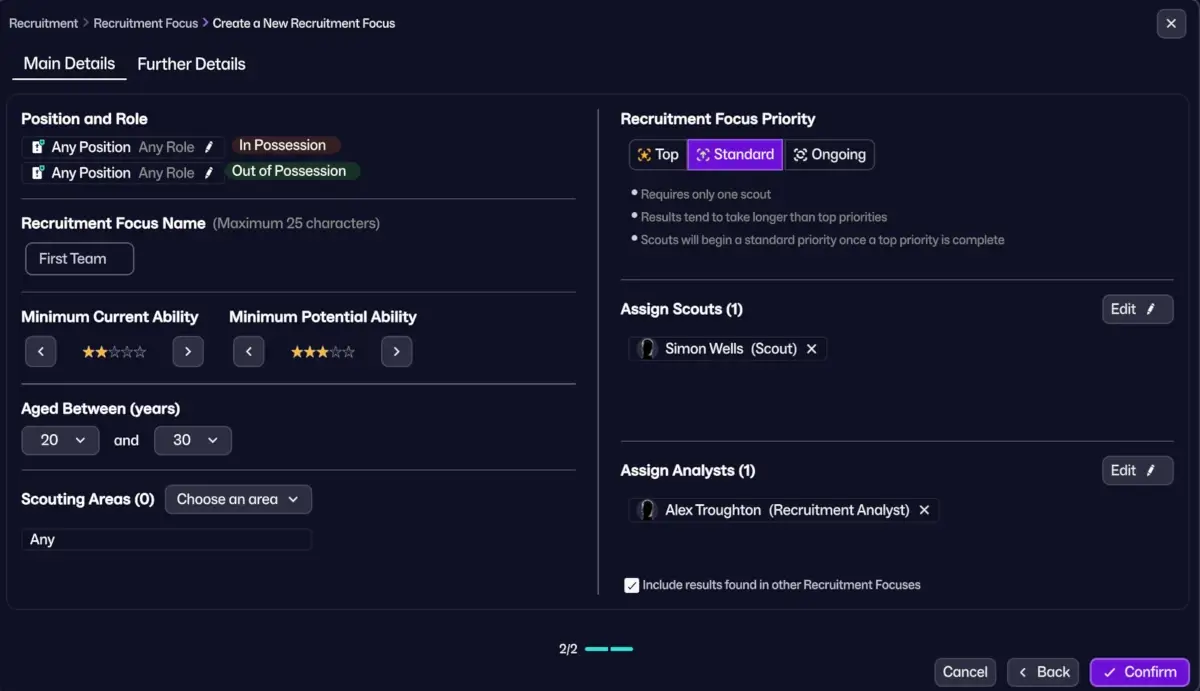
Here’s how I would set up a recruitment focus to identify first team players or back-up options:
- Choose Any Position
- Name: First Team 20-30
- Minimum Current Ability: 2 Star (Gold star)
- Minimum Potential Ability: 3 Star (Gold star)
- Age Between: 20-30
- Scouting Area(s): Any
- Recruitment Focus Priority: Standard (one scout)
- Assign Scout with: High Judging Player Ability (Primary) + Good Judging Potential Ability (Secondary) + Adaptability (Tertiary)
Additional condition to consider: Average Ratings
2. Free Agents
For a lower league side with minimal transfer budget, or no money at all, scouting for free agents might be beneficial. In this instance, creating a recruitment focus where you look to identify players out of contract could be useful throughout a season.
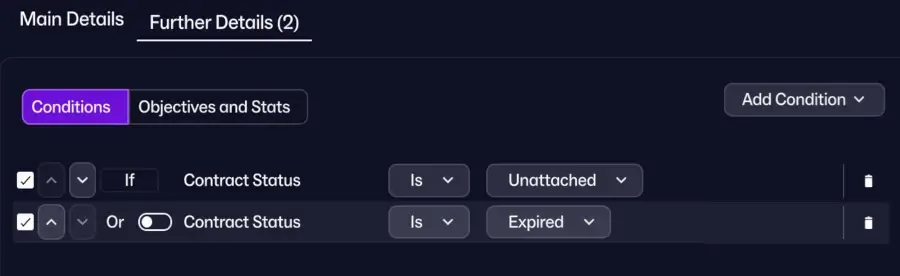
A necessity is to add a condition that enables us to simply scout for players who are unattached, or is on an expired contract. This way we can identify players on free transfers more easily that can easily become a useful player for the first team.
- Choose Any Position
- Name: Free Agents
- Minimum Current Ability: 3 Star
- Minimum Potential Ability: 3 Star
- Age Between: 15-32
- Scouting Area(s): Any
- Recruitment Focus Priority: Standard (one scout)
- Assign Scout: High Judging Current Ability
- Further Details: Add Condition: Contract Status > Unattached and Expired
Quickly find the best free agents on Football Manager 26 with our comprehensive list of players on free transfers on FM26.
3. Approach to Sign Players
An important task of recruitment is to be hands-on and be ahead of everyone else. There’s no better feeling than swoop up a potential wonderkid, cheap gem or a player on an expiring contract – meaning you’ll pay nothing more than agent fees, wages and clauses.
Poaching approach to sign wonderkids, or great players at a minimal cost could be one of the best tricks in the book.
All players on an expiring contract of three to six months will be available on an approach to sign in Football Manager. Yet again, we will use a condition to limit the search to only players with a contract status with expiring.
The major difference between scouting for free agents and these approach to sign players is that the recruitment focus priority will have an ‘endless’ duration. Although it has the lowest priority, it will be an ongoing process as players are on an expiring contract throughout the entire season – especially if you load South American nations and wish to sign players from across the Atlantic Ocean.
To create such a recruitment focus you can follow this step-by-step process:
- Choose Any Position
- Name: Approach to Sign 15-32*
- Minimum Current Ability: 4 Star (silver)
- Minimum Potential Ability: 3 Star (gold)
- Age Between: 15-32
- Scouting Area(s): Any
- Recruitment Focus Priority: Ongoing
- Assign Scout: High Judging Current Ability + High Judging Potential Ability + Good Adaptability
- Further Details: Add Condition: Contract Status > Expiring (6 Months) / Expiring (3 Months) / Expiring (1 year)*
By including those players with an expiring contract of one year, you can monitor players with a decreasing transfer value and may come at a bargain price.
4. Wonderkids U21
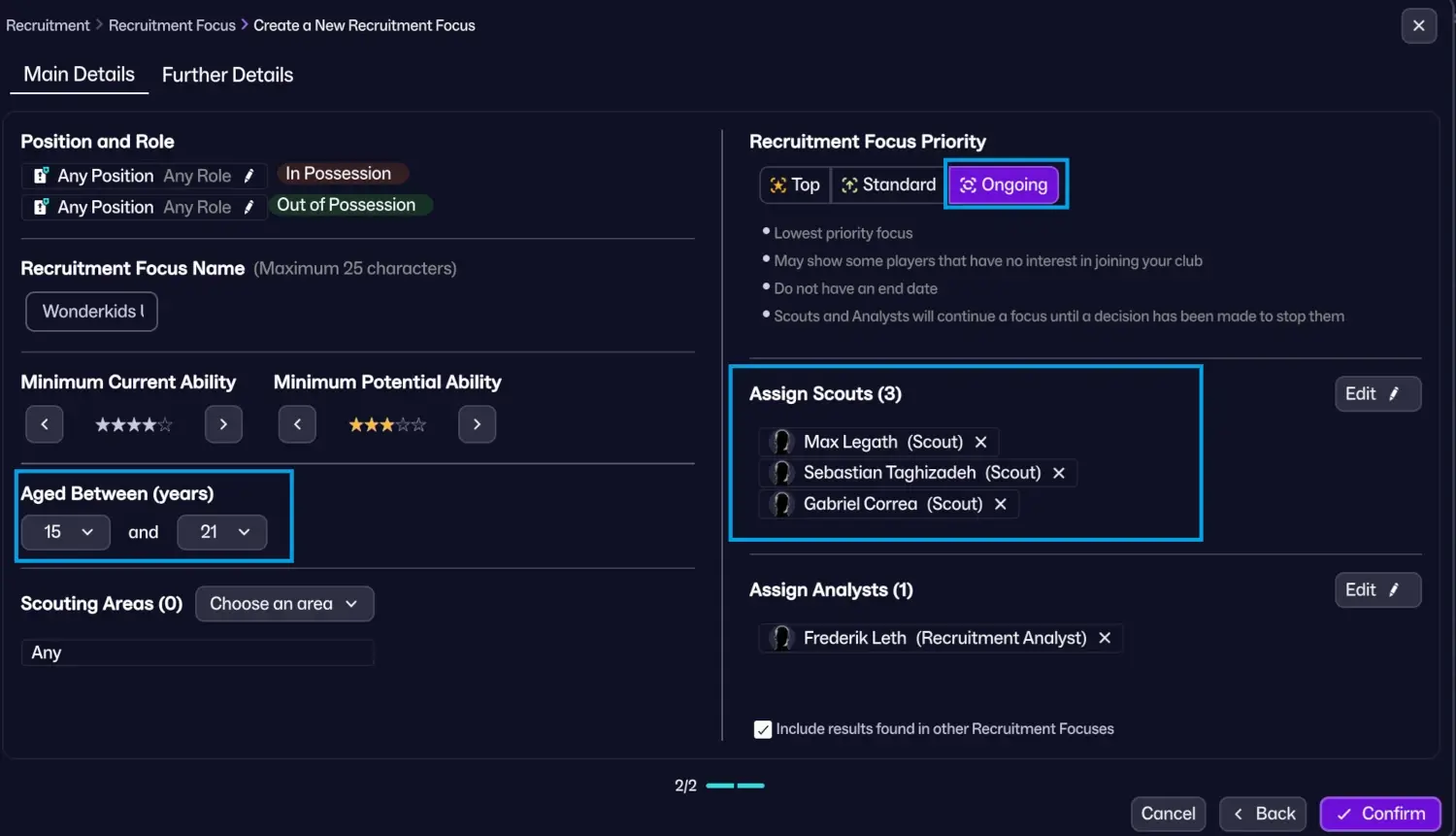
Another fairly overall recruitment focus is one where you aim to track down the best under-21 wonderkids on FM26 – any places within the world. Personally, this is one of my favorite methods when scouting for potential signings and although this recruitment focus can be as specific as you desire, a rather general but comprehensive recruitment focus aimed at finding wonderkids should be set up.
To produce results quicker, it may be useful to assign a minimum of two scouts on this assignment UNLESS you favor to be more specific and target specific nations or regions.
- Choose Any Position
- Name: Wonderkids U21
- Minimum Current Ability: 4 Star (silver)
- Minimum Potential Ability: 4 Star (gold)
- Age Between: 15-21
- Scouting Area(s): Any
- Recruitment Focus Priority: Ongoing
- Assign Scout: High Judging Potential Ability + Good Judging Current Ability + Good Adaptability
- NB! It’s recommended to tick ‘Include results found in other Recruitment Focuses’
This ongoing focus may show players who are not interested in joining your squad, but that’s not a huge game-breaker as you might identify future targets that may wish to join your club as your club’s reputation increases, or the performance of your team improves.
5. Best Newgens
In the process of scouting for wonderkids, my strategy doesn’t stop with just one recruitment focus looking at finding young players. Since the game generates new players towards the end of every season aka newgens, it’s useful to identify the next generation of super stars and elite wonderkids.
Scouting for newgens can be a great and effective way to improve your squad – regardless of the standard of your club. Perhaps you can eat the left-overs from the big teams as you try to poach rejected youth candidates – those players who wasn’t good enough to earn a professional contract. Perhaps you can poach a youngster from a bigger club, or splash the cash on the next Lionel Messi or Lamine Yamal before he becomes too pricey?
This is where creating a recruitment focus looking at finding under-17 players comes in!
Scouting for the best young players between the age of 15 and 17 is a viable option throughout the year. It will let you build knowledge of all those newly generated players who enters the game at the annual youth intake. For instance, since we know most European clubs got their youth intake in March, you may want to prepare this recruitment focus from December but if you got a transfer policy and club vision to build one of the best youth academies in the world, keeping the scouting mission ongoing throughout the year is beneficial.
Yet again, if your scouting network and you got an extensive size of your club’s recruitment team, it’s recommended to delegate this responsibility to 2 scouts for quicker results. You can even select, the same scouts who looks for U21 Wonderkids – since they are actually travelling around the world for talents with high potential.
- Choose Any Position
- Name: Newgens
- Minimum Current Ability: 3 Star (silver)
- Minimum Potential Ability: 4 Star (gold)
- Age Between: 15-17
- Scouting Area(s): Any
- Recruitment Focus Priority: Ongoing
- Assign Scout: High Judging Potential Ability + Good Adaptability + Good Judging Current Ability
- NB! It’s recommended to tick ‘Include results found in other Recruitment Focuses’
IMPORTANT! The minimum potential ability star rating you set depends on your preference, your league standard and how narrow, or broad, you wish your filter to be. Do you want to just find the best wonderkids in FM26, or the newgens with highest potential, increase the star rating from 3.5 to 4… or above!
More Specific Scouting
So far we have gone through rather general recruitment focuses and scouting priorities that are either ongoing or continues over the long-term. Some of these recruitment focuses could be used to increase your scouting knowledge by travelling across the world for the next superstar. However, a manager with responsibilities of scouting, he needs to have two thoughts in mind.
The best FM managers plan for both sustainability and succession – meaning every decision is well-thought out and has an intent.
When it comes to the recruitment of players, there are three rules to keep in mind: buy low, develop well and sell high.
A good manager, plan, visualize and take actions before an issue occurs. This also a key ingredient when creating recruitment focuses in Football Manager.
Regardless of your club’s vision, smart scouting starts by long-term planning. Even though scouting for wonderkids is useful, it’s important to replace aging starters before they decline. Rather than being reactive you should look at signing their successors one to two seasons in advance – meaning it’s a greater chance to get a decent return on your Investment – making sure you cut the losses.
If you got a first team starter with a remaining contract of 1 to 2 years and the player is closing on his peak, it might be advisable to set up more specific scouting assignments that looks for an replacement for that position and role.
1. Role-Specific Attribute Targeting
One of the biggest mistakes players make is scouting based on star ratings alone. Stars are contextual—they depend on your staff opinions and squad strength. Attributes are absolute. Targeting specific player attributes for a position and role may be a viable solution!
In my save, I have identified a future potential issue on both the left and right full-back position. Ben Davis’ contract will expire at the end of the season. At the age of 32, there’s no interest from me renewing his contract despite he could become a great mentor since he got a Resolute personality.
On the right flank, I have poor cover for Pedro Porro, with only Djed Spence natural in that position.
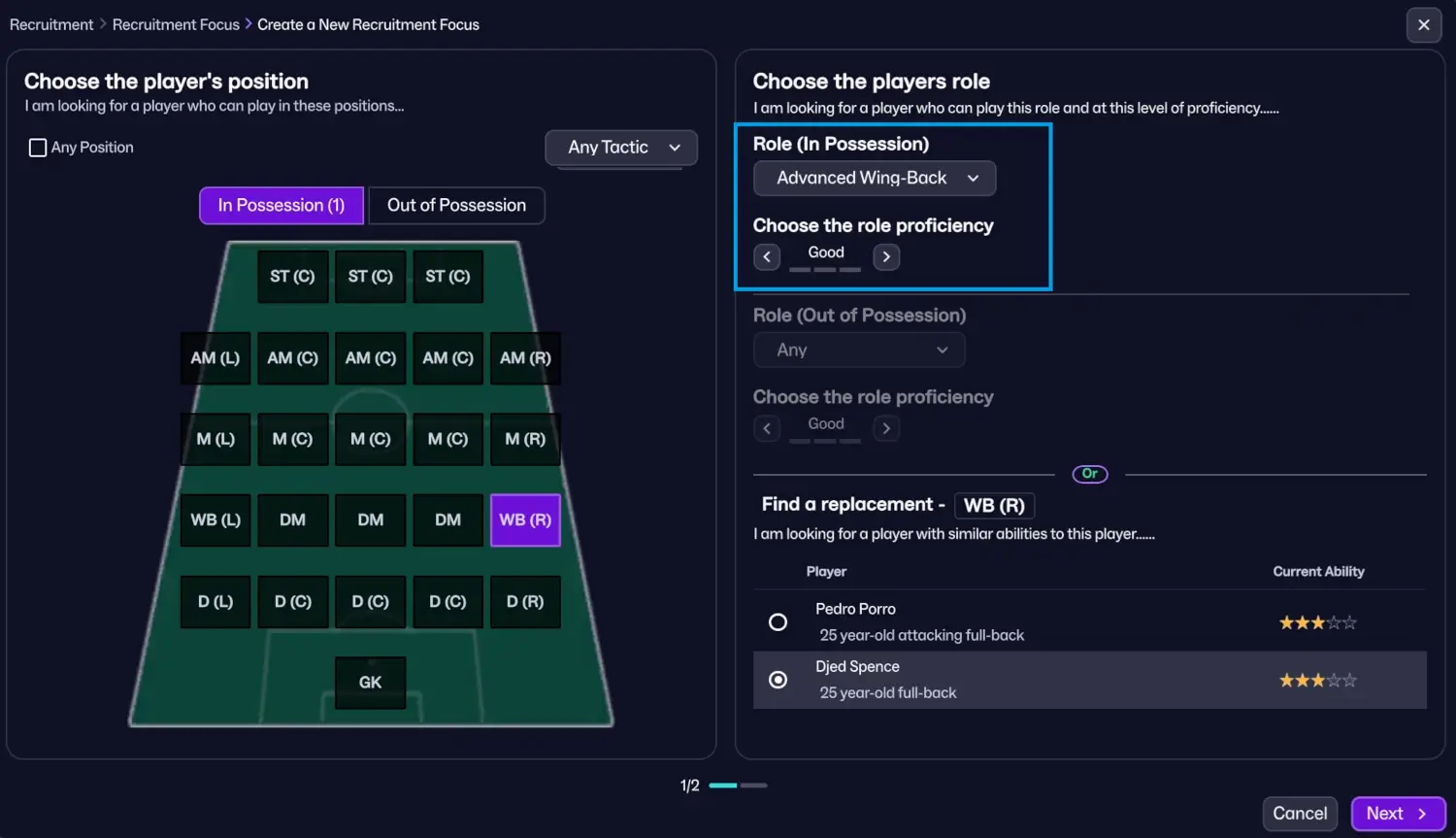
To identify potential signings for the full-back positions I can create a recruitment focus that prioritize a role-specific attribute targeting.
In the Squad Planner you can easily create a new recruitment focus that looks to find replacement for either the left or right FB position.
Rather than selecting any position and role, we want to customize the recruitment focus to set some parameters and conditions that ensures only viable replacements are searched for.
- Unclick Any Position – Select Position e.g. D(L) or D(R).
- Choose In Possession Role – e.g. Wing-Back
- Choose Out of Possession Role: Any – I would not select an Out of Possession role unless you are using a very specific role
- Limit your search to show only players with a role proficiency: Good
- Name : Position / Role e.g ‘LB – WB’
- Minimum Current Ability: 2.5 Star (gold)
- Minimum Potential Ability: 3-3.5 Star (gold)
- Age Between: 18-23*
- Scouting Area(s): Europe*
- Recruitment Focus Priority: TOP / STANDARD
- Assign Scout: High Judging Current Ability + Good Judging Potential Ability
* What you set for age depends on your transfer policy, and club vision. Searching for players between 18 and 23 is just my personal preference at signing players who can still develop and isn’t at their peak, yet.
The same applies to the scouting area. You could focus your scouting assignment at a specific region to increase the number of players more quicker, scout some of the biggest competitions to identify players who performs better, or target any area.
The recruitment focus priority for this search will depend on how fast you want to identify a replacement. Do you need to find a potential signing quicker, a TOP priority will return the fastest response. This will ask two or more scouts to attend the scouting assignments, and it will be prioritized ahead of all other recruitment focuses.
However, if you’ve set up this recruitment focus to identify a potential target for one or two seasons ahead, using the Standard Priority is recommended. It requires only one scout to be assigned, and may take a bit longer time to finish but will be prioritized ahead of any other ongoing recruitment focus – if you got a limited number of scouts.
NB! Football Manager also got a built-in system that enables you to find a replacement for a specific player within your team. By choosing this option, the game will automatically select notable player attributes that separates this person from others. I would not recommend you to use this option unless you have applied a rather specific tactical system which makes you want to find a similar player.
Performance-Based Recruitment Focus
Do you need to identify a potential new signing that should perform in your specific tactical system, then you might want to turn to statistics and data to identify a suitable player that fits your tactics. Perhaps you are using a player role and instructions that asks more of the player – resulting in the role-perfect player may outperform an all-round player.
Perhaps you need a specific type of player to play alongside a more well-rounded player, e.g. a creative playmaker alongside a central midfielder / box-to-box midfielder. Regardless of your needs, creating recruitment focuses that uses parameters and criteria that focuses on performance data and key metrics will be more advantageous than simply scouting for players natural in a position.
The smartest managers scout with the role in mind – by taking performance data into account, along side attributes:
- Is your pressing forward quick enough to lead the line? And, how is his conversion rate?
- What does a Ball-Playing Defender actually require? Does he make enough progressive passes and tackles to be reliant both in the build-up play as well as in the defensive third?
- Does a midfield playmaker actually need off-the-ball movement, vision, or both? Will the player create enough open play key passes, clear-cut chances or assists to be that creative source in the progression phase?
When searching for a potential replacement we can ask our scouts and analysts to filter players according to certain statistics. Although I will talk about this topic more closely in the future, we can create a specific recruitment focus that looks for players that better fit your tactics – meaning you ensure every signing suits your tactical identity. This transforms recruitment from “best player available” to “best player for the job.”
To set up such a recruitment focus you need to understand what you’re asking of the player. Having good insight into the player role’s requirement is a necessity.
Let us assume you’re looking for a new attacking midfielder who should be able to thrive in the Shadow Striker Role.
- Unclick Any Position – Select Position e.g. all AM(C) and ST (C) positions.
- Choose In Possession role: Shadow Striker
- Choose Out of Possession Role: Any
- Limit your search to show only players with a role proficiency: Good
- Name : Position / Role e.g ‘Shadow Striker’
- Minimum Current Ability: 3 Star (gold)
- Minimum Potential Ability: 3-3.5 Star (gold)
- Age Between: 17-26*
- Scouting Area(s): Europe*
- Recruitment Focus Priority: TOP / STANDARD
- Assign Scout: High Judging Current Ability + Good Judging Potential Ability
- Assign Analysts: High Judging Ability + Analysing Data + Tactical Knowledge
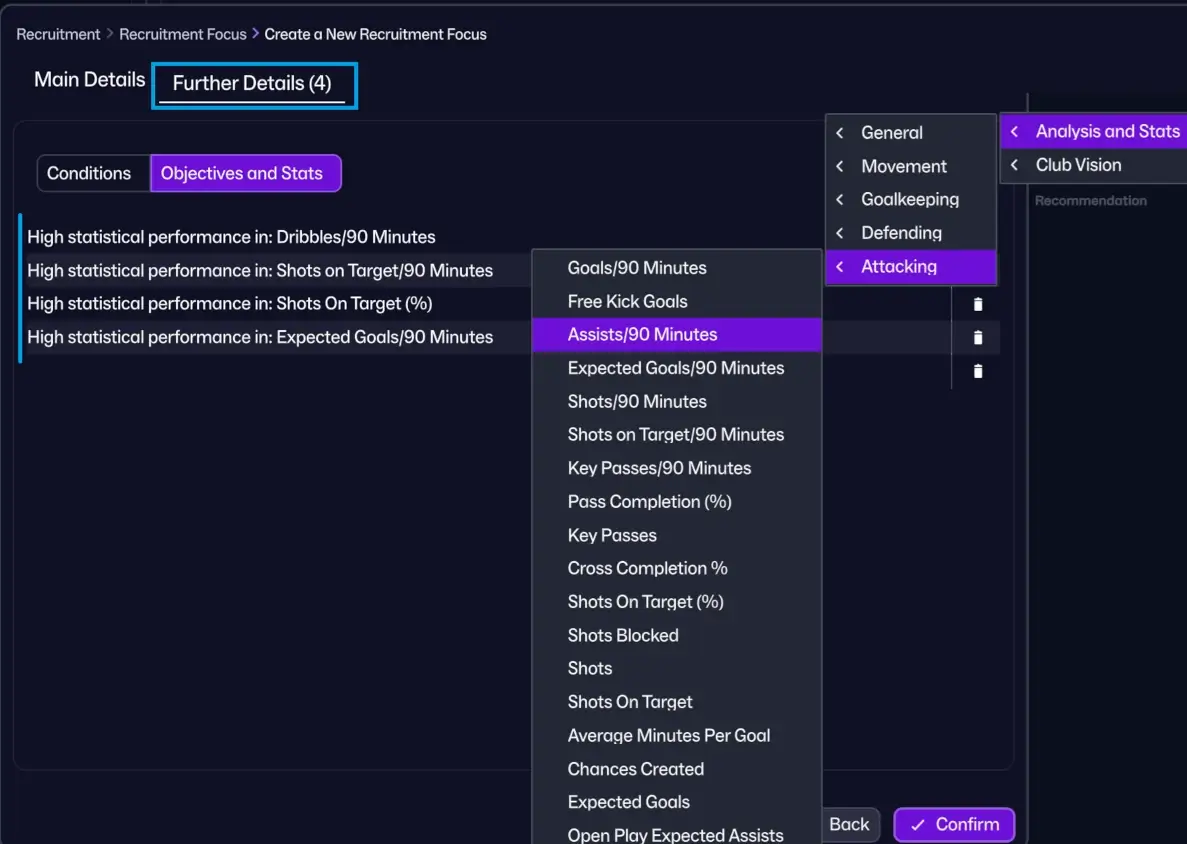
Important! Before you click confirm you should go to Further Details and add a few more parameters and conditions. Within ‘Further Details‘ go to ‘Objectives and Stats‘ section. Click the ‘Add‘ button and hover the mouse cursor over ‘Analysis and Stats‘ to pick key metrics that enables your scouting team to identify suitable players who are both creative and can become a goal threat.
- Dribbles/90 minute
- Shots on Target /90 minutes
- Expected Goals
- Shots on Target %
At the moment, FM26 lacks the opportunity to include Sprints made by 90 minutes. If it was an option, I would have incorporated it into this type of recruitment focus, as the Shadow Striker is a Sprinter role but who may perform similarity to a Channel Forward due to his position in the final third.
This type of recruitment focus can also be a smart way to identify potential signings in the future if you’re debating to switch formations or briefly edit your tactical system between seasons.
By mastering creating Recruitment Focuses in Football Manager, and understand when to use rather basic but quite wide-ranging scouting assignments in difference to tailored and more specific scouting missions, you’ll be one step closer to transform recruitment into a powerful engine that drives success for years – no matter your playing level.
Let us know in the comments your favorite recruitment focuses in Football Manager!