Anyone who have played Football Manager knows how crucial the match engine is both for the experience of the game and the success of your tactics. It can make or break the entire game! Whilst everyone hunting for those big wins, the Football Manager match engine has a huge influence of the success of your tactics.
In every Football Manager, the match engine wish to replicate both the latest tactical trends but also offer you the opportunity to make your own football philosophy come to life! But sometimes, there are certain instructions, player roles or formations that works better than the rest… regardlessly!
Whether you’re chasing a record-breaking league campaign or trying to squeeze every ounce of performance from an underdog squad, a handful of player roles in Football Manager 26 consistently stand out as overpowered.
With a host of new tactical changes and improvements made into how you create tactics in Football Manager 26 and the addition of both new in and out of possession player roles, there’s a lot to get familiar with to become a tactical mastermind in FM26.
Today, I like to explore the tactical trends of Football Manager 26.
Starting out by exploring the most overpowered player roles in FM26, I’ll provide an insight into how the different FM26 meta roles works, and what instructions you should enable to make these player roles more powerful.
These roles don’t just fit the match engine, they bend it to your advantage, generating elite chance creation, high-value goals, and dominant control in every phase of play.
Understanding why these roles work so well, and how to build a system around them, can turn an average save into a dynasty. This is exactly what I’ll be doing in this series of FM26 meta roles!
Understanding how the Football Manager player roles operate either in possession or out of possession, can give you vital knowledge in your quest to build more successful tactics. So, without further ado, lets take a look at some of the most overpowered player roles in FM26!
Disclaimer!
Since the performance of player roles and tactics may differ from each different match engine build, I’ve noted what build I’ve been using for each role just in case there are major changes to the match engine of Football Manager 26 from now to the end of the game cycle.
Advanced Wing-Back – IP Meta Role FM26
Match Engine Version: 26.1
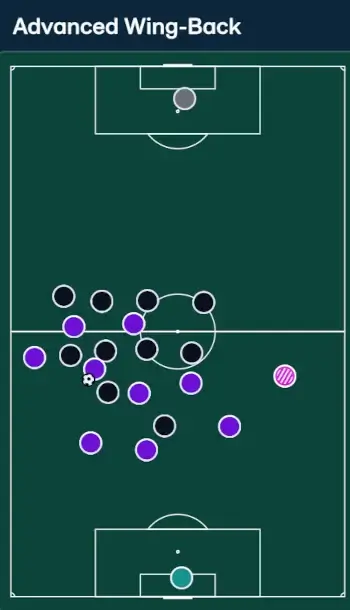
Regardless of your tactical identity, your preferred shape or what type of player roles you favour in FM26, you need someone to stretch the width. The question is where width shall come from. Should it come from a winger, a wide midfielder or a wingback.
Although I’m an admirer of Pep Guardiola’s tactical principles, how he uses his wingers is not my cup of tea. Instead, I feel there are more advantages using double width with attacking full-backs getting forward on every occasion using that extra space down the wide channel to accelerate into space!
The Advanced Wing-back aka AWB is a role that could describe most of the attacking wing-backs these days. From Dani Alves’s attacking intent towards the end of Pep Guardiola’s Barcelona era to players like Nuno Mendes, Jordi Alba, or Alejandro Balde, who plays more like wingers than traditional full-backs.
Perhaps, it’s the nostalgy of Dani Alves – the epitome of Brazilian wingbacks, who revolutionized the game with how he roamed the pitch and connected with Lionel Messi. His playing style continued the legacy of Brazilian wingbacks who had as much flair and attacking skills as the best wingers.
How does the Advanced Wing-Back IP role operate in Football Manager?
In FM26, the Advanced Wingback is a fantastic role to improve your tactic in the final third. It has really become one of my favorite player roles on Football Manager 26.
Football Manager describes the Advanced Wingback in this way: “With more aggressive positioning than a traditional Wing-Back, the Advanced Wing-Back looks to play high and wide as much as possible“.
By default the AWB is an in possession role that will get forward whenever possible by default! This is also one of the biggest differences between the Advanced Wing-Back and the Full-Back in FB-strata. Whilst the FB will hold position, the AWB loves to attack the space in the wide channel and influence the game in the final third, as the role description reveals.
Although how the Football Manager player roles work will depend on the players’ abilities and traits, the role is designed as a highly attacking role who acts more like a winger than a fullback – aggressively pushing forward and overload the opposing fullback with his forward runs.
What Formations suits the Advanced Wing-back Role?
The Advanced Wing-Back aka the AWB is available in the WB position as an In Possession role. It can be used in a huge variety of tactical systems, from 3-5-2 formations to more traditional 4-3-3 tactics.
In tactics with double width, such as the 4-3-3, 3-4-2-1 Wide or 3-3-3-1, it enables you to create 2vs1 overloads on the flank and use the role’s forward movements to disrupt the opponent’s defensive block. In narrow systems, such as the 3-5-2 or 3-4-2-1AM, will the Advanced Wing-Back be the one providing the entire width and will have to work the wide channel by moving up and down the flank between attacking and defensive phase.
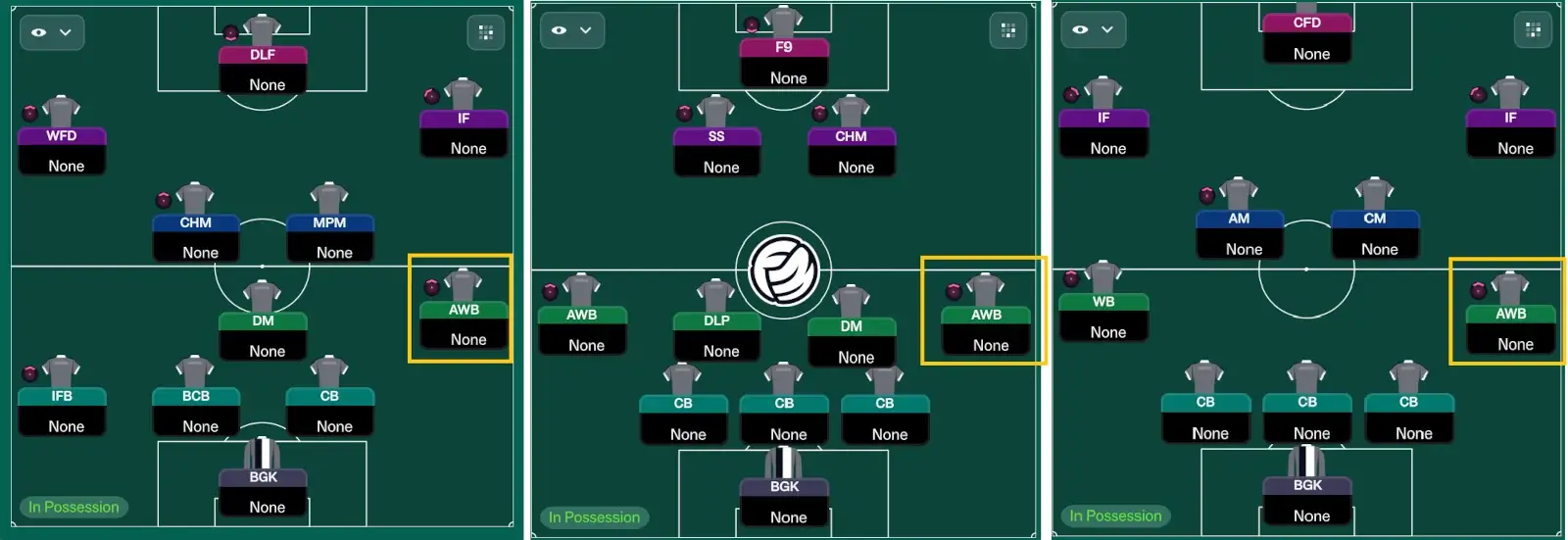
The positioning of the AWB will be both a strength and a weakness for the team, as you’ll discover later on!
By using the AWB role in Football Manager 26, you’ll get an attacking-minded player who can turn your 4-3-3 formation into a 2-3-5 or 3-2-5 shape in the final third – making that player become the fifth or even sixth attacker!
This is something to keep in mind when allocating roles around the AWB. Often positioning himself as high as an attacking midfielder/winger, it leaves huge acres of space the opposition can take advantage of, if the ball is lost in dangerous positions.

Fragile in the counter-attacks but devastating in the final third, it’s a role that requires much attention in terms of what player roles you select around the Advanced Wing-back. Designed to generate 2vs1 situations down the flanks as the player role will overlap his winger in a double-width system, the AWB requires a central midfielder who can provide support for his attacking runs.
Personally, I would consider using a bit more defensive-minded player next to him. At least, not one who tries to make similar forward runs as the AWB.
For instance, you don’t want to use an Attacking Midfielder, Advanced Playmaker or a Channel Midfielder next to him. Instead, you want a supporting player who provides defensive cover, such as a Defensive Midfielder or Deep-Lying Playmaker in DM-Strata, or Central Midfielder or Midfield Playmaker in CM-Strata.
His aggressive positioning is also something to keep in mind when selecting the player roles for your out of possession formation. Personally, I prefer to take advantage of his high positioning by coupling the AWB role with a Pressing Wing-Back – trying to regain possession high up the pitch and use his higher pressing initiative to try to delay counter-attacks.
Due to his forward runs, there will definitely be a vulnerable space behind him – just like the negative defensive influence Trent Alexander-Arnold had in Liverpool’s right side – forcing others to defend and cover for his forward movements. In a 4-3-3 system, you might consider the Wide Covering Central-Midfielder or a more Cautious player who holds position. The best is probably to use three centre-backs who can defend the half space channels.
The Advanced Wing-Back in Build-Up Phase
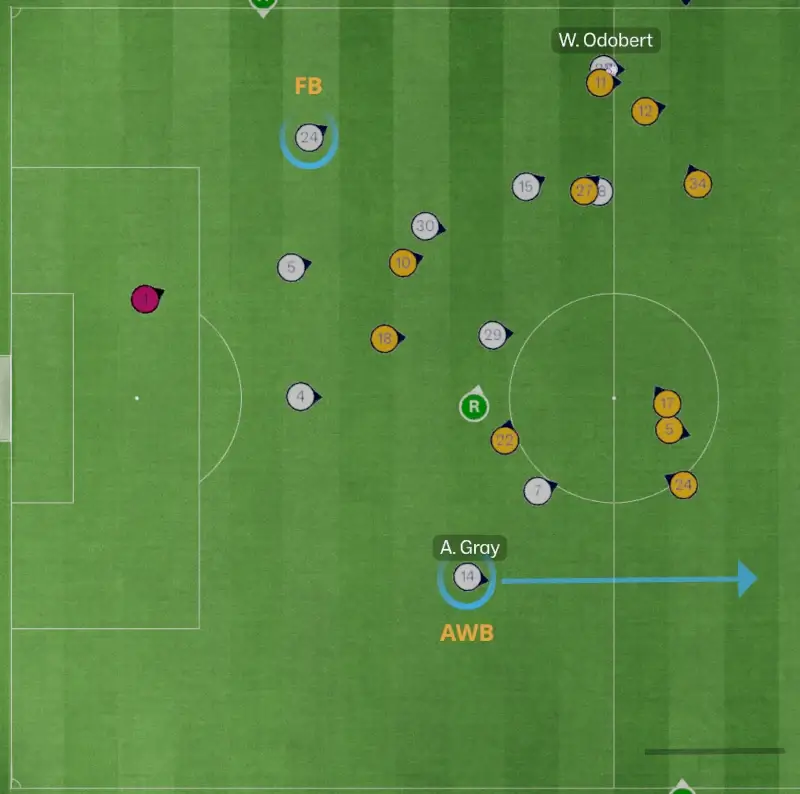
The Advanced Wing-Back in FM26 looks to play high and wide as much as possible – drawing similarities to the Complete Wing-Back role from FM24. This is also the case in the deep build-up – often positioning himself close to the midfield line – making it seem like an extra midfielder playing between the lines.
Compared to the traditional full-back will the AWB position himself far higher in the deep build-up – making him not a viable option for the goalkeeper to distribute the ball to, at least not immediately. This is also why some might favor the Wing-Back role in FB strata for back four tactics.
However, his advanced positioning means the opposite winger might have to stay slightly deeper which opens passing lanes to the central midfielder on that side, provide space for the defensive midfielder to come deep, or generally cause dilemmas to the opposition’s high press as there’s 2vs1 further down the pitch that could be taken advantage of, if your team manage to bypass the high press.
The Power of Advanced Wing-Back in The Final Third
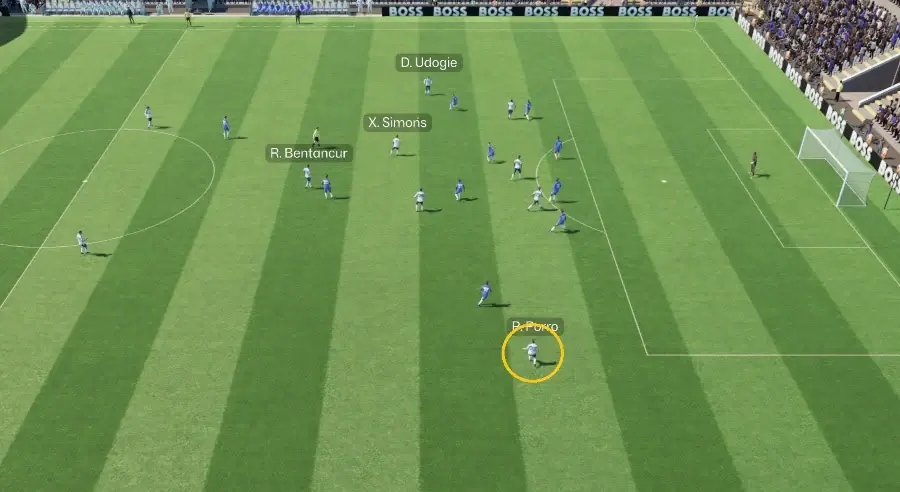
It’s once we reach the progression phase and final third, the true power of the AWB in FM26 comes to effect, especially if you’re playing with a rather narrow tactical shape.
It’s in these situations, the Advanced Wing-Back can provide overlaps on the flanks. It’s especially effective if you’re using an Inside Winger or Inside Forward ahead of him as they will move towards the middle of the pitch – opening the entire wide channel for the AWB’s devastating forward runs.
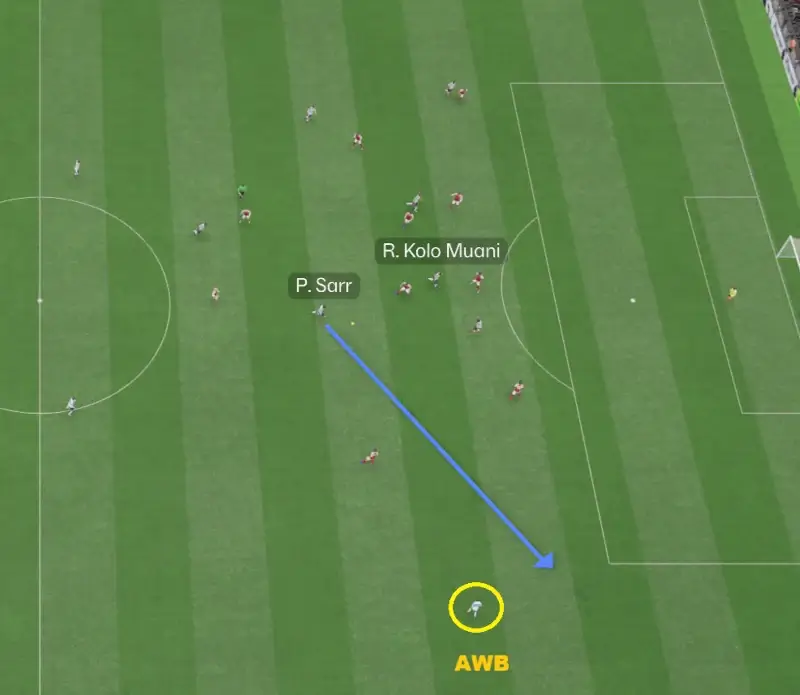
These two players can either combine passes or use opposite movements to cause chaos in the opponent’s defensive block as one move inside and one runs ahead of him – often into space behind the defensive line.
The central midfielders or forwards can then seek to make diagonal passes, switches of play or key passes towards the AWB, who acts more like a winger than a traditional full-back as soon as play advances towards the final third.
When in possession of the ball, his positioning enables him to either drive to the byline to get crosses into the box or make through balls to the Inside Forward or Inside Winger who makes moves between the FB and CB.
Time and time again, the outer defenders in FM26 seems to skip marking the AWB and since he makes so powerful runs from deep, there has been several occasions where the AWB can carry the ball into the penalty area – either going for a shot on the goal, or make low crosses towards the other forwards, cut backs if the attack stagnates, or initiate progressive passes and through balls from the wider areas of the penalty box.
How to improve the effectiveness of the Advanced Wing-Back role?
To get the most out of the Advanced Wing-Back player role on Football Manager you might want to enable a few player instructions. It will be very effective if you ask the Advanced Wing-Back to Stay Wider – making him an outlet to progress play into the final third – or come to a goalscoring opportunities.
By instructing him to stay wider, the player will position himself regularly on the outside of the outer defender – making it seem like the player is ALWAYS available for a pass in this match engine (26.1).
What’s been highly powerful so far in the FM26 match engine is crosses! The Advanced Wingback is made for that! Especially in regards to how he pushes forward at every occasion and is on the receiving end of a diagonal pass – ready to make crosses into the box or create chances from wide areas!
To take advantage of crosses in FM26, you can ask the player to make crosses from the Byline – giving him clear instructions on what to do with the ball as soon as he receives it.
If you’re asking him to drive to the byline to make more crosses into the box, the player will be slightly more individualistic – trying to carry the ball forward and beat his marker by quickness in dribbles and feints.
Additionally, to get even more out of the AWB on FM26, you could ask the team to focus play down the side you’re AWB is positioned at by customizing the Supporting Run instructions by telling your midfielders to look for overlaps. Then, you may increase the probability of a high-scoring chance even more by turning to wide play as an attacking vision.
Player Instructions of Advanced Wing-Back on Football Manager
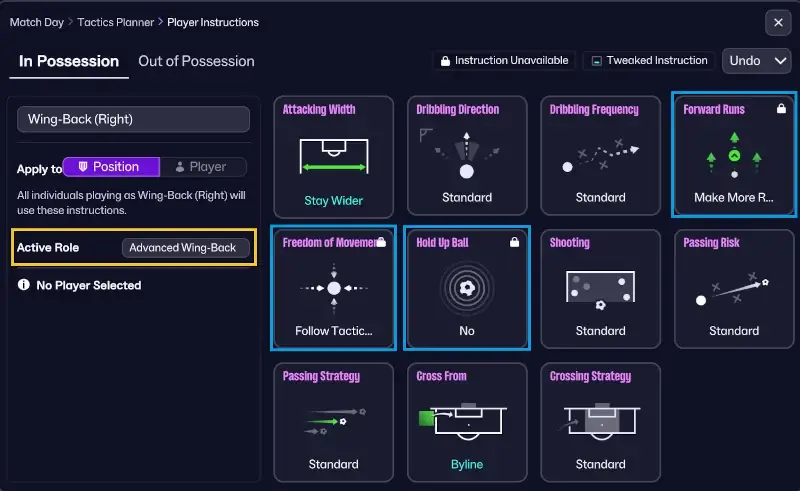
What is required of the Advanced Wing-Back?
To get the most out of the Advanced Wingback on FM26 you should look for a player with better abilities in attacking situations than defensive skills.
As you can imagine, the role is quite physical demanding.
As an outlet in the attacking phase, the player requires both Off the ball Movement, Stamina and Acceleration/Pace. He must move up and down the wing for most of the match and must sprint forward in the attacking transition to make himself available for a pass, quickly track back if the attack breaks down, or use rapid changes of speed to get behind his marker.
Depending on your tactics, it’s not rare to see the player run more than 13km per match! Include the intensity of the match, the number of matches per week, and you’ll understand how difficult the role is!
The person’s abilities to get forward whenever possible and time his runs is important – read Decisions. Not only must the player find space to move into but also have the appropriate decisions to get forward at the right moment.
With the ball at his feet, the player requires not only good first touch, but dribbling and agility to carry the ball away from his marker and into the penalty area or escape the pressure to get to the byline (depending on what you’ve instructed of him or your team).
Since the role can also become a goal threat in the final third, it would be helpful to consider his finishing and long shots. Why many managers convert quick wingers or playmakers into wingbacks.
However, the most important attributes to prioritize except for Stamina and Off the Ball is first and foremost Technique, Crossing, Passing and Vision – all depending on what team instructions you’ve selected.
Quite often, you’ll discover that the AWB role happens to be one of the players with the most progressive passes in your team – always looking to advance play by feeding the forwards with through balls either into space – behind the defensive line or at the feet of a wide forwards run.
Having a player who can deliver accurate crosses into the box and find the target might let you see tenfold of key passes, assists and clear-cut chances created from the AWB on FM26 at the end of the season.
Quick summary of key attributes for the FM26 Advanced Wing-Back Role:
Technical IP: Crossing, Technique, Passing, First Touch
Technical OP: Marking, Tackling
Physical: Stamina, Acceleration, Pace & Natural Fitness
Mental: Off the ball Movement (IP), Decisions, Vision, Anticipation & Teamwork
Positioning (OP)