In Football Manager, tactics are a crucial part of success, and one of the many strategic decisions you can make is the choice between overlaps and underlaps.
The question is: what’s the most effective attacking strategy on Football Manager, encouraging overlapping or underlapping runs?
Although that’s a matter of your squad’s abilities and your tactical preferences relating to how you want to build your attacks, encouraging runs from deep regardless of whether they come from the inside or outside of the player in possession, can provide that unpredictability that enables your team to unlock the opposition’s defensive block.
Understanding how and when to utilize overlaps or underlaps in Football Manager can significantly help the team to come to more goalscoring chances and thereby score more goals – something that will determine the success of your Football Manager tactic.
Over the coming chapters we will discuss not only the difference between the overlap and underlap team instruction in Football Manager but also how to apply these two opposite tactical instructions correctly when creating your Football Manager tactics.
Key Topics in our guide to Overlaps & underlaps in Football Manager
In this instance, we will take a closer look at what formations and shapes, player roles and combinations, as well as traits to use to enhance the number of overlapping or underlapping runs in Football Manager and why utilizing overlaps or underlaps in Football Manager can become an effective attacking strategy that helps to create more chances!
If you have ever questioned how to create the perfect tactic that looks to take advantage of underlaps, or overlaps, as an effective attacking strategy to create chances and hopefully score more goals, then this piece is for you!
Guide to Overlaps & Underlaps in Football Manager? What’s the difference?
When creating your Football Manager tactics, one of the first things you need to consider is how you want your team to create chances and approach play in possession of the ball.
One way to look at this is to consider how you want to stretch the opposition and where you want to create overloads to increase the number of chances and goalscoring opportunities that reflects your tactical philosophy.
For anyone who have downloaded my Barcelona Tiki-Taka tactic or the Erik ten Hag Ajax tactic, one essential part of these tactics is how I use overlaps and underlaps in Football Manager to create space and manipulate the opponent to get into better goalscoring opportunities.
These two attacking strategies is slightly different regarding how players operate with the ball and how movements and forward runs takes effect in the attacking phase, as the team aim to enter the final third.
How the team aims to build their attacks and progress the ball using overlaps or underlaps will be slightly different but generally it relies to any situations where a player in a more defensive position makes a forward run either on the inside or on the outside of the ball-carrier.
Let us take a closer look at the difference between these two tactical concepts relating to how you want to approach play in the final third.
1. The Definition of Overlaps or Overlapping Runs
The concept of overlaps is to put emphasize on wing play by instructing your players to channel play down the wide areas. Now, it must not be confused with ‘focus play down the flanks’, but rather that when a player receives the ball in the wide areas, for instance on the right or left flank, it will trigger a forward movement from behind.
An overlap occurs when a fullback or wingback makes a run on the outside of the wide player, e.g a winger, wide forward or attacking midfielder, or any other player with the ball.
These overlapping runs will thereby happen when the fullback moves forward in the attacking phase and commit their run down the touchline and on the outside of the ball-carrier, as seen in the below illustration.

This forward movement is meant to provide additional width to the attack and offer support for the winger to either cross or drag defenders out of position.
Utilizing overlapping runs may increase the chances of creating 2vs1 situations in wide areas and thereby create the necessary numerical advantage to create chances from the wide channels – perhaps due to individual capabilities or a vision on how to break down the opposition due to certain weaknesses within their line-up.
1.1 When to Use Overlaps
Overlapping runs are an excellent tactical tool when you want to stretch the opposition’s defense and create additional width in your attack.
Here’s why and when you should consider using them:
- Creating Space for Wingers: Overlaps are especially effective when you have a pacey winger who excels at dribbling and crossing. By having the fullback overlap, it forces the opposition fullback or winger to choose between covering the fullback’s run or defending the winger. This can lead to confusion in the defensive structure and free up space for your winger to get into dangerous positions by carrying the ball towards central areas as he cuts inside with the ball.
- Wide Play and Crossing: Overlaps are a great choice when you have a team that excels at delivering crosses into the box. With overlapping runs, fullbacks can get to the byline and cross into the box for your strikers or attacking midfielders to attack.
- High Pressing System: If you’re playing a high-pressing system with lots of width, overlapping runs can be very effective. They allow your wide players to stretch the opponent’s defense horizontally, potentially leaving gaps in the middle for your attackers to exploit.
As this shows, increasing the number of overlapping runs has its advantages – all depending on how you want to build your team’s attacks.
When to use overlaps is a matter of the profile of your strikers, their abilities, physic and major strengths. Trying to increase the number of crosses when possessing a tall striker with great aerial abilities is more proficient than forcing him to use his technical skills and speed.
However, as you might imagine, an overlapping run requires first and foremost space to make them happen, but timing of these runs is as essential as player’s positionings in the attacking phase.
1.1.1 The Advantages of Overlaps
As you’ve discovered, overlaps aim to overlacal advantages around the ball zone and offers more opportunities to progress play further by providing additional passing options for the ball-carrier ahead of the ball.
It’s most effective when the opposing team uses a narrow formation where there is more space down the flanks – for instance in the cases where it’s only one wide player in the wide channel. It may be a 3-5-2 formation with wingbacks tasked to provide the width, with very little support in wide areas. Or, a 3-4-3 formation where the opposing team uses wide midfielders who are better in the attacking phase than the defensive phase – struggling to regain possession by tackles, interceptions or blocks.

In these situations, creating overloads such as 2vs1 in wide areas or other numerical advantages down the wings may help to break down the opposition block more easily as by offering more options for the attacking team.
When an overlap occurs, it causes a dilemma for the opposing defender. They will need to decide whether to track the run of the overlapping player or maintain control of the ball-carrier by following his actions.
If the ball carrier cuts inside with the ball and the opposing marker follows his movement, the overlapping fullback will be free – giving the winger an opportunity to thread through balls onto his feet.
If the opposing marker tracks the overlapping run, the wide player can cut inside with the ball using his one-on-one abilities to drive to the center of the field to either shoot on goal, initiate a quick-one two with the centre forward, make a through ball to a better positioned teammate or dribble the ball towards the penalty area before making a cut-back.
How the opposing marker reacts to the situation will also open more opportunities for the ball carrier. If he holds onto the ball and wait for the fullback or wingback to come to his support, he can pass the ball to the marauding fullback. He can then move into the centre of the pitch – potentially both dragging his marker away from the ball, as well as moving into the penalty area closer to the centre-forward to be on the receiving end of a potential cross or help to overload the centre channel by being in support of the lone striker.
At the same time, when a player gets forward from deeper positions it may increase space elsewhere as defenders push out of their zone to help his teammate – something the attacking team can take advantage of in the near future by tilting the formation to one side of the pitch before looking to shift play to the other side swiftly and efficiently by looking for underloads.
Another advantage with overlaps is that it’s a great choice when you have a team that excels at delivering crosses into the box. With overlapping runs, fullbacks can get to the byline and cross into the box for your strikers or attacking midfielders to attack – meaning you look to use player’s crossing and aerial abilities as the main strategy behind scoring goals.
READ MORE | Ultimate Guide to Pressing on Football Manager
1.1.2 The Disadvantages of Overlaps as a Tactical Strategy
Although it provides an extra layer to the team’s attacking play, one of the disadvantages of using overlapping runs as the main source of attacking the opposition, is that it may result in the attack to end up rather static and thereby predictable.
Just imagine if the same player moves forward in the same situations time and time again, it will be easier for the opposition to defend against these pre-planned situations as they know where runs will come from and tilt their shape to defend against these moves.
Against a 3-4-2-1 or 3-5-2 formation, the defending team can use man-marking to track the runs – asking the attacking midfielder to close down the fullback meanwhile the wide centre-back tracks the winger.
Rather than using overlaps in pre-planned situations, it should be used with cautious to ensure the impact of these situations in wide areas are still effective.
1.2 Utilizing Overlaps in Football Manager
In Football Manager, overlaps is an effective attacking strategy for anyone desiring to use wing play as the main source of attacking play.
You can control whether you want one or both fullbacks to make overlapping runs through the tactical screen by enabling ‘Overlap Left’ or ‘Overlap Right’ under the approach play within the in-possession team instructions.

By enabling the overlap team instructions in Football Manager, you will instruct your wide player to hold onto the ball and look for passing options to an advancing player e.g. a marauding fullback or wingback.
What will happen under the hood is that it will encourage your fullbacks or wingbacks to be a little bit more adventurous and get forward more often than default, as their individual mentality will increase by potentially going from Balanced to Positive or Positive to Attacking – all depending on the selected match mentality.
At the same time, will the individual mentality of the wide player further forward slightly decrease – potentially going from Very Attacking to Attacking or Attacking to Positive all depending on match mentality and player role and duty – ensuring more combination play will happen.
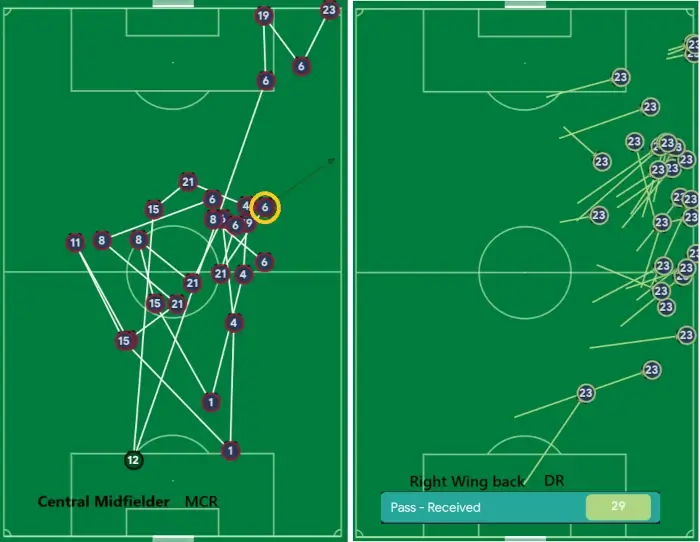
What’s important to keep in mind when enabling the overlap team instruction on Football Manager is that when a winger receives the ball, he will spend an extra second on the ball. This is also the case of the midfielder, who will hold up possession and look for any potential passing options to that specific flank.

The below illustration of passes received for the right wingback and the passing direction of the right central midfielder perfectly shows you how the tendency in passing play slightly changes when overlaps are enabled.
How overlaps affect tempo
Since any player towards the flank where you’ve enabled overlap on will hold onto the ball to look for potential overlaps, enabling the overlap team instruction in Football Manager may slightly reduce the tempo of the game.
If you want to play a high-tempo pass and move game, the effect is that triggering overlaps will go against your desired game plan and hurt the performance of the created Football Manager tactic.
What’s important is to find a balance between tempo settings and passing directness. Too direct and fast paced football, and the fullback won’t get time, or the opportunity, to overlap his teammate. Too slow tempo based around short passes, and the opposition will get time to defend these vulnerable zones within their structures out wide.

Then, you must consider the player role combinations down the flanks where you want overlaps to occur.
1.3 Tactical Setups for Overlaps to Happen: Best Formations & Player Role Combinations
Overlaps works best when you have an attacking fullback, wingback or complete wingback either on a support or attack duty with a wide player asked to sit narrower to free up space for the marauding full back to make progressive runs forward.
1.3.1 Player Role Combinations to Trigger Overlapping Runs?
Asking a ‘winger’ to stay wider and hug the touchline will block the path of the attacking fullback or wingback – making these overlapping runs not as effective as possible. Instead, you wish to use a player role with sit narrow as default instruction.
How often overlaps will happen will be a matter of Match Mentality, player role and duty.
The higher you are on the mentality ladder, the more you can increase the number of overlapping movements. You will notice that if using the Balanced or any other more defensive Match Mentalities will make the fullback or wingback more cautious, as they are more likely to hold position, and only overlap his wide partner where there is less risk of being caught on the counter.
This means that you won’t be likely to see as many overlaps with a defensive duty on Balanced or Positive Match Mentality than if you are using the attack duty on the same mentality level.
This is due to his natural behaviour and default instructions where a player on a defensive duty is more likely to hold position than an attack duty where he is asked to get further forward or dribble more, more often.
It’s important to keep in mind that you should try to avoid using wingers or wide players on an attack duty. These players will be more individualistic and prefers to cut inside with the ball to fashion out chances for himself or his teammates by carrying the ball towards the central areas of the pitch, rather than holding up the ball and wait for the forward run from deep.
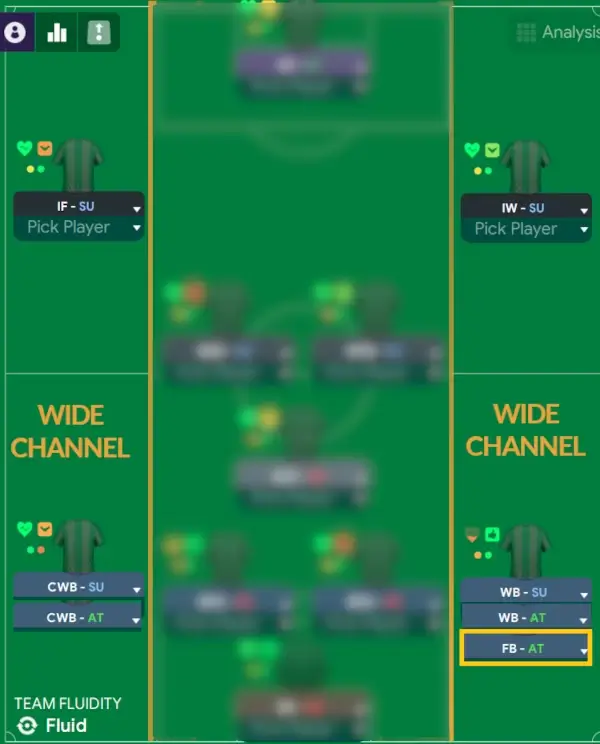
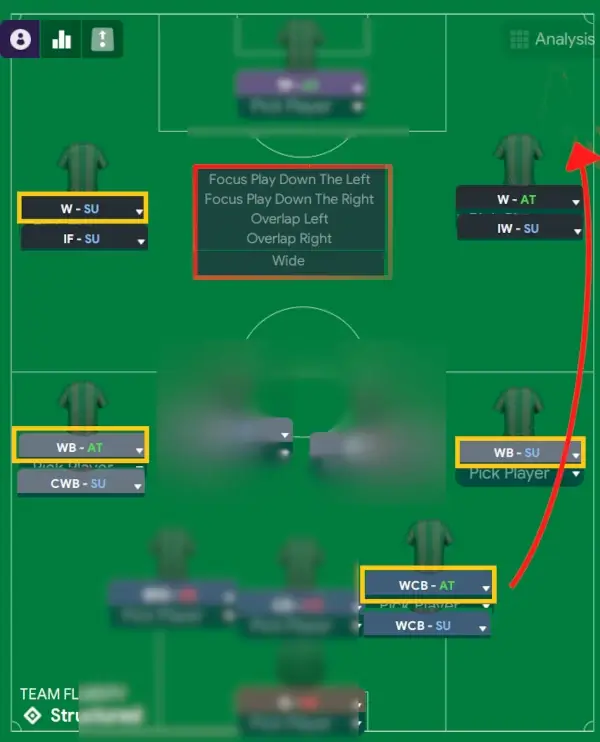
Best Role Combinations: Inside Forward-S, Inverted Winger-S or Advanced Playmaker-S in M/AMRL strata coupled with a Fullback-A, Wingback-S / A, Complete Wingback-S / A in DR/L or WBR/L strata.
1.3.2 Best Formations for Overlapping runs?
Traditionally, overlapping runs can be an effective strategy for any systems and shapes using a back four, regardless of whether it’s seen as a 4-4-2, 4-3-3 or 4-2-3-1 structure.
This means that to use overlaps within your tactics, you should look at any systems using two wide players as you can take advantage of their partnerships to build attacks.
Whether you like to make overlaps occur naturally with the use of support duty on wingers and attack duty on fullbacks, or trigger the overlap instruction on Football Manager on both flanks, or to a specific side of the pitch, you can easily use this tactical setup to experience a 4-3-3 formation transit into a 2-3-5 shape in the attacking phase – ensuring you have one player in each channel and thereby overload a traditional back four system.

However, it could also be used to make your back three formations more fluid where one of the wide centre-backs makes more frequent forward runs to help the midfield to stretch the pitch – much like how the fullback operates when the team is in possession.
Instructing players to move out of their designated position can help to channel play down the wide areas by creating numerical superiority within the ball zone.
1.4 What’s required of an overlapping player?
The overlapping player requires first and foremost great athleticism, football IQ and technical abilities. Just like Daniel Alves in the good old days, these attacking wingbacks requires both acceleration and stamina as he must make many high intensity sprints throughout the match to push ahead of the winger.
Then, once he breaks ahead of the opposition’s midfield line, he must be capable of moving back as fast as possible once the attack breaks down.
Apart from great speed and stamina, these players also need good understanding of when to move forward and not. His anticipation and decision-making are as important as his off the ball movement.
He must be capable of making themselves available to receive the pass in a dangerous position as well as using his technical abilities to take advantage of the ball when getting it.
His crossing, technique and first touch is as important as his dribbling and agility to carry the ball towards the byline, or into space where he can progress the ball further.
This means the fullback will require most of the same abilities as a winger – emphasizing his attributes for the attacking phase over his abilities to hold position and stay back to protect against counter-attacks.
As DarkHorseFM mentions in his video about overlaps and underlaps in Football Manager, using overlaps can be a great strategy if you have a not as pacy winger who is not as capable of attacking space, or have that qualitative superiority to come out successful in one-on-one situations.
Perhaps he lacks the quickness and agility to get past his marker and must try to hold up the ball to wait for a deeper player to come to his support.
1.4.1 Recommended Player Traits for overlaps:
- Gets Forward Whenever Possible
- Hugs Line
2.0 What are underlaps or underlapping runs?
The concept of underlaps has many of the same intentions as overlaps but rather than trying to exploit weaknesses down the flanks, triggering underlapping runs will look to increase forward runs from deep on the inside of the ball-carrier e.g. the winger or any other player positioned in the wide channel in order to exploit space in central areas.
The underlapping run will most often be made inside the half space channel but can also happen in the central channel with an attacking midfielder moving between two forwards.
Taking advantage of underlaps can be an incredibly useful weapon in your tactical arsenal, that not only surprise the opposition with more runs behind the back of the opponent but also changes the entire focus on manipulation of space.
As we’ve come to experience in recent years, is how the disciples of Juego de Posesión uses underlaps to destabilize the opposition whilst confirming to the rules of positional play.
The result is that it requires more movements and position changes to maintain defensive solidity when taking advantage of underlaps as an effective attacking strategy.
A perfect example is how Pep Guardiola or Ange Postecoglou uses their wingbacks in their 4-3-3 system. Rather than instructing their wingbacks to stay wider and overlap, they behave like Inverted Wingbacks who moves from the wide channel to the centre of the pitch in the attacking phase which thereby free up the central midfielder to advance further up the field and overload the central areas.
Once the midfielder, or in strange circumstances the Inverted Wingback, runs between the central defender and fullback, when the wide player is in possession of the ball, you got an underlapping run.

2.2 Understanding underlaps in Football Manager
As a direct opposite to overlaps, underlapping runs will channel play more towards the centre of the pitch as wide players will hold up the ball and initiate passes towards the centre of the pitch. Just like wingers or central midfielders looks for passes on the outside towards an onrushing fullback, players on the right or left flank will take a moment to hold onto the ball to wait for a teammate to arrive from deep – making a run on their inside and beyond.
To instruct your players to look for underlaps on Football Manager you can tick the ‘Underlap Left’ or ‘Underlap Right’ in possession team instruction. You will find Underlaps under the ‘Approach Play’ headings.
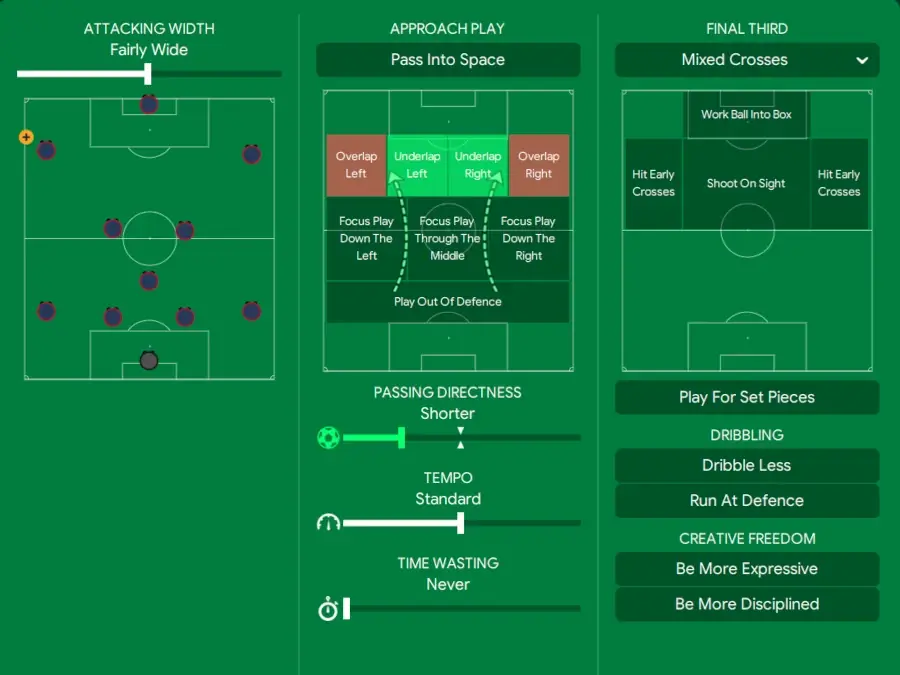
This gives you the opportunity to instruct your team to prioritize underlaps on one side of the pitch, or both – all depending on what you think may be achievable.
To ensure underlaps can happen, it’s necessary that players aren’t blocking the path of their run. This means that the winger or wingback must stay wide and hold position in the wide channel.
However, it can also be used as a strategy to overload certain areas of the pitch with 2 or more players advancing into the same zone. This might attract attention and thereby open up space elsewhere on the pitch.
At the same time, you need to use the appropriate player roles in your tactics to make underlapping runs happen – more about that later!
2.2.1 How does the underlap team instruction work?
When triggering underlaps in Football Manager, you will discover that the individual player mentality of wingbacks increases, meanwhile the mentality of wide forwards reduces. This makes the wingers more focused at looking for passing combinations rather than carrying the ball into the final third whilst the wingbacks will advance forward more often than normal. However, there are several under-the-hood changes happening that might not be visible with the clear eye.
What you will notice if paying attention to players positioning, passing tendencies and tempo is that the wingers will hold onto the ball – reducing the tempo of the game in the same manner as what happens when overlaps are turned on.
However, rather than central midfielders holding up the ball, it could be the wingback or winger holding up the ball to wait for an underlapping run from behind to happen.
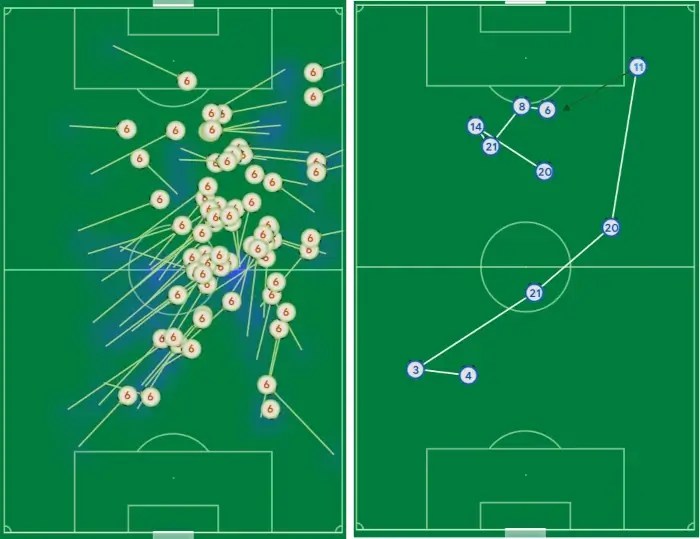
To increase the probability of looking for underlapping runs, it could be beneficial if playing with a slightly higher tempo to instruct your wingers to hold onto the ball. This will give the underlapping player more time to advance beyond them and offer progressive passing options.
When using underlaps team instruction on Football Manager you should consider your team’s attacking width. A wider shape will naturally channel play towards the flanks, while a narrower shape will prioritize moving the ball through the central areas of the field.
At the same time, you might notice that the team initiate more threaded through balls between the opposing defenders and forwards making more runs into the channels when underlaps are turned on and width isn’t set to very wide.
Instead, you must find that perfect balance between stretching the oppositions back line to create space in the half space channels and ensure you’re able to progress the ball through these channels.
2.3 When to Use Underlaps in Football Manager
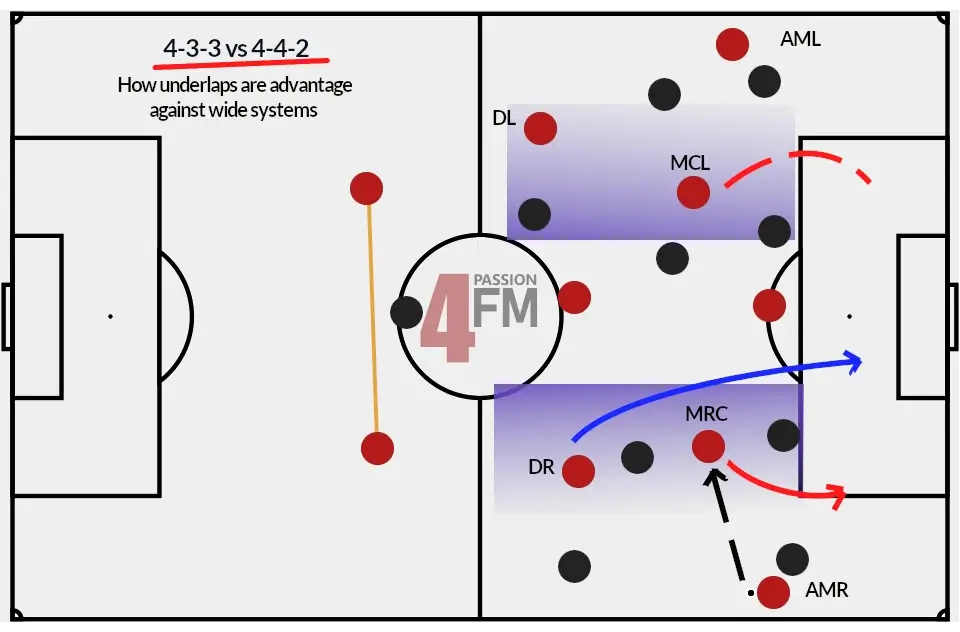
Underlaps is a great tactical solution if you wish to exploit certain weaknesses in the opposition’s defensive structure. It works best when coming up against an opponent who defends wide and there are ‘acres of space’ between the centre backs and fullbacks.
However, with the right tactical approach, the key when using underlaps is to stretch the opposition’s back line in a manner that creates space for these underlapping runs to happen between the centre back and fullback.
When instructing your team to take advantage of underlaps as an attacking strategy, the aim is to create numerical superiority in the half space channels – penetrating the opposition in the vulnerable zone between the centre back and the fullback.
This is something that fits the vision of any possession-based systems – whether you want to utilize a variant of the Tiki-Taka tactical style.
These underlapping runs will thereby provide more support and passing options for the forwards – making them able to cause chaos in the opposing team’s defensive block by using movements in opposite directions to drag defenders out of position – for instance if one player overlap on the left wing, the left winger cuts inside and the right central midfielder underlaps through the right half space, meanwhile the forward drops deep.
This will cause major headaches for the defenders as they need to track runs, keep the eye of the ball and defend their zone.
You can use underlaps to exploit space in the centre and will be particularly effective when you want to get your fullbacks or wingbacks into more central attacking positions. This can be especially beneficial against narrow defensive systems that tend to crowd the middle. Just imagine the power of creating a 2vs1 against the outer defensive midfielders in a double pivot or push a midfielder into the attacking line making it 4v3 in the middle of the pitch with wingers staying high and wide to limit the fullback’s opportunities to help his team to keep a solid defensive shape.
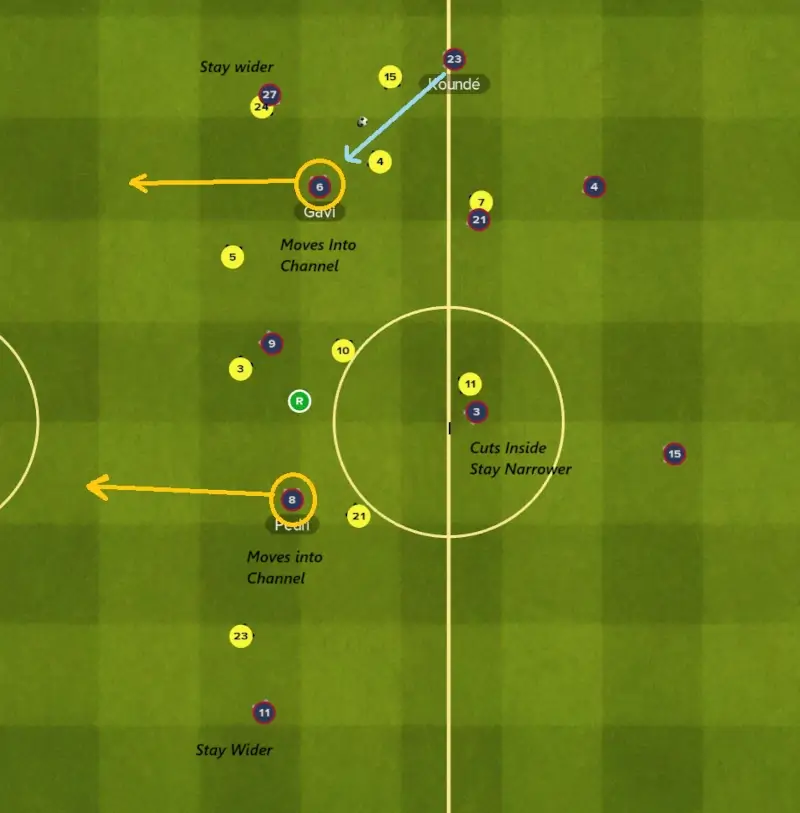
Underlaps can also be a useful tactical strategy if you got highly creative fullbacks in the mould of Trent Alexander Arnold or Joshua Kimmich. By allowing the fullbacks to underlap they can break through the defensive lines and get into goalscoring positions more often than if they were forced to maintain the width.
Once the wingback inverts, or the central midfielder initiate deep runs in the half space channel, it creates a more fluid attacking combination that not only aims to pull the opposing defenders out of position but creates space for the winger to influence the game with their flair, one-on-one abilities and quickness off the ball.
Underlaps can also be used in a possession tactic to provide a more direct route to goal. Just imagine the power of late deep runs at the back of the defender when the team is chasing a late equaliser. By creating more direct goalscoring opportunities like this, you can offer more unpredictability to your team’s attacking game plan whilst overloading specific vulnerable positions in the opposing team’s defensive line-up.
Perhaps there are defenders who lack concentration, anticipation and acceleration to quickly track these smart movements.
Then, underlaps help to increase the number of passing triangles around the most important area for chance creation – zone 14.
The positioning of the underlapping player in the attacking phase will also provide more freedom to the forward(s) – enabling them to roam more freely between the channels and let more players interchange positions more often which will eventually increase passing combinations and thereby provide more attacking variety in terms of passing and movement.
Read More | Understanding the Tactical Styles of Football Manager
2.4 Tactical Setups for Underlaps to Happen: Best Formations & Player Role Combinations
2.4.1 Best Formations for Underlapping runs?
Underlaps is one of the tactical theories that isn’t restricted to a certain shape or structure. It can be used in several formations with decent success.
Using underlaps is an attacking strategy that can make any structured tactic more fluid. A rather traditional 4-3-3 formation can easily transition into a 3-2-4-1 shape in possession. The 3-4-3 can transition into a 3-1-6 shape in the attacking phase, or it can also be used in a 4-2-3-1 with a double pivot to create a 2-3-5 shape.
Since underlaps is used to build more central attacks where the team takes advantage of quick, intricate passing combinations to unlock the opposition’s defence, it offers a unique way to break down the opposition’s defence.
It can be used in any system with a double pivot where you ask one to get further forward and the other to hold position – much like how it’s done in the Ruben Amorim’s Sporting tactic meaning you can use it in back three formations as well as back four or back five systems.
2.4.2 Player Role Combinations to Trigger Underlapping Runs?
To increase the number of underlapping runs there are certain player roles you should prioritize over others. Personally, I would recommend looking at these player role combinations:
i) Triggering Underlaps in 4-3-3 Systems
When playing with a back four system, the Inverted Wingback coupled with a winger who stays wide will be a great player role combination to trigger more underlapping runs.
The behaviour of the IWB on attack duty will, or any other role that cuts inside and stay narrower will naturally initiate underlapping runs.
For instance, if building up play through the wide areas, an inverted wingback can move on the inside of the winger, e.g an Inside Forward, when he is in possession of the ball. This movement can free up the space for the winger to take advantage of the ball by trying to drag the opposing marker away from the ball.
At the same time, it provides more advanced passing options for the ball carrier – creating those passing triangles that helps the team to play quick short-passes to get into the final third.

Helped by the central midfielder, it could create a 3v2 out wide or in the half space channel.
When underlaps are turned on, you can also use the Complete Wingback role who will thereby occasionally make runs on the inside of the winger.
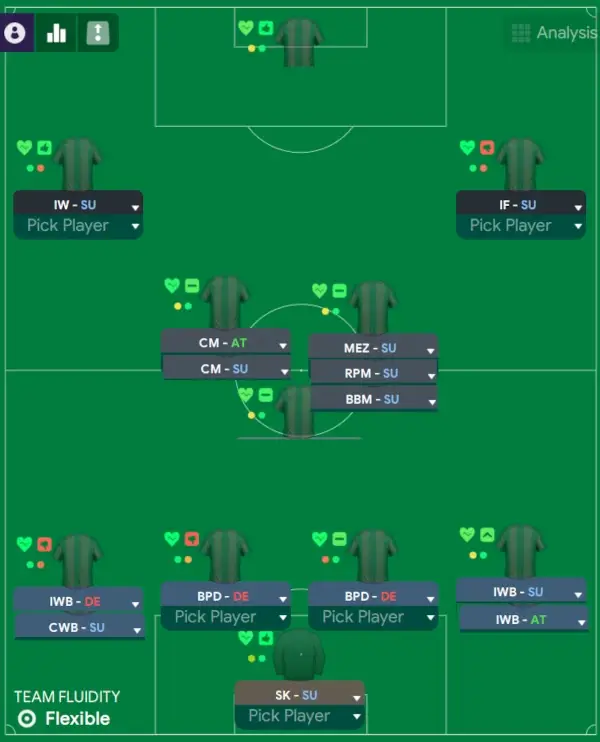
Another suitable player role combination in a 4-3-3 system is using either one or two central midfielders who gets forward whenever possible. Whether you will entitle these players as penetrating midfielders or progressive midfielders. These players will initiate runs in behind the defensive line and thereby provide more direct attacking threats – also known as third man runs.
One option is to use the Central Midfielder on attack duty (CM-A) – a role that will surge into the final third as often as possible and thereby provide more support for the lone-striker in or around the penalty box.
Another option is to use the Mezzala role, who likes to drift into the half space and contribute in the attacking third with both initiating runs, thread through balls or crosses to the forwards as well as making those crucial third man runs which aims to open up the opposing team’s back line.
Regardless of the midfield role you prefer, you should look for any role with default instruction to ‘Move Into Channels’ and ‘Get Further Forward’, or has the opportunity to select it.
This is the case of Box to Box Midfielder (BBM), CM-S/A, MEZ-S and Roaming Playmaker (RPM-S).
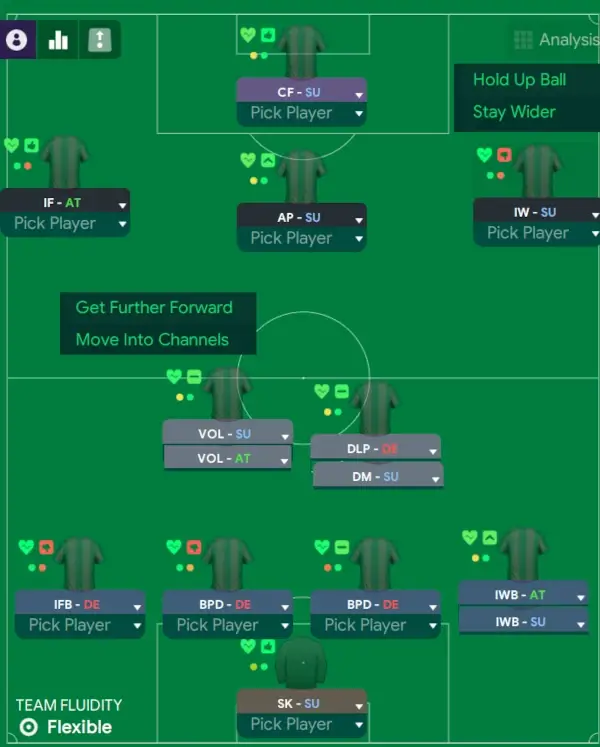
ii) Triggering Underlaps in 3-4-3/5-3-2 Systems
If using the CM-A o MEZ-S/A, you should consider the balance of your tactics and it would be useful to couple these roles with an Inverted Wingback on support, or a Inverted Fullback in the back line to defend the counter and provide that defensive solidity you need when instructing your central midfielder to advance further forward and become the fifth attacker.
When playing with a back three, how you set up your tactics for underlaps will be slightly different. With less players in the middle in a 3-4-3 system, you need to find that perfect balance between penetration from deep, attacking support and defensive solidity.
In these kinds of systems, it’s naturally to use a double pivot where one player is tasked to hold position whilst the other provides support to the attack.
A recommended player role combination is using the wonderful Segundo Volante next to a defensive midfielder (DM-D). Consider using the VOL-S if you prefer more balance, or the VOL-A if you prefer to overload the opposition’s back four.
Another useful option is to use the DM-S with ‘Get Further Forward’ player instruction ticked – making him able to arrive late in or around the penalty area and thereby take advantage of late deep runs to support attacking moves.
Such a player combination might also be considered if you’re opting for a 4-2-3-1 system with a double pivot.
In these circumstances, we could recommend using the Inverted Wingback (support/attack) on the same side as the holding midfielder – giving him the licence to push ahead of the defensive midfielder and move into the space between the attacking midfielder and the winger.
With positional play incorporated into Football Manager, there will be lots of rotations happening with the appropriate use of player roles and combinations – something that will help us to create overloads when underlaps team instruction is enabled.
The power of Inverted Wingbacks
One of the greatest ways to set up effective underlaps in Football Manager is taking advantage of the inverted wingback on attack duty. The IWB-A is a powerful role that you should consider either in 3-4-2-1 DM Wide or 4-3-3 systems where you lack central support to the single forward.
The IWB-A will advance towards zone 14 from the wide channel and increase the passing triangles in the final third.

By overloading the centre channel when moving inside, he will push the attacking midfielder towards the far half space – becoming the fifth or sixth player in the attacking line.
Besides creating numerical superiority around zone 14, the IWB-A could work well with the Carrilero, attacking Inside Forward and an Advanced Playmaker in the AMC strata – creating a rotation towards that side of the pitch.
The intention is that the Carrilero will move wide whilst the inverted wingback will move inside and beyond him – defending against counter-attacking moves whilst also balancing the team to give the Inverted wingback the freedom to attack.
2.5 What’s required of an underlapping player?
A player instructed at making underlapping runs needs first and foremost above average off the ball movement. His ability to determine when it’s purposeful to advance up the field or seek to balance the midfield makes you want to look for players with good decision-making skills and anticipation.
Some of you might look at runners who can sprint forward by taking advantage of their extraordinary stamina and acceleration. Others might favour their all-round abilities where creativity (vision, flair and passing) is coupled with defensive abilities (tackling, aggression and work rate).
Finally, we can’t underestimate the power of the inverted wingback and his abilities to become an untraditional playmaker. Using his vision, passing, technique and flair to create chances from central areas of the pitch once they cut inside.
Regardless of what you emphasize you should look for midfielders or wingbacks with sublime spatial awareness. Players who might see potential openings and can provide additional unpredictability in the attacking phase with their direct movements or inverted runs.
Just remember the importance of Ilkay Gündogan at Manchester City when he made those third man runs and managed to score goals from underlaps by offering a more direct way to goal next to a centre forward who dropped deep.
2.5.1 Player traits to consider for your players when applying underlaps
- Gets into opposition area
- Gets Forward Whenever Possible
- Moves Into Channels
- Roam into space
- Arrives Late in the Opposition’s Area
3. Conclusion
Overlaps and underlaps can be an effective attacking strategy to create chaos in the opposition’s defensive block. With movements arriving from deep, it creates both overloads in specific areas of the field as well as opportunities to create space to progress play into the final third by increasing the number of passing options for the ball-carrier.
While overlaps may be more predictable to defend against, underlaps can surprise the opponent with deep runs behind the back of the opposing markers and free up more players in the final third as you’ll have opposite movements around the ball zone.
Key Tips for Overlaps and Underlaps:
- Player Attributes: Make sure that your fullbacks or wingbacks have the right attributes to execute these runs effectively. Pace, stamina, crossing, and dribbling are all important for overlapping runs, while underlapping runs will benefit from players with good vision, passing, and positioning.
- Balancing Attacks: It’s important to strike a balance between overlapping and underlapping. Too many overlapping runs can leave your team exposed defensively, while too many underlapping runs can clog up the central areas of the pitch. A balanced approach helps maintain width and variety in your attacks.
- Counter-Attacks: Overlaps can be very useful when your team is counter-attacking. A quick burst down the wings with a fullback overlapping the winger can quickly catch out an unorganized defense.
In FM24, overlaps and underlaps are subtle but important tactics that can transform how your team attacks. Overlapping runs help stretch the defense and create crossing opportunities, while underlapping runs add surprise and central threat. By understanding when and how to use these tactics, you can add another layer of sophistication to your tactical setup. Be sure to assess your team’s strengths, the opposition’s weaknesses, and the overall flow of the match to determine when and where to implement overlaps or underlaps for maximum effect.