Play like Flick’s Barça on Football Manager 26. Here’s a tactical deep-dive into Barcelona’s tactics under Hansi Flick from 2024/25 season to 2026. Explore our tactical recreation of Hansi Flick’s Barcelona Tactics on FM26.
For anyone admiring attacking football, Barcelona’s tactics under Hansi Flick has been a joy to watch! Under Hansi Flick, Barcelona has resurrected into one of the best clubs on the planet, especially if we look at their extreme possession and number of goals! Led by Lamine Yamal, Pedri and Raphinha, Hansi Flick’s Barcelona has emerged as one of the most effective attacking sides over the last two seasons by scoring the most goals across the top five leagues in Europe.
By combining youthful energy with Barcelona’s tradition of playing a quick-short passing game, with the Germanic school of using high-intensity pressing, quick vertical transitions by countering the counter, Hansi Flick has reshaped Barcelona’s way of playing by incorporating a high-octane vertical tiki-taka tactic that has immediately been applauded by pundits and fans.
Today I’ll be taking a closer look at Hansi Flick’s Barcelona tactics – his formation and shape, attacking principles, build-up play, movements and structures, as we go through the most notable features of Hansi Flick’s new high-octane Barça with the aim to recreate Hansi Flick’s Barcelona tactics in Football Manager 26.
Table of Contents
The Immediate Influence of Hansi Flick – Barça’s New Identity
From failing to win any trophies in Xavi’s last season, Hansi Flick’s Barcelona ended his first season in charge, the 2024/25 season, by winning a remarkable domestic treble, winning the LaLiga in a sublime fashion.
By scoring both the most goals in the LaLiga 2024/25 and topping the charts as the most goal-scoring team in Europe with 102 balls finding the back of the net, Barcelona under Hansi Flick was one of the highlights in European football last season, and deserved facing Paris SG in the UEFA Champions League final.
Although that never happened, Hansi Flick’s appointment at Nou Camp brought not only new energy and ideas to the dyeing Xavi project but also managed to change the player’s mentality to get the best out of each player with his implementation of a more direct playing style than ever before, at a side probably best known for their Tiki-Taka tactics under Pep Guardiola.
From Control to High-Octane Tiki-Taka: Hansi Flick’s Tactical Philosophy
When Hansi Flick took over at FC Barcelona in 2024, he inherited more than just a squad in transition, he inherited the weight of a philosophy.
For decades, Barcelona has been defined by its possession-based identity, a footballing ideology rooted in La Masia and perfected by the likes of Cruyff, Guardiola, and Xavi. Yet, under Flick, something has shifted.
Whilst Xavi’s Barcelona can be summarized as the return to positional play and territorial control, prioritizing structure, patience, and defensive stability over chaos and transition speed, Flick’s Barça is more vertical and explosive.
In under a few months, the German manager quickly showcased his tactical brilliance at creating an attacking force that has entertained us with lots of goals and a new identity that embraces the essence of modern football; taking advantage of the transition phases with speed and more directness.
When asked upon his tactical philosophy at the time of appointment, Hansi Flick said;
Here the tradition is to play play play (with a short passing style), but I also want them to go straight to the goal. They should focus a bit more on scoring. I don’t think my style has any other changes.
Hansi Flick speaking to Barca One, July 2024
Hansi Flick’s Barcelona represents one of the clearest tactical identity shifts the club has made in the modern era – something that is evident in the team’s performance, statistics and data.
By eradicating the vision of passing the ball until the breakthrough occurs, Hansi Flick’s tactical vision has seen the team attack the opposition more directly, earlier and with slightly more relationism than under Xavi’s and Pep Guardiola’s Tiki-Taka style of play – bringing a more modern style of possession-based football to Spain.
By blending the German gegenpressing with the club’s ideology of using possession as a tool to control the game, Hansi Flick has brought with him a new identity at Barça – one where the team blends positional play with relentless pressing, vertical attacks, and an extremely aggressive defensive line.
The result is a hybrid system that combines several title-winning ideologies, from Barcelona’s traditional ball dominance which we have seen under Pep Guardiola through his focus on positional play to Klopp’s Liverpool where intensity in pressing and speed in transition thrives. Combine that with Flick’s ideology at Bayern Munich where he focused on verticality in attack and using a box midfield for stability, and Barcelona is totally revolutionized!
This set the tone of the new identity Hansi Flick and his coaching team wanted to install.
Couple that with the winning mentality and tactical experience Hansi Flick has acquired through managing both the German national team and Bayern Munich to major success, Barcelona was set for a rise!
A Background to Hansi Flick’s Winning Mentality
At Bayern, his tactical brilliance turned the Bavarians into one of the greatest teams in the world by not only completing a continental treble by winning the Champions League 2019/20, Bundesliga and the DFB-Pokal, but leadthe team to an outstanding sextuplethe following six months asthey lifted the FIFA Club World Cup in February 2021.
By winning the sextuple, they became the second club in the world’s history to win sixtrophies in a calendar year – a record only Pep Guardiola has achieved earlier.
During his rather short but eventful Bayern tenure, Hansi Flick left the club with a remarkable 81.4%-win ratio after not only scoring 255 goals over 86 matches but only lost 7 games during his 18 months stay at Bayern Munich.
For any Barça fans, the humiliating 8-2 loss against Hansi Flick’s Bayern in the Champions League Quarter finals in August 2020 left a huge scar in the club’s history but reveals Hansi Flick’s tactical knowledge to find weaknesses in even the top teams and turn those big match clashes into a real knockout match.
This has been evident in his first season at Barcelona as Hansi Flick has managed to beat Real Madrid four out of four times and ended the season with a 16-7 goal difference.
This is a drastic difference to Xavi, who during his Barcelona tenure only won two trophies: LaLiga 22/23 and Supercopa de España 2023. Then, Xavi only won 4 times out of 6 against Real Madrid, scoring 12 and conceding 8.
The immediate effect on Barcelona’s performance and the rapid rise of quality in a few key players output is one thing,but it can all be credited back to Hans-Dieter Flick’s winning mentality and understanding of how to use his players to the greatest effect.
Now it’s time to take a closer look at the new dimension in the team’s tactical evolution that has arrived with the appointment of German manager Hans-Dieter Flick.
Let us examine Hansi Flick’s Barcelona tactics by taking a tactical deep dive into their shape and player movements with the quest to recreate Barça’s fascinating attacking football in Football Manager!
About Hansi Flick’s Barcelona Tactics
Hansi Flick’s tactics represents one of the clearest tactical identity shifts the club has made in the modern era. By blending positional play with relentless pressing, through an extremely aggressive defensive line and using the transition phases to launch vertical attacks, Barcelona is playing some fascinating attacking football.
Rather than abandon the Barça DNA, Flick weaponised it – turning his side into the 3rd highest scoring Barça side ever(!), whilst also recording the fewest defeats in a calendar year since 2018.
Rather than resting with the ball, and retain possession until the break through appears, by building up his attacks patiently, Hansi Flick has stamped his mark on Barcelona’s evolved positional play tactics by favouring a hybrid system that combines extreme possession with more intensity and speed in the attacking transition – something that draws similarities to Flick’s Bayern Munich tactics.
With its high-tempo football where central overloads is used to free up pacy forwards, Hansi Flick has managed to get the best out of his players – turning the club into a Champions League winning candidate.
Since the start of 2024/25 season, Barcelona is topping the chart for the most possession in Europe with an outstanding 68.9% average possession whilst scoring around 2.7 goals per game after making an incredible 20.6 shots per game or 494 shots in total – the highest in Europe’s top competitions!
At the same time, they are currently on one of the club’s longest goalscoring streaks ever – founding the net in 40 straight La Liga matches at the time of writing – a run which started in December 2024. This is an achievement far better than Pep Guardiola’s Barcelona between 2008 and 2011.
When digesting the data and other key metrics about Flick’s Barcelona, it’s not only their extreme possession that stands out.
- Recording 11.2 dribbles per game – the second highest in Europe – only beaten by RB Leipzig’s 11.6
- Topping the chart for the most key passes per game (15.8)
- Significant increase in goals from pressing – making an incredible 8.7 high turnovers per match
All in all, painting the picture of Barcelona’s evolved style of play under Hansi Flick – becoming a possession-press hybrid which has turned Hansi Flick’s Barcelona to be regarded as one of the best attacking sides in football Europe.
Now, it’s time to take a closer look at Barcelona’s tactics under Hansi Flick with the aim to recreate the system in Football Manager 26.
Flick’s Barcelona’s Tactics: from 4-2-3-1 Shape to 4-3-3 Formation
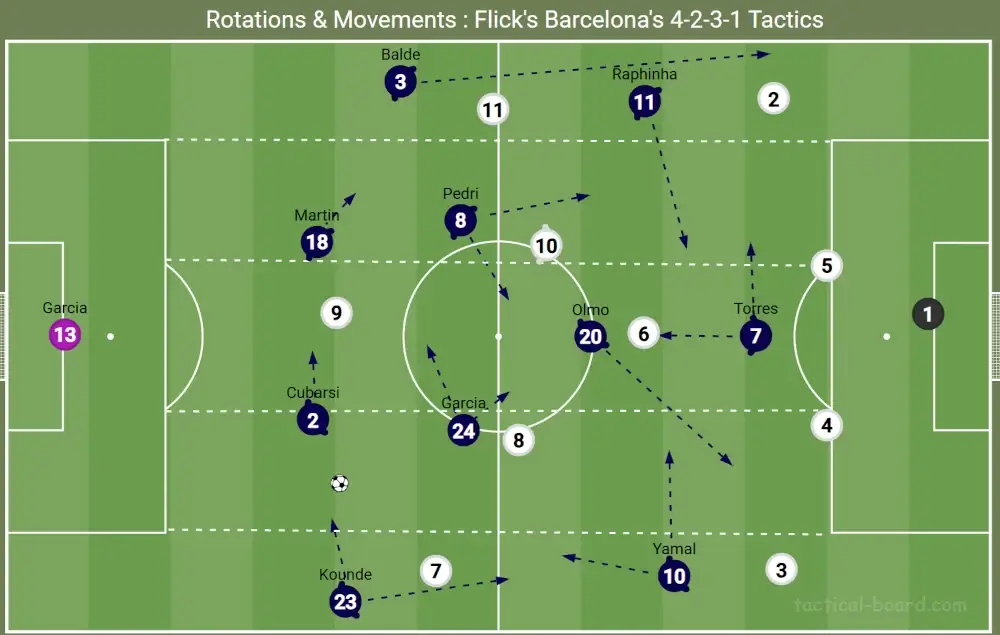
Under Hansi Flick, Barcelona’s shape has revolved around a hybrid 4-2-3-1 formation with a double pivot in front of two centre-backs to provide the necessary defensive stability. Whilst the 4-2-3-1 formation is Hansi Flick’s preferred attacking system, the German manager has also tended to use a flexible 4-3-3 formation at times – all depending on the opponent, and the game plan.
What’s interesting is that although the 4-2-3-1 formation used a double pivot out of possession and in the build-up, we could witness that the midfielders moved seamlessly in the transition to one holding midfielder behind two #8’s – making it seem like Barcelona’s shape was a 4-3-3 system in regard to how the midfielders operated, in possession.
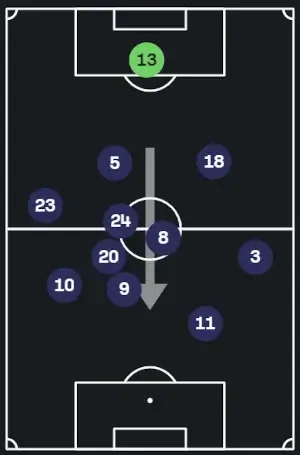
When Barcelona had the ball, each of the midfielders would cover their respective channel. The result was a significant transformation of their attacking structure from 4-2-3-1 to a 3-2-5 / 3-2-4-1 attacking shape, as seen from this screenshot of Barcelona’s average position against Atletico Madrid from December 2nd 2025.
The double pivot would split, where one was tasked to hold a more defensive position in front of the centre backs, whilst the other within the double pivot would operate slightly further forward.
In reality, you would experience that one player would screen the centre channel by holding position in front of the centre backs, one staying wider in the left half space, meanwhile the number 10 was slightly withdrawn deeper on the pitch in the right half space – making it look like he was used as an attacking central midfielder.
If you had an eagle eye view of their structure, you would immediately notice the midfield diamond the midfielders created together with the deep-lying forward.
An interesting aspects of Hansi Flick’s tactic is how he has somehow mirrored Pep Guardiola’s tactics in regards to the movement and positioning of the players in the different phases of play, especially in terms of the behavior of Alejandro Balde (Daniel Alves), Jules Kounde (Eric Abidal), Raphinha (Lionel Messi) and Pedri (Andres Iniesta/Xavi).
However, that’s the closest their tactics resembles.
A major difference in Barcelona’s shape under Hansi Flick is the greater freedom given to the players in position. Not only could they leave their zones, but they could swap positions and roles depending on the ball and vulnerabilities in the opposition’s defensive structures.
With more rotations within their framework, Barcelona’s evolved possession tactics managed to create space for each other that enabled the team to quickly progress the ball into the final third.
Whether it was Frankie de Jong operating next to Eric Garcia, Pedri next to Casado, the double pivot would move according to each other. If one decided to venture forward – roaming into space to free up another player, the other would trace back.
The same applied if the attacking midfielder moved deeper on the field, another player would attack that vacated space.
In the overall structures of Barcelona in possession, you will notice that every player would create ideal passing triangles to another – none of them stayed on a horizontal line. This is also one of the fundamental rules of positional play. It was required that these triangles was maintained whether it was down the flanks, between the forwards, or through the midfield.
The 3-2-5 Shape
Under Hansi Flick, Barcelona’s in-possession shape sees some notable structural features. Like most positional play systems, Barcelona builds their attacks in a 3-2-5 structure.
Barcelona’s 3-2-5 shape is quite asymmetrical and flexible – changing their attacking structures frequently and depending on the situation between 2-3-2-3, 2-1-4-3 to a 3-2-5 shape once the ball reaches the final third with the movement of one to two players – most often fascilitated by the positioning of the right Full-Back and the central midfielders.
Frankly, their attacking structure in the progression phase was a matter of subtle movements of the players and the synergy between how everyone anticipates the situation.
Barcelona’s 3-2 shape in the controlled build-up provided several advantages:
- Safer ball progression and more diagonal passing lanes
- Immediate counter-press structure
- multiple passing triangles with players operating in multiple lines
Just like Arsenal, Barcelona instructs one of their Full-backs to be more conservative by holding position – dropping inside the half space zone to protect against counter-attacks down that flank.
This is normally the job of Jules Kounde, the right back, who stays back – providing both a passing option for the centre-back to play wide and around the high press, as well as covering for the attacking mentality of Lamine Yamal – enabling him to do what he’s best at – succeeding in one-on-one situations.
This creates a nominal back three in the build-up phase whilst also providing an extra passing lane to safely progress the ball towards the left wing.
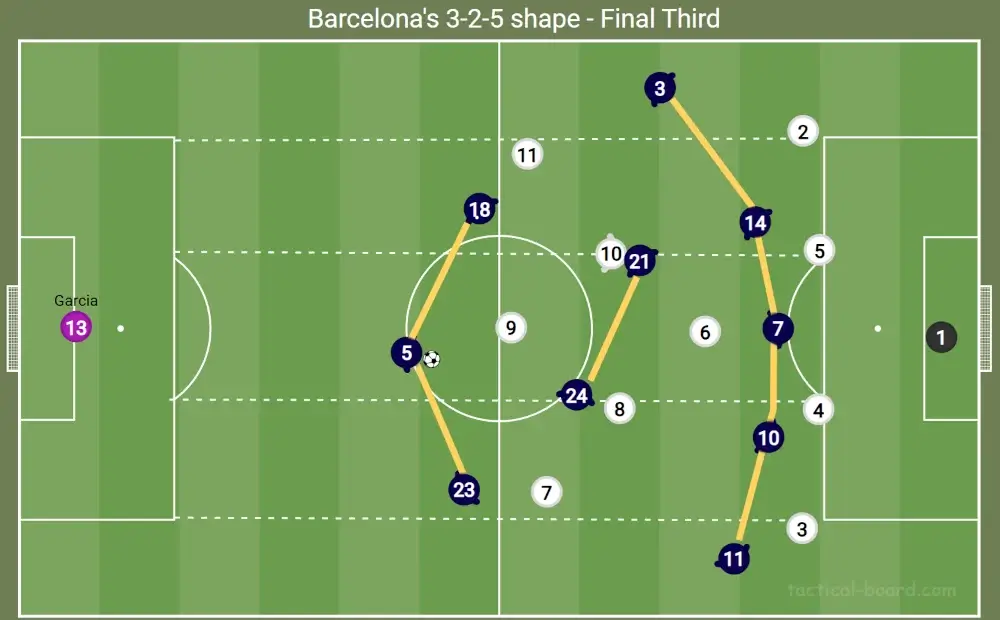
Whilst Kounde is more conservative in the progression phase, the left back, Alejandro Balde, is encouraged to venture forward – stretching the width down the left flank, whilst providing overlapping runs and wide overloads – operating like a winger!
However, Balde is not sticking to the touchline as you would imagine. Instead, depending on the location of the ball, he will often move towards the centre, either in a bid to offer an outlet for a switch of play by moving into pocket of spaces, or to defend against counter-attacking situations if the opposition is close to regain possession in the opposite half space zone.
If you watch Barcelona, you’ll discover how crucial the double pivot is to the team’s ability to progress play from defensive third to the attacking third.
The Importance of Pedri
A significant change in Hansi Flick’s Barcelona tactics for 2024/25 season was the subtle change of the player role of Pedri. From traditionally using a single holding player, Pedri was moved deeper on the field – becoming the second pivot, alongside Marc Casado.
The positioning of Pedri in the 2024/25 season was quite different to how Barça’s interiors normally operated, especially out of possession and in the deep build up.
Acting more like a Deep-Lying Playmaker in the build-up than an Advanced Playmaker/Mezzala, Pedri’s position enabled him to get more space to play through balls and progressive passes in between the channels, or behind the opponent’s defensive line.
At Barcelona, the role and movement of Pedri is key to their ability to create overloads in central areas, as well as creating the necessary passing triangles to enable vertical penetration.
Within Barcelona’s 3-2-5 in-possession shape, Pedri would seek to make an impact by moving inside the left half space – enabling him to dictate the tempo of the game, adding the necessary rhythm to progress play, and the required ball control to take off the press by taking advantage of his elegant technique and flair.
Then, his role changed by moving higher up the pitch – all in all resembling how the Box to Box Playmaker operates in FM26.
By producing the most final third passes in the LaLiga 24/25 with 918 successful passes at a success ratio of 83.2%, making the third most through balls and creating the third most chances (70), Pedri was the playmaking maestro Barcelona needed to play that beautiful style of football that Hansi Flick envisioned.
This has continued for the 2025/26 season.
Attacking Through the Five Channels
When Raphinha played, it was common to see him move inside – trying to create a central overload along side creating a box midfield that provides both balance and stability as well as better circumstances to advance play through numerical superiority.
How Raphinha operated in the right half space was especially evident in the 2024-25 season. Despite holding a wide position in the build-up in the same manner as Lamine Yamal, Raphinha would roam around the entire attacking third – looking for pocket of spaces to cause chaos with his attacking attitude – making penetrating runs behind the opponent’s defensive line at the earliest opportunity.
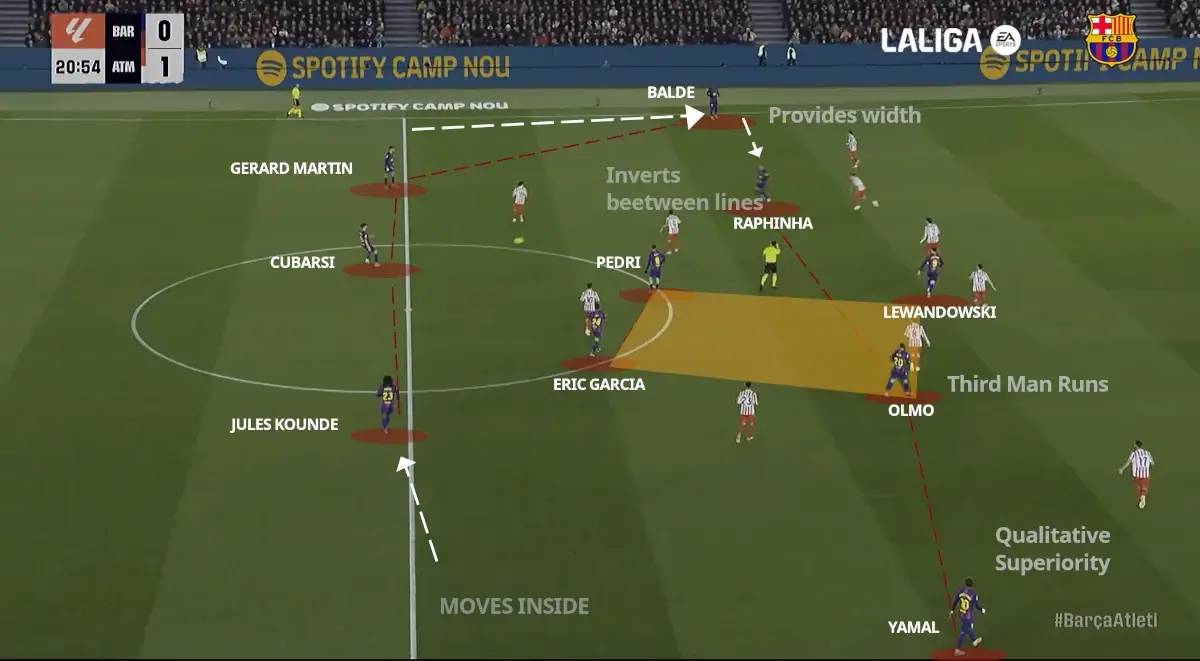
While Pedri is roaming around the entire centre of the pitch, Dani Olmo or the one tasked to fulfil the attacking midfielder role would move between the lines – dropping into the right half space to offer third man runs and passing alternatives for the other attackers.
This ensured that Barcelona had one player in each of the five channels – each with their own specific specialties.
- Two players stretching the width: DL and AMR
- Two interiors occupying the half spaces: AMC, DMCL or AML
- One providing threat in the centre channel with Lewandowski often dropping deep
In fact, Barcelona’s attacking structure was quite fluid with many subtle rotations.
Although Lamine Yamal was pushed high and wide to set him up for 1v1 situations, the attacking structures relied on lots of penetrating runs, or third man runs, to offer attacking threat behind the opponent’s defensive block.
In some events, you could notice that the right Full-Back behaves like an interior – making underlaps and forward runs in the right half space – just like he was playing as an attacking midfielder. This required the AMC to drop deep, or move inside into the center channel.
Something similar could be seen inside the left half space, or in the centre with the opposite movements from the double pivot, between the striker and the attacking midfielder, or between the Left Forward, the Wing-Back and/or the left central midfielder.
Regardless of who made the penetrating runs and from where, the 3-2-5 shape was a constant. Hansi Flick would always encourage someone to provide attacking depth by accelerating from deeper positions. More about this later on!
If one moved forward, another was required to hold position. If one inverts, another must move wide – all the while trying to create overloads in key areas of the pitch, and around the ball zone.
This required great team cohesion and understanding of the system.
Barcelona in the Deep Build-Up
When building out from the back, the goalkeeper would become the first playmaker, required to be comfortable with the ball at his feet, intelligent and composed with his passing decisions and quickly switch play either from one flank to another, or to beat the high press with a smart pass to one of the midfielders, or centre backs.
Capable of dictating the tempo and the rhythm of Barcelona’s passing play, the sweeper keeper’s role was crucial in the deep build-up.
In the deep build-up, Barcelona would use short passes to patiently build their attacks, often through the centre backs with the aim of finding the double pivot, sooner or later, for instance by moving the ball wide before the pass inside.
This is also evident in the player’s passing statistics. Last season, both the centre-backs, Pau Cubarsí and Íñigio Martínez, completed the most successful passes in the team – with 74 and 86.3 average passes per game, ahead of Pedri’s 72. This season, Cubarsi’s average passes has increased to 86.2 ahead of Pedri’s 76.2.
Looking at the overall player stats of La Liga 25/26, both Cubarsi and Eric Garcia has completed the most passes this season with 1724 and 1687 total passes, meanwhile Kounde is on 5th place with 1474 total passes.
When building out from the back, the sweeper keeper would move up between the centre-back – enabling the centre-backs to split wide and the fullbacks to push slightly forward. With a 4+2 structure in the building, or a line of five (1-2-4-1-3) including the goalkeeper, with two holding midfielders holding position in front of the penalty area, Barcelona had numerical options in the deep build-up to play through the high press.
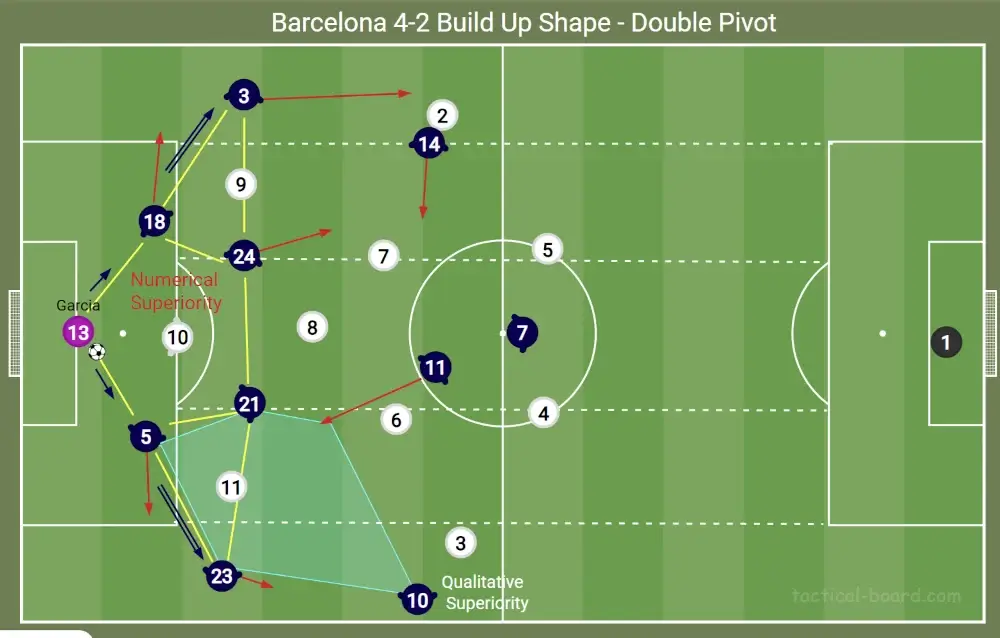
The positioning of the double pivot ensured the team had several options when building out from the back, which the opposition had to consider. Rather than being able to mark out the single pivot, the opposition had to stretch their high press to defend against passes out wide, and even then, Barcelona had numerical superiority in the middle to play through the centre.
If you look closely, Barcelona’s structure and system ensured they had wide diamonds on each flank – making the team more lenient to progress play through the flanks.
With subtle movements from the holding midfielders together with the fullbacks and the attacking midfielder, Barcelona seaked numerical superiority down the flanks to facilitate clean progression to the next phase of the attack by short passes.
Whilst play was progressing down the flank, with the centre-back, full-back and one of the holding midfielders creating triangles, the other midfielder would seek to roam into the centre of the pitch – occupying the free space that erupts as the opposite team tilts over to initiate a press.
This was also one of the clear strategies when Barcelona build their attacks – building their attacks through the back line and the holding midfielder whilst always searching for either the number 10 in their 4-2-3-1 system, or one of the #8’s – most likely Pedri to progress play into the final third.
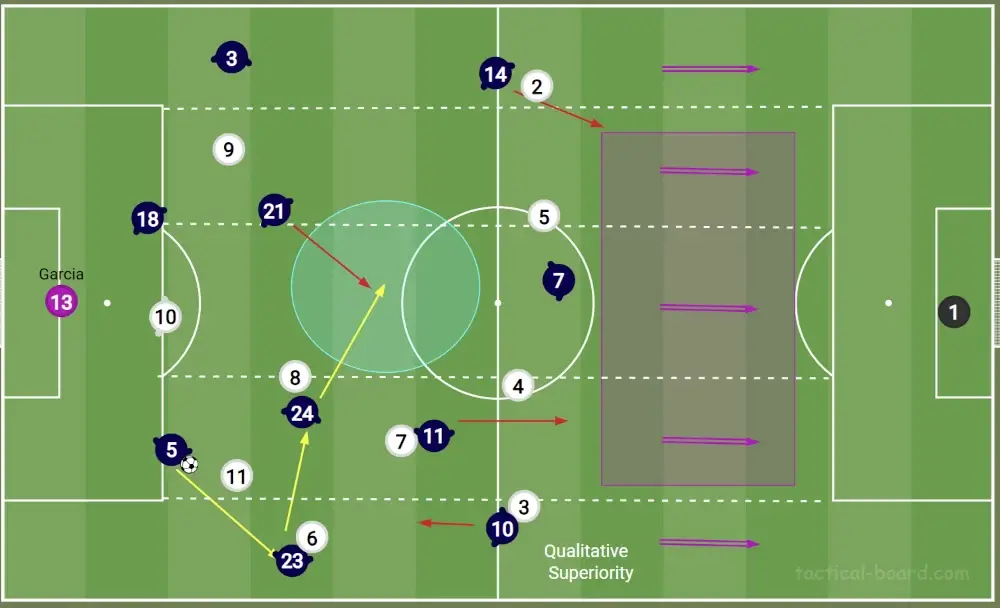
With under 4 passes, Barcelona could easily bypass the press and play their way out of the back – moving the ball in intricate patterns from the goalkeeper, ending up at the fullback who finds the holding midfielder who immediately seeks the advanced central midfielder.
From there, Barcelona can do what they do best – explode and use the progression phase to initiate vertical attacks, if the opportunity arises. However, as we’ll discover, Barcelona had many strategies when progression the play from build up to their offensive strategies.
Barcelona in the Progression Phase
When progressing the ball from the deep build-up to final third, Barcelona had a number of different weapons within their attacking arsenal.
From moving the ball slowly and patiently among each other when building out from the back, trying to lure the opposing pressers onto the ball carrier to create room behind them to initiate an attack, Hansi Flick encourages his Barcelona side to try more direct balls in the middle third, and within the deep play.
This is quite different to the Barcelona’s way of playing under other managers, such as Xavi or Pep Guardiola – trying to take advantage of the attacking transition phases by urgently get the ball forward.
In these situations, Barcelona often look for passes to players in the half spaces – looking for the free player which can be either Pedri, Olmo or Lamine Yamal, who often receives the ball around the middle third.
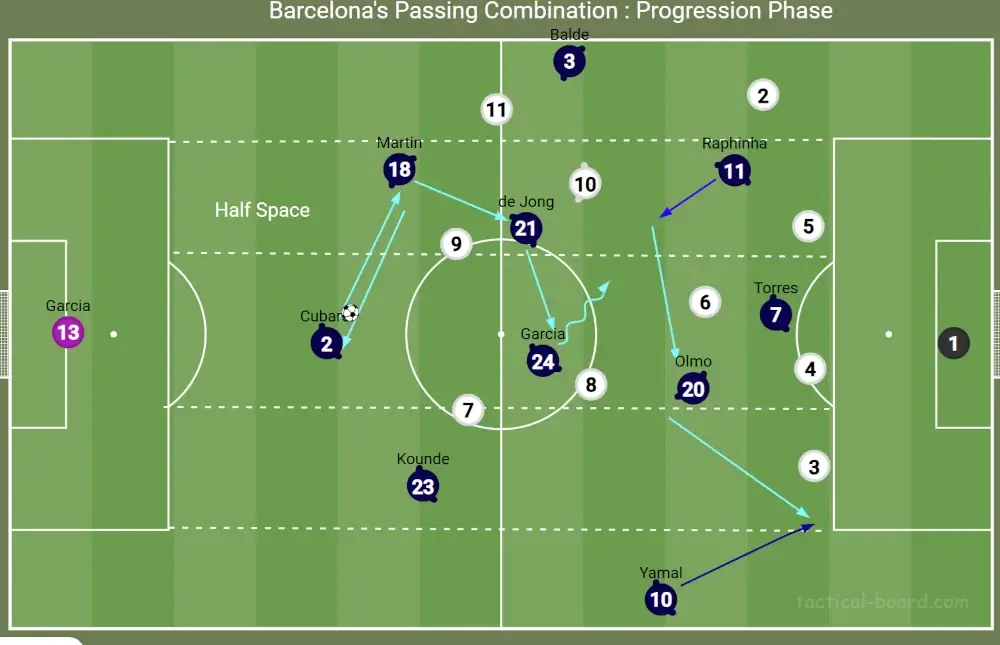
This season, Pedri stands out for his 2.9 long balls per game, painting the picture of how important the midfield playmaker is to Barcelona’s ability to launch attacks from deeper areas. Capable of unlocking the tighest defensive blocks by finding the player with space to attack in, Pedri’s vision is one of the fundamental reasons behind Barcelona’s success.
Another notable strategy in Barcelona’s deep play was how frequently one of the central defenders, or the goalkeeper tried to launch long balls – compared to the rest of the team’s passing strategy.
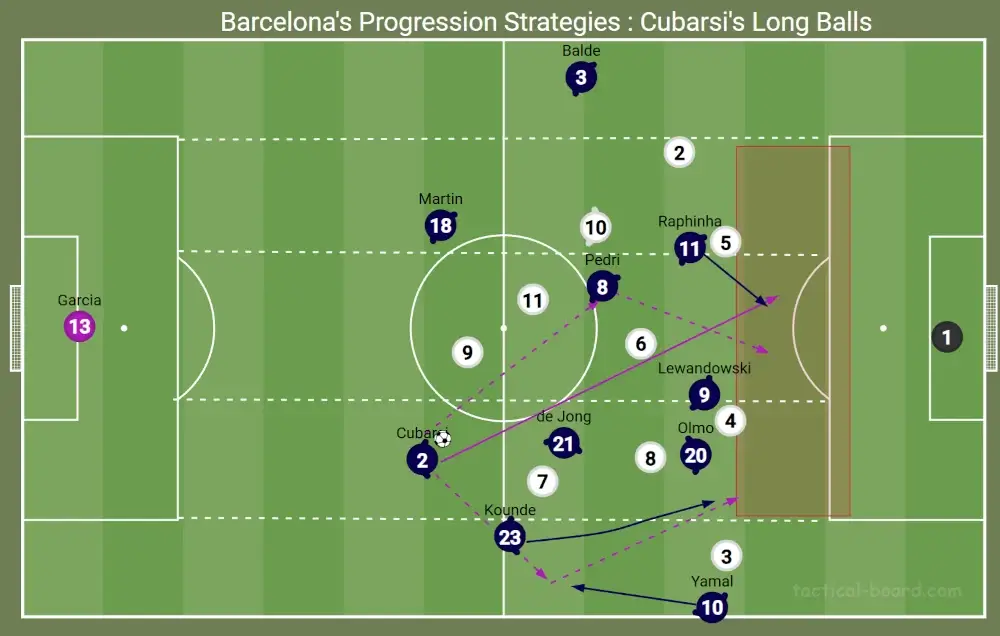
If the opposition defended high, Cubarsi (25/26) or Martínez (24/25) could initiate more direct passes from deeper positions over the top of the opponent’s defensive line – often aimed towards Raphinha who exploded between the channels.
As the illustration below reveals, Cubarsi could even look for Pedri who found pocket of spaces who could make through balls behind the opponents defensive line. So far this season, Pedri has completed 2.4 key passes per game – second most after Lamine Yamal’s 2.9 key passes per game – which leads me to the next strategy.
Another method was to take advantage of Yamal’s sublime passing technique and playmaking abilities to reach the final third with penetration runs and passes. By carrying the ball, Yamal would look to hold up play and drag the opposing marker out of position by taking advantage of his dribbling skills, flair and agility.
What often happened in more settled attacks was that Yamal and Kounde would switch positions. The right Winger would drop deep, dragging his marker with him, before Kounde moves forward – becoming the team’s winger.
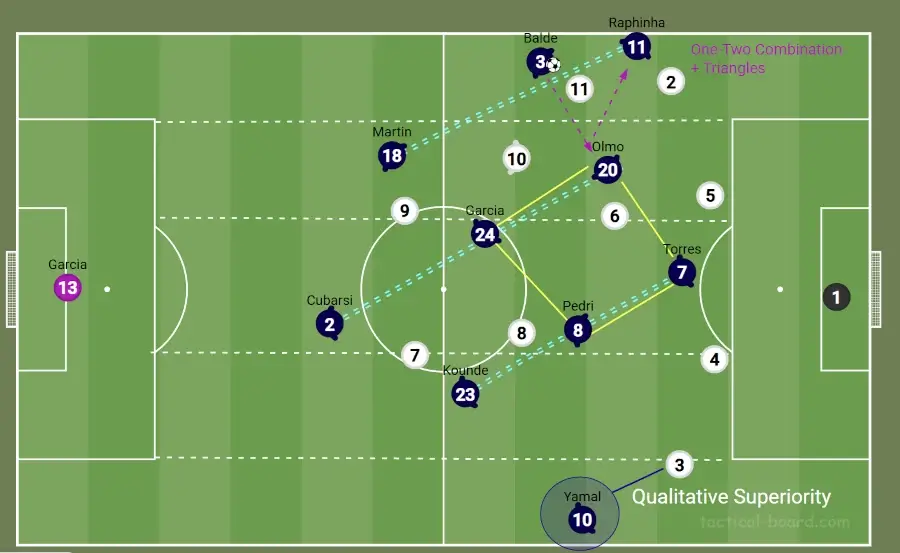
Then, Lamine Yamal could try to make through balls or long balls from the middle third towards the front trio, or swiftly make a supporting pass to Cubarsi in cover who could try a long ball behind the opponent’s defensive line who pushed up to initiate a press. If the opposition stayed deep, the team could continue moving the ball – hopefully through the lines with short passes. One method was through quick one-two’s between Yamal and Kounde who moved inside the right half space – making an underlapping run – to free up the right winger in an 1v1 situation.
By neatly exchanging passes and through Yamal’s exceptional ball control, he could then swiftly cut inside in the attacking third and try crosses to the far post, or continue playing one-two’s with the attacking midfielder or Raphinha who had moved in support of the striker.
With a number of beautiful assists made by Lamine Yamal, his ability to curve the ball whether it was inside or outside of his foot with such an accuracy made life easier for the forwards – especially Raphinha in those counter-attacking situations where he has 1/3 of the pitch to run into.
This season, Lamine Yamal is topping the chart for completing the most key passes per game in La Liga with 2.8 compared to Mbappe’s 2.3 which has ended up in 9 assists – the most after 25 matchdays. At the same time, he makes an astonishing 5.1 dribbles per game – way more than Nico Williams or Kylian Mbappe (2.5 and 2.7) – painting a picture of how important the 18 year old Inside Winger is to Barcelona’s recent success.
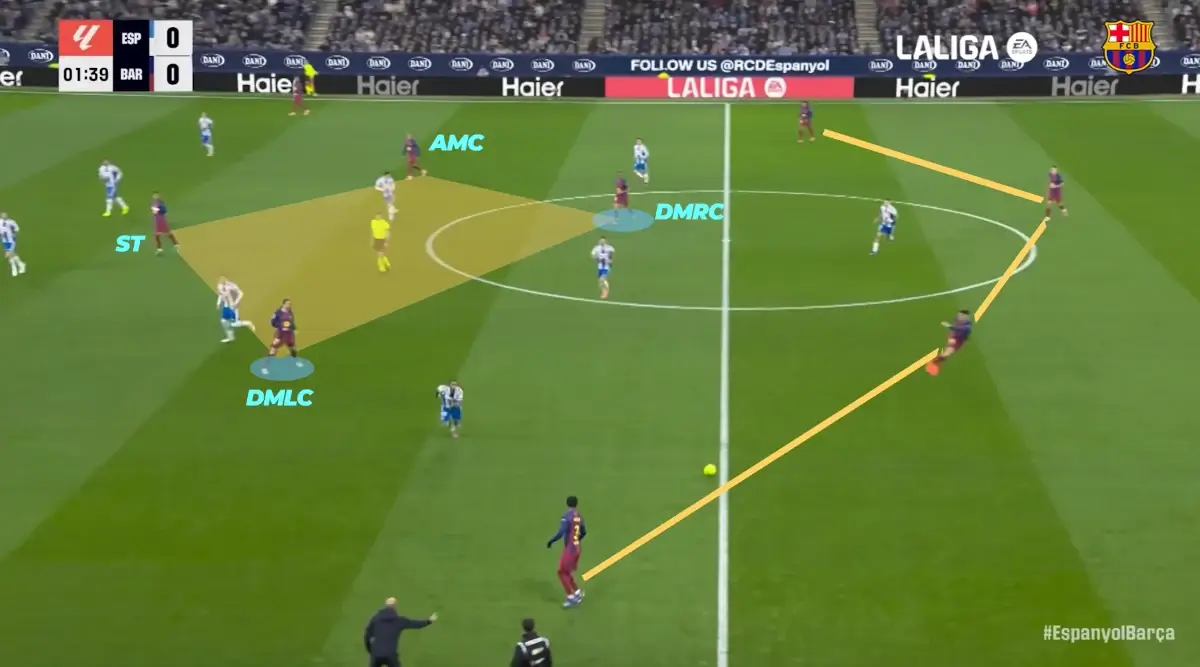
Below is an illustration from Barcelona’s game against Espanyol – showcasing some of the methods Barcelona used to get the ball quickly into the final third – often seeking the breaking player through third man runs. Although the long ball was never played in this scenario, it clearly shows what Barcelona are trying to do with the rotations down the right flank.
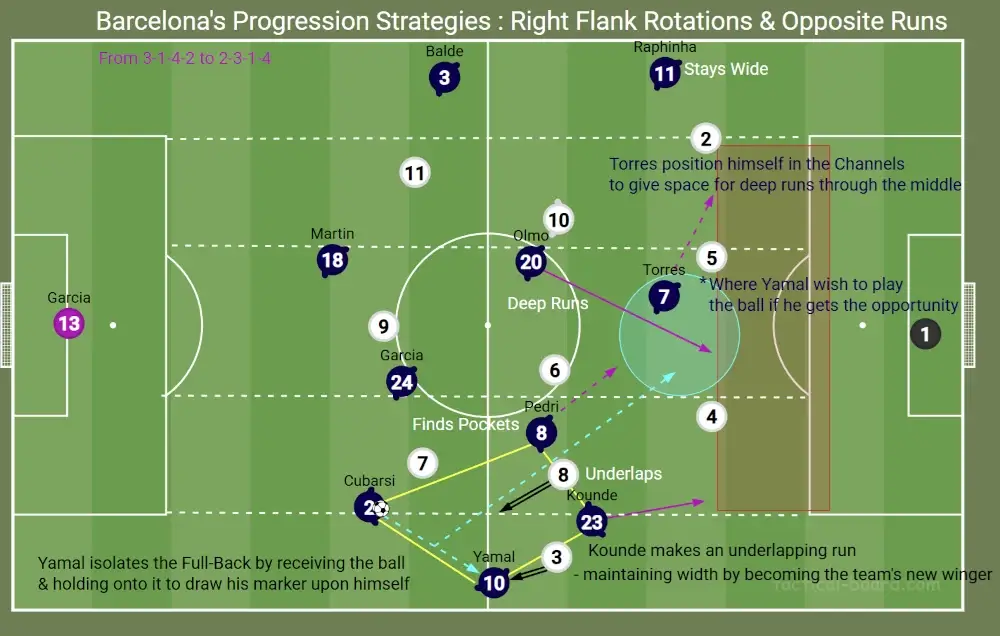
If you look closer to Barcelona’s system you can split their roles into three at this stage of the attack:
- two to three players attacking vacated space – making forward movements: Kounde, Olmo and Torres – each attacking in of the three centre channels.
- one space investigator, often the job of Pedri but could have also been Olmo, who finds pocket of spaces and provides a short passing option
- players furthest away from the ball provides width: Raphinha and/or Balde
- two to three players providing cover and defensive stability
This is a constant that runs through every offensive strategies Hansi Flick has established at Barça.
At last, both fullbacks had the necessary skills to carry the ball forward, either all the way into the final third which was more likely when Balde had the ball than Kounde, or by feeding the Wingers with through balls made between the channels.
The Wingbacks Different Attacking Contributions in Hansi Flick’s Barcelona Tactics
A significant feature of Barcelona’s attacking shape was the forward runs and attacking contribution of Alejandro Balde on the left flank, and Jules Kounde on the right. In honesty, the attacking runs and the wingbacks influence in the final third was a major factor behind the success of Hansi Flick’s revamped Barcelona tactics.
By using short passes at a lower tempo in the deep build-up, Barcelona’s strategy was to give time for the left wing-back to advance forward, something he loved doing(!), meanwhile Jules Kounde often delayed his timing of his runs until the team entered the settled attack stage.
Whilst Alejandro Balde made the second most progressive carries, only Pedri and the two centre backs made more progressive passes than Jules Kounde.
In Barcelona’s 4-2-3-1 system Balde acted more like a winger than a fullback. Standing out with a shot-creating action metric of 2.62/90, compared to Kounde’s shot-creating action value of 1.84/90 minutes – something that shows the difference in their impact in the final third.
Now, we must remember that Balde offered the entire width down the left flank, whilst Kounde had Yamal in front of him, and could progress the ball to a player magnificent in 1vs1 duels and take-ons.
Comparing the duties of Balde vs Kounde also reveals that despite attempting approximately the same number of crosses, Balde attempted more dribbles and carries meanwhile Kounde performed better defensively by successfully attempting and completing more tackles, interceptions and clearances.
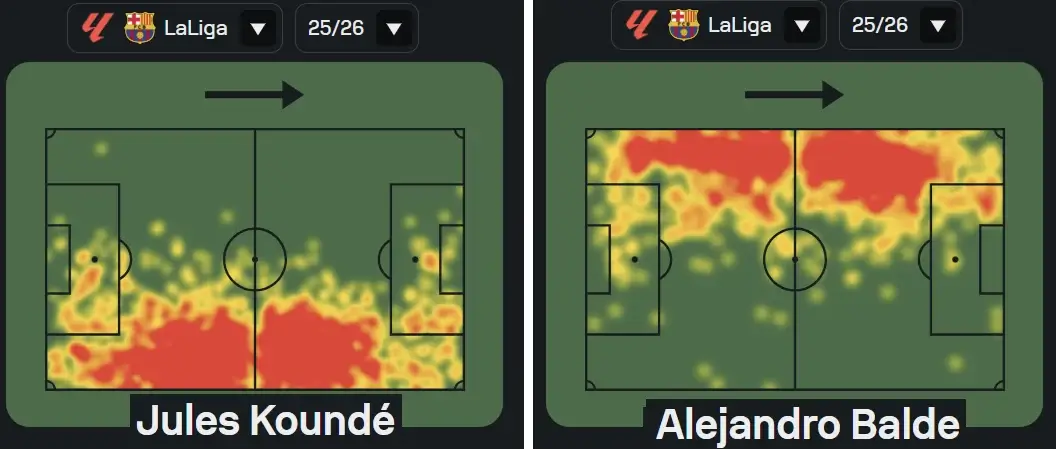
The difference in heat map between the two Wingbacks also reveals that Jules Kounde was more inclined at roaming towards the centre of the pitch – making underlapping runs in the right half space, meanwhile Alejandro Balde maintained his position in the left wide channel more oftenly – freeing up the duties of Raphinha to move into the centre, towards better goalscoring opportunities.
The role of Jules Koundé was especially important when it comes to providing defensive balance and stability.
When the play was on the opposite flank, the right back would often drift inside – protecting the right half space while Yamal isolated the opposing Full-Back in a one-on-one situation.
The difference in role and duty becomes evident if we look at the number of key passes per game, each of them make, and their passing accuracy. According to Whoscored, Alejandro Balde has completed until matchday 26 1.1 key passes per game, meanwhile Kounde has made 0.7 key passes per game for the 2025/26 season. They completes the same number of crosses per game – Balde 0.3 and Kounde 0.4, but Balde completes far less passes per game, 44.4 at an accuracy of 91.5, compared to Kounde’s 61.4 and 90.8% passing accuracy.
On the left side, Balde might be more inclined at feeding Pedri who naturally sits closer to him on the inside, whilst on the right Kounde tries more progressive passes to Yamal who shall be the creative force down that side of the pitch.
This can be explained not only through Barcelona’s lenient to attack down the right flank, but through their strategy and shape. According to Whoscored, Barcelona focus their play 32% down left flank, 39% down right flank and ‘only’ 29% through the center – another noticeable difference to Barcelona’s Tiki-Taka era where it was almost equal percentage in all three channels.
Being a wingback at Barcelona has always been demanding, and perhaps even more in this Barça side. Knowing when to get forward, when to move inside to protect space but also provide passing options to switch the point of attack is crucial.
Their advanced positions leaves a lot if space behind to cover when the ball is lost, but their positioning in the final third is also what enables the team to counter-press with such efficiency.
Capable of putting immediate pressure towards the opposing wingers or fullbacks when the ball is lost, they can quickly swarm around the opponent together with the advanced midfielders, Pedri and Marc Casado and the inside forwards – forcing the opposition to play long or inside – using the touchline as an extra defender.
Penetration as a Weapon
What’s interesting with this Barça side was the way they looked to take advantage of counter-attacks or more vertical direct attacks as soon as possible against unbalanced opponents to penetrate in behind their defensive block.
Flick’s Barcelona looked towards the centre back and the double pivot to make more precise line breaking passes – enhancing the focus on verticality over retaining possession for the sake of it.
In fact, Barcelona had several methods and strategies to beat the (high) press and could adapt quickly.
Rather than progress play in intricate passing patterns in the Tiki-Taka style we have experienced so often, the new Barça favoured passes through the lines at the right moments – looking to create goalscoring opportunities from through balls and third man runs.
Barcelona was no stranger to skip the entire build-up phase by surging for available spaces and attack through explosive movements and accurate long balls – often made by Cubarsi, Pedri, or even Koundé, as briefly mentioned above – combining a strategy around playing over the press and into the space against a high-mid block.
The aim was to hit the opposition on the counter, before they were able to reset into a defensive block.
The strategy by Flick’s Barcelona in the attacking transition was to immedately search for the runs made by Raphinha, who quickly moved between the full-back and the centre back into the space behind the defensive line.
But, Raphinha wasn’t the only one making penetrating runs as soon the opportunity arised.
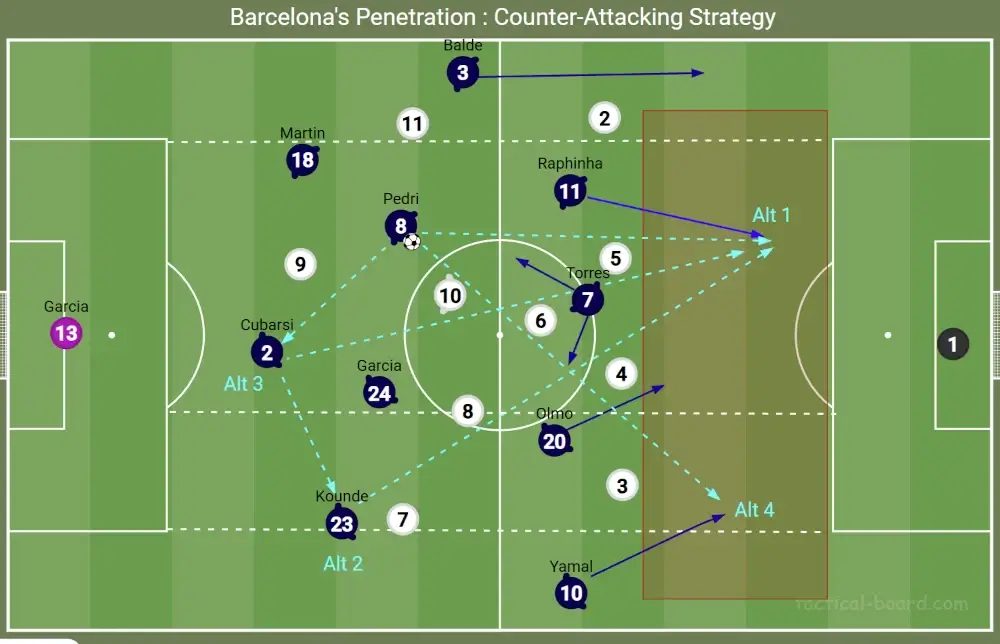
Meanwhile Lewandowski either dropped deep or held position, both wingers as well as the attacking midfielder could sprint into space – each attacking their respective channel. Helped by Pedri’s sublime passing range, Barcelona’s use of through balls from deeper positions on the field to one of the players within the front trio, gave an extra element to their attacking arsenal, which the opposition always had to take into account.
- Defend with a high defensive line and risk penetrating passes into space behind
- Defend with a low block and be forced to chase the ball
With such a quick transition from defensive to the attacking third, Barcelona wanted to catch their opponent’s off guard – using limited number of passes to progress play effeciently.
The increased element of risk and the urgently to get the ball directly forward was a strategy Barça often used. It added an extra layer of unpredictability for Barcelona with the ball – revealing how versatile Flick’s team was in their approach to come to goalscoring opportunities.
Raphinha’s Revamped Role within Flick’s System
Another noticeable signature of Barcelona’s 4-2-3-1 formation under Hansi Flick was the positioning of Raphinha in the attacking transition and when the team entered the final third. From being primarily used on the right flank in the 23/24 season, the Brazilian winger has got a resurrection with his change of role within a more direct Barça side.
As the season heat maps from Sofascore reveals, Raphinha was used primarily on the left flank and started high and wide in the build-up before roaming towards the centre once play progressed towards the final third – behaving more like a false Winger than a Wide Forward.
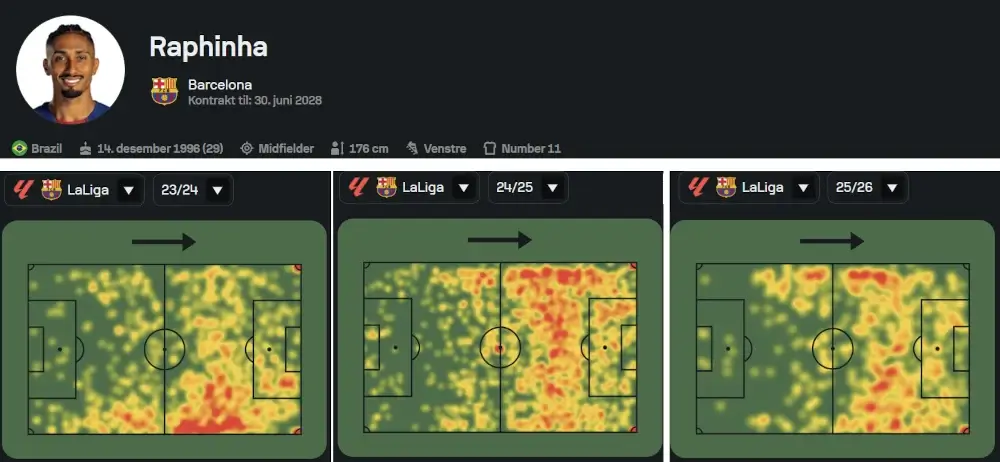
Raphinha’s heat map over the course of the last three seasons reveals a major difference in his positioning and movement from one season to the other. Now, it seemed like Raphinha could pop up anywhere in the attacking third.
In fact, throughout the recent matches, Raphinha is instructed to move inside the left half space and sit quite narrow – acting more like a Shadow Striker or Second Forward than an Inside Winger. This was probably more evident in the 2024/25 season compared to this season.
Quite often, as Barça moved closer to the penalty area, he could position himself behind the forward – taking advantage of the space between the centre backs and the holding midfielder – moving into channels – to get closer to goals scoring actions and combination play that enables Barça to unlock teams who sit back and park the bus.
The positioning of Raphinha had mainly two purposes:
- Give more support to the lone striker and creating an overload in the left channel between the opposing fullback and the centre back.
- Opening the wide channel for overlapping runs from Alejandro Balde and thereby create 2vs1 situations out wide
- provide better connections with the attacking midfielder to overload the centre channel – using a mix of explosive and smart runs to get to goalscoring opportunities around the penalty arc.
Then, you could also imagine the difficulty for the opposing defenders to deal with both Raphinha, Olmo, Pedri and Torres/Lewandowski, who occasionally dropped deep.
However, it was in the attacking transition phase Raphinha became pivotal to the team’s rapid success. Always willing to sprint forward into space. Always showcasing sublime work ethic both with and without the ball. Always hungry to get into goalscoring opportunities. Raphinha is literally a new player under Hansi Flick’s tactics.
Often making darting runs behind the defensive line after moving into the channels and be on the receiving end of either a progressive pass or a long ball from the back line, Raphinha was finally able to take advantage of his greatest skills; his off the ball movement, explosiveness, 1on1 skills and finishing.
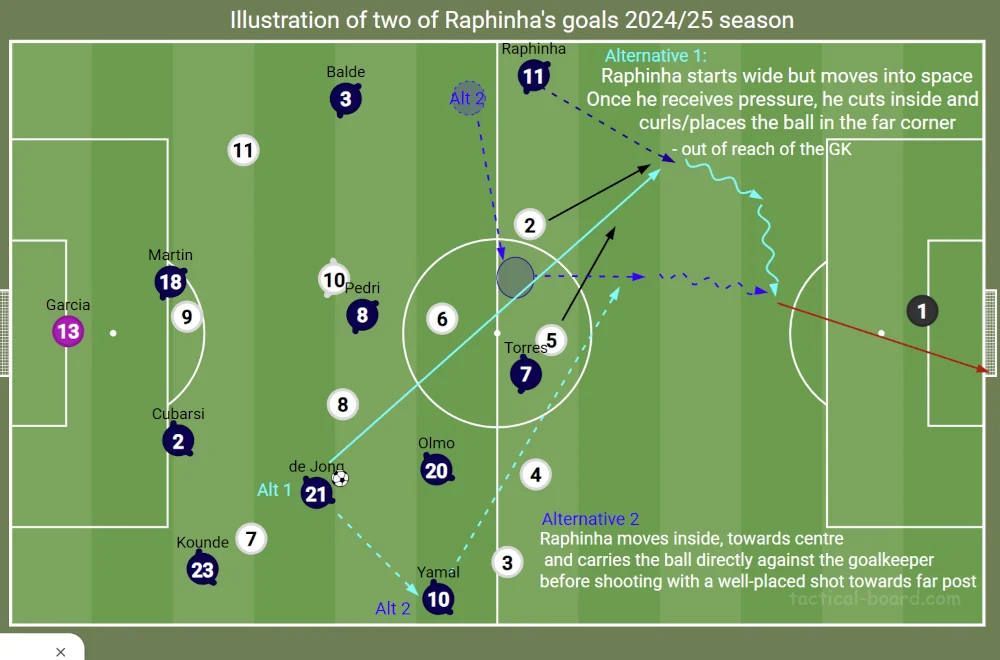
If you look at highlights from all the goals scored by Raphinha in the 2024/25 season, it reveals how Raphinha often starts wide but moves into the center with diagonal runs into space – perhaps from well-executed switches of play, for instance when Barcelona tries to focus their play down the right flank before seeking Raphinha with a long diagonal pass.
When receiving the ball from long passes or through balls, he was exceptional well at getting control of the ball and carrying the ball into the penalty box before finishing with a well-executed shot despite sprinting with the ball at full speed.
Here’s an illustration of two of Raphinha’s landmark goals for Barcelona in the 2024/25 season.
The change of player role, alongside more creative freedom and a tactical shift towards using quick transitions and turnovers to come to goalscoring opportunities, had a significant impact on Raphinha’s performance. At the end of the season, Raphinha had produced 26 assists and 34 goals over 57 appearances across all participating competitions – making him a candidate for the Ballon D’Or award, which he surprisingly ended on 5th place.
Although Ousmane Dembele won the award for the 2025 season, Raphinha earned lots of praise and accolades for his records at Barcelona – winning the La Liga’s Best Player (MVP) for 2024/25 along with three other individual awards.
The Secret Weapon(s): Olmo & Yamal
In attacking situations, Hansi Flick often relied on Olmo and Yamal as two different attacking weapons.
While Lamine Yamal and Raphinha produces magic on either flank, Dani Olmo or Fermin Lopez roamed between the lines – providing support to the deep-lying forward Robert Lewandowski.
Dani Olmo’s statistics and performance might not immediately stand out but the attacking midfielder is the secret weapon to Barcelona’s attacking play. It might not seem like he do much. For instance, he doesn’t produce as many key passes like Yamal, nor have as many touches on the ball like Pedri. Nor, does he takes many dribbles.
However, Dani Olmo is an important figure to Barcelona’s attack.
Looking closer at Olmo’s role, you could interpret him as a space investigator.
Helping to provide triangles and diamond shape on the right flank, Olmo tended to drift into pocket of spaces in the right half space, just like Pedri did inside the left half space. Rather than coming short for the ball in the deep build, Olmo would help to overload the opposing defensive line by gathering a front five.
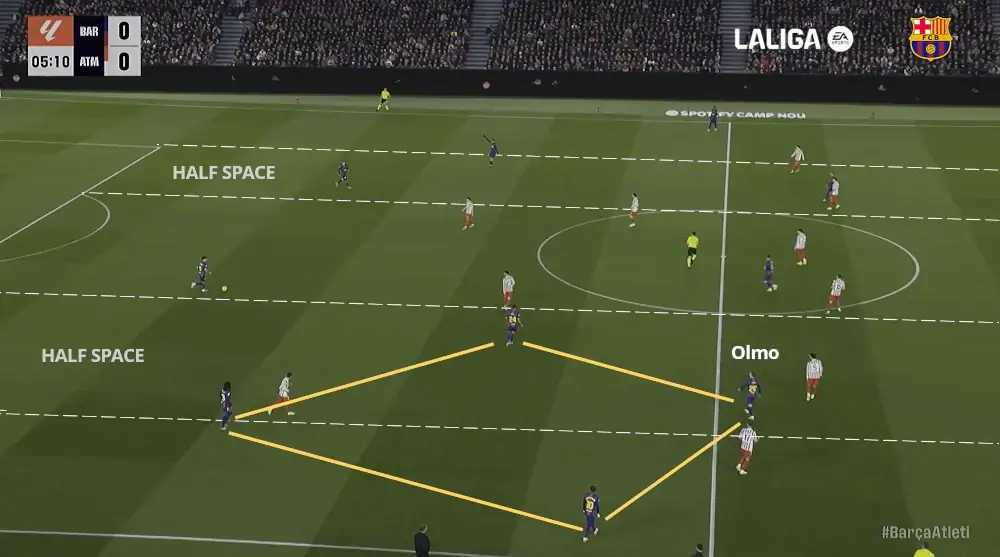
Some would describe him as a creative “joker”, who doesn’t only provides flexibility and versatility with his positioning in the front five but can use his football intelligence to make smart clever runs, or basically use his positioning and movement to create space for others.
Just like a supporting central midfielder, Olmo could drop into pocket of spaces in the progression phase – enabling Lamine Yamal to attack the space behind him – creating a rotation down the right flank which may confuse the marking scheme of the opposing team.
When dropping into the midfield line, just as if he was a #8, he often initiated forward runs from deeper positions – making those crucial third man runs, often on the inside of Yamal which made it seem like he could pop up anywhere in the penalty box.
By drifting slightly deeper, it seemed like he wanted the opposition to forget he was there.
However, for Barcelona, his off the ball movement provided both opportunities for supporting passes and options for penetrations. If he drifted towards central positions, the centre or wide forwards could use him as an outlet to play one-twos or help to switch the point attack, as he always tried to be in a diagonal angle for a pass inside. If he moved into the right half space, he could make those crucial third man runs, often on the inside of Yamal that helped the team to provide attacking threats.
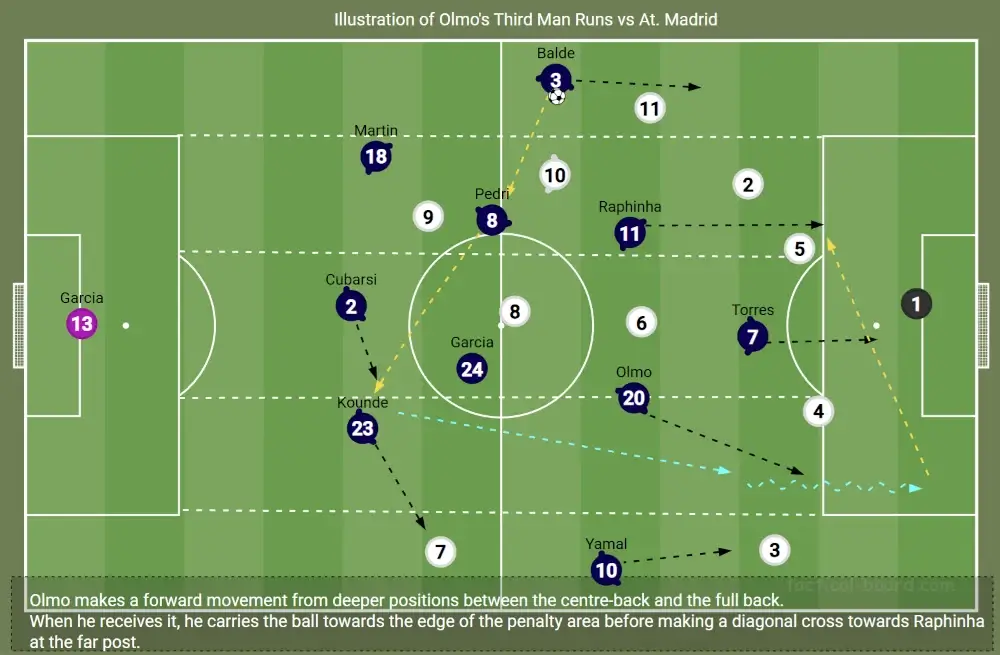
Illustration from a sequence within Barcelona’s vertical progression in match day 19 against Atletico Madrid. Watch the clip here.
Just like Raphinha, it seemed like he could pop up anywhere, any time. If you should classify his role, Olmo was first and foremost the extra player in the attacking phase. If he received the ball he could then use his technical abilities and finishing to score goals from bounces, lay offs or take matters in his own hands by scoring from one-twos or flick-ons.
His smartness in runs, his technical abilities to move the ball quickly and tactical intelligence, made Olmo into a creative threat that gave an extra layer to the team’s attack.
On the outside of Olmo you had Lamie Yamal. As mentioned previously, Flick instructed Yamal to take advantage of the amount of space the system created in wider areas – isolating the opposing Full-Back and thereby receive the ball in situations where he can take advantage of his dribbling skills to progress play into the final third.
If you closely watch any attacking situations for Barcelona, whether that being corners or deep build-ups, you’ll notice how Flick instructs Yamal to position himself outside crowded areas – isolated but in ideal position to create goalscoring opportunities.
In attacking corners, Yamal will stay on the edge of the penalty area, inside zone 14, ready to try curved long shots or through balls just like Messi did in his prime. When progressing the ball, Yamal will start high and wide but move deeper to get the ball – giving him an extra second to try to turn or create space. In the attacking phase, Yamal likes to cut inside with the ball seamingly glued to his feet – giving the team an extra attacking threat from far areas to shoot on goal if he get a clear sight on goal.
In Flick’s Barcelona attack, Yamal provides more unpredictability to the attack with his crossing, passing and finishing skills, meanwhile Raphinha provides a more direct goal threat.
Barcelona’s Shape Out of Possession
Out of possession, Barcelona often switched their formation according to the opposition’s attacking shape. Basically, there was three different defensive formations being used:
- the 4-1-4-1 / 4-1-2-2-1, mostly used against 4-4-2 to press effectively in a man-oriented press
- the 4-2-3-1 with two deeper defensive midfielders to protect narrow
- the 4-4-2 with the attacking midfielder defending higher up the pitch to screen passes out wide.
In reality, there was even times when Barcelona defended in a 5-4-1 structure – asking the defensive midfielder, normally Eric Garcia to drop back into CB position, as seen in this YouTube clip to defend a lead in the latter stages of the game.
When Barcelona didn’t have the ball, their system and strategy was to defend the centre channel by staying very narrow and forming a compact shape to force the opposition to play down the wings or over the top of their defensive line.
Regardless of whether they used the 4-1-2-2-1 or 4-2-3-1, the centre forward would lead the first line of defence. In their 4-2-3-1 defensive shape, Barcelona used a double pivot in front of a back four with Cubarsi covering the space behind the defensive line – always ready to track back and cover runs made between the channels once Kounde applies the press onto the winger.
Although playing with a double pivot, you’ll often see one of the central midfielders, most often Eric Garcia or Frankie de Jong holding position behind the the two #8’s – roaming the space between the centre-back and the midfielders to defend that important area of the pitch. Think of him as the spare player out of possession – a role much like Sergio Busquests performed for Pep’s Barça.
That means, if up against two strikers, the defensive midfielder will drop between the centre-backs – prodiving a nominal back three – or numerical superiority against the opposing team’s rest attack. This changes their high pressing structure from a 2-3-2-3 to a 3-2-2-3.
Barcelona’s Defensive Approach: High Line & Counter-pressing
Barcelona’s tactical approach out of possession was very proactive.
Hansi Flick is a huge advocate for using a high defensive line to compact the space ahead of the ball carrier – trying to force errors and inaccuracies that increases the chance of winning possession in the opposition half, and thereby come to goalscoring chances through swift moves.
By applying a rather high defensive line, which Flick has received some critic for, especially when they concede goals, the German manager aims to squeeze play and win back the ball high up the pitch. Together with a rather narrow defensive shape and the compression of the pitch to make it more difficult for the opposition to play between the lines, Barcelona wish to disrupt the opposition’s progression quickly and as soon as possible.
Playing with a high defensive line is a rather risky approach but one that is firmly integrated into Barca’s tactical DNA.
When Hansi Flick was criticized for their extremely high defensive line, his reply was:
Hansi Flick in a press conference after 3-3 against Club Brugge” We can talk about changing everything, but I’m not the kind of coach to do that. We want to play true to our DNA – not sit deep and win 1-0 on counterattacks.
Due to the aggressive high line, Barcelona is vulnerable to direct long balls played over the top of the defensive line and mobile forwards who can easily manipulate the defensive block with speed and clever runs.
Although Barcelona concedes 1 goal per game in La Liga – the third lowest in the Spanish competition, playing with a high defensive line is classic Barcelona. It’s one of the reasons behind why the team experiences the lowest number of shots against per game in La Liga – 9.4 and what provides the foundation for their high pressing game and extreme possession stats.
However, it also represents a lot of risk and might be a weakness against those teams who knows how to exploit the high defensive line. In this perspective, Flick’s Barcelona doesn’t differ much to Pep’s Barcelona nor any other pupil of the Dutch Total Football and other team’s applying a possession philosophy.
What differs is the intensity of the press and how attentive the team is to apply pressure and cut off passing options for the opposition – both when they loose possession in the midfield or in the final third.
To succeed with an high defensive line you need to press as an unit with excellent work rate, stamina and fitness among your players to shift their positions quickly and make it harder for the opposition team to bypass the team’s press with a limited number of passes. Without great coordination between the players, Barcelona’s counter-pressing will suffer – turning a proactive defensive approach into one of the greatest weakness within the team’s tactics.
What’s perhaps the most interesting aspect is the focus on providing defensive cover by creating multiple diagonal lines – something that makes it difficult for the opposition to find teammates inside but have to either play over the press and thereby risk losing possession as the centre backs can intercept the long ball.
Prevent Central Progression!
Barcelona’s defensive shape and tactical approach when trying to regain possession of the ball is mostly focused around blocking and preventing central progression.
In fact, the entire defensive organisation of Barcelona’s out-of-possession tactics is geared towards denying passing options through central areas. Most often this starts with the positioning of the forwards, and the runs they make to force passes out wide.
Quite oftenly, Hansi Flick has instructed his wingers to press the opposing centre-backs – forcing them to make rushed decisions and thereby block passes that enables them to progress the ball into the middle.
At the same time, Barcelona’s midfield and forwards are quick to compress play once they loose possession – setting up pressing traps both in the middle or down the flanks due to the brilliant positioning with a box midfield in possession, or the use of the 4-2-3-1 system that enables the team to better set up a high press.
The objective is to use the touchline as the extra defender – forcing the wide receiver to have limited options.
Barcelona often tries to set up pressing traps out wide – effectively using the work ethic and dynamism of their Wing-Backs, Interiors and Wide Forwards to create a 3vs2 down the flanks. This is most oftenly evident on the left flank, where you have quick and physical strong players like Balde, Pedri and Raphinha working together to regain possession.
As you’ll discover in the following chapters, Barcelona took huge risks out of possession.
So let us take a closer look at how Barcelona tries to regain possession and use their high defensive line as a foundation to initiate a high press.
Flick’s Barcelona High Pressing Machine!
Out of possession, Barcelona’s shape was a pressing machine that positioned themselves quite narrow and compact, especially compared to when the team is in possession of the ball.
Under Hansi Flick’s 100 games in charge for Barcelona, the German manager has instructed his team to apply the counter-pressing strategy – winning the ball as quickly as possible as soon after loosing it. They press the ball carrier ferociously as soon as the ball is lost and everyone must be committed to narrow down space and time for the player on the ball and cut off any passing options nearby.
Coupled with the high defensive line, Barcelona initiate a high press that aims to force the opposition to play the ball long or screen passes out wide where they can set up a pressing trap – using a defensive structure with multiple lines that helps to regain possession higher up the pitch.
Through a rather sophisticated pressing system reliant on an heavy man-marking scheme, Barcelona’s ability to press has resulted in a remarkable 8.5 PPDA (passes per defensive actions) – one of the lowest in Europe. According to OPTA, Barcelona also has a pressed sequence of 13.04 per match, which is the third highest in La Liga.
*Pressed sequence is a defensive metric which calculates how effective the team’s high press is by counting how often they disrupt building play close to the opposition’s goal.
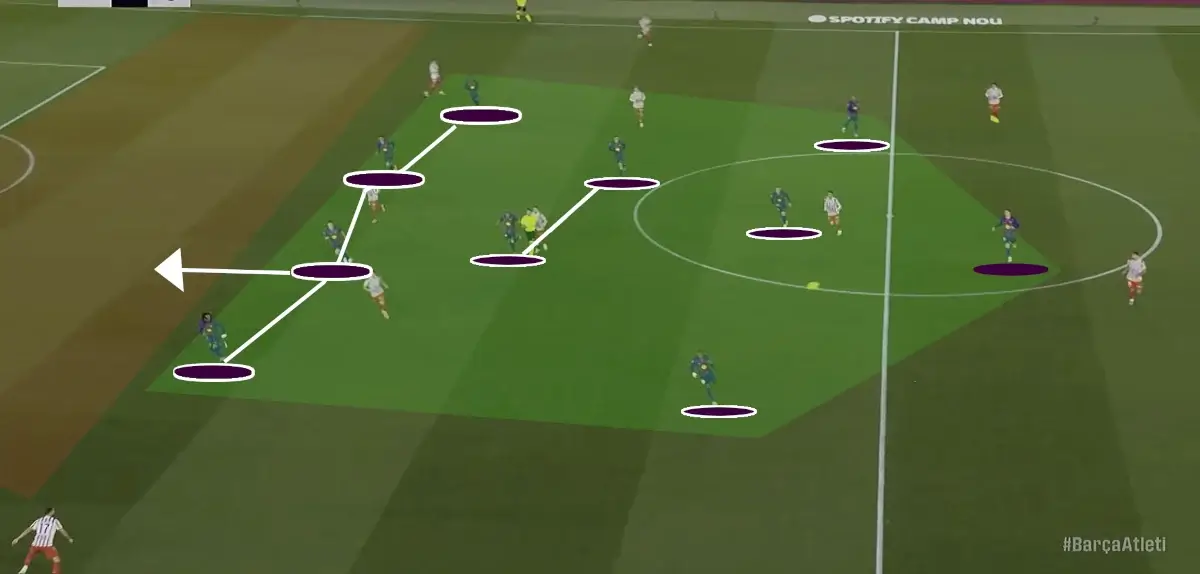
When pressing high, the team’s shape is often a 2-3-2-3 shape, as revealed from this screenshot from Barça’s game against Atletico Madrid, which they won 3-1 in the beginning of December 2025.
The pressing strategy Barcelona often starts with the wide forwards, who curve their runs in a manner that blocks off passes from the goalkeeper to the Centre-Back, as well as putting the Full-Back in a passing shadow of their pressing movement.
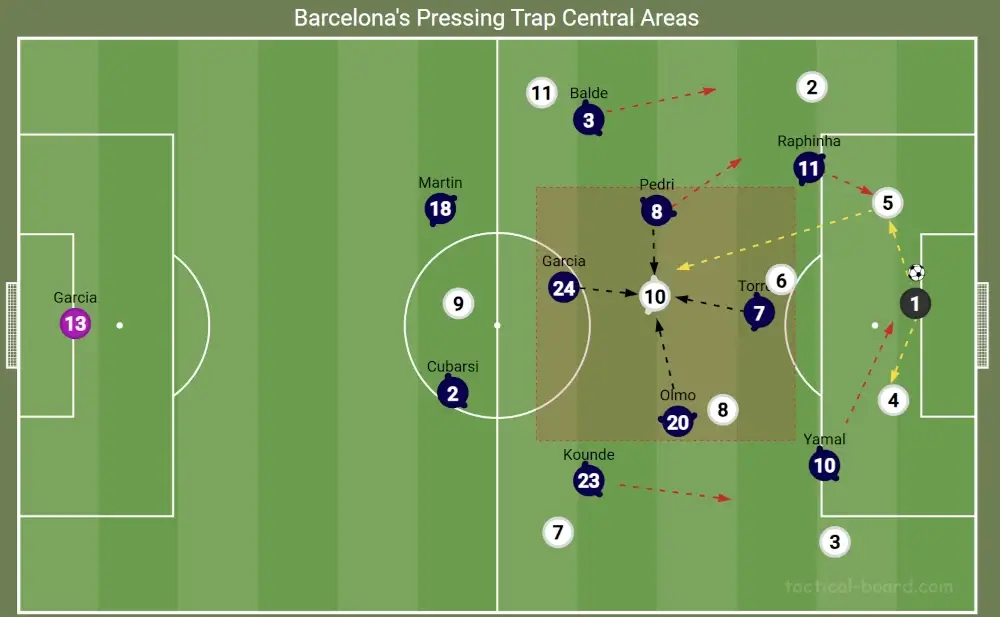
As you’ll notice, Barcelona uses a man-to-man marking scheme in the middle with Pedri and Olmo locking down any passing options to the centre of the pitch, whilst Lewandowski drops slightly deeper – protecting against passes through the middle by positioning himself in what would be the zone of the defensive midfielder. Due to his lack of quickness, he’s instead instructed to man marking the opposing playmaker – helping to screen passes wide rather than through the middle.
Both of the Wide Forwards, Raphinha and Yamal, is instructed to zonally mark the area between the opposing full-back and the centre back – blocking off any passing alternatives out wide, but as the screenshot shows, one of the wingers will apply pressure on the goalkeeper when a back pass is made – closing him down to try to reduce his passing accuracy, which might help the wingbacks to regain possession around the middle of the pitch.
When pressing high, Flick instructs both the wing-backs to push slightly forward – starting their defending in the space between the opposing Full-Back and the Winger – ready to urgently close down and initiate an aggressive press onto the opposing Full-Back as soon as the ball moves wide, or track back if required.
This is crucial in terms of the team’s ability to effectively counter-pressing when the opposing team builds out from the back. However, despite shutting down passes between the Full-Back and Winger, there are often 2vs1 situations down the flanks once the Wide Forward initiate the press towards the centre-back and the opposition managed to bypass the press.
This is especially apparent in those situations where Yamal doesn’t track back or try to help out in defensive situations – leaving Koundé up against two players alone.
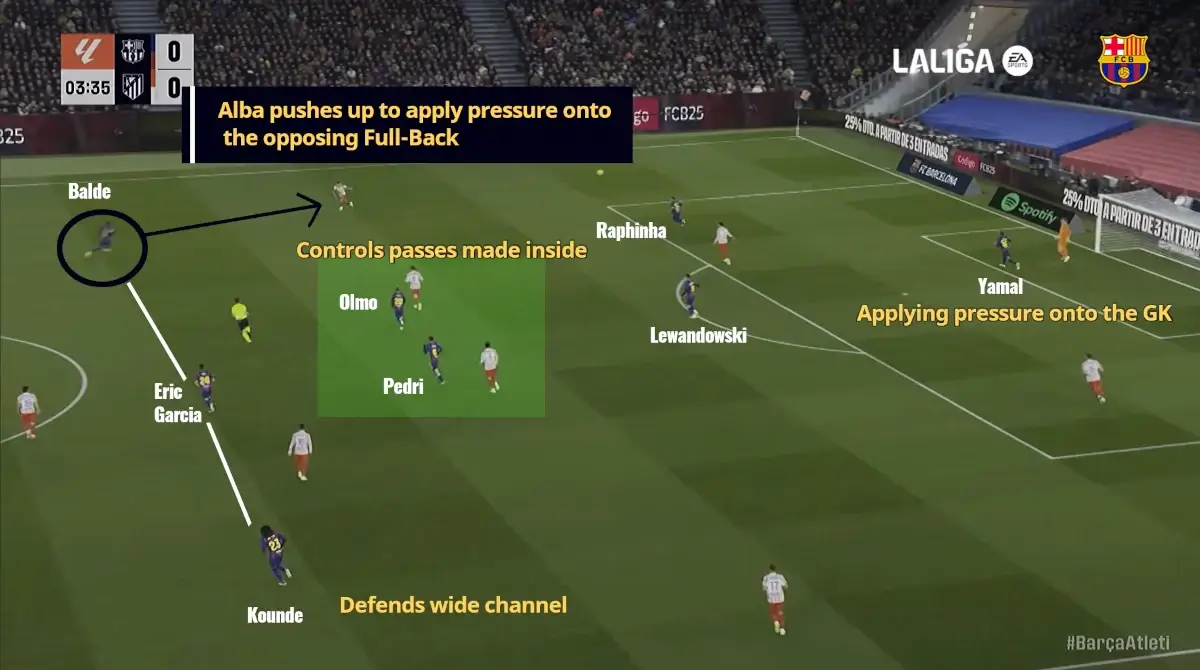
By pushing into advanced positions to try to initiate a high press that suffocate the opposition in their own half, the defensive structure of Barcelona leaves huge spaces behind their wingbacks which the opposition can exploit with direct long balls played behind them. For this reason, the awareness of the Wing-Backs and how they anticipate the situation is crucial.
It’s important that they retreat quickly if the high press is bypassed with a pass beyond the press. Their change of positioning ensures the team got numerical superiority at the back – often defending in a back four with one of them ready to win second balls and close down the ball carrier immediately. Then, if possession is won, they are in position to quickly move the ball forward.
From the screenshot above, you’ll experience that due to Balde’s excellent awareness, quick decision-making and acceleration, he’s able to apply pressure by moving up from a defensive position to win the ball inside Atletico Madrid’s defensive third. With three players already staying high, the team can continue their attack inside the final third, just like they had never lost possession at all!
At the back, you’ll discover that one of the Centre-Back, normally Cubarsi, applies a man-to-man marking on the opposing Centre Forward – tracking runs made behind the defensive line.
The interesting aspect of their defensive structure is the positioning of Jules Kounde relative to Balde. Meanwhile Balde stays slightly higher and more connected to Pedri, Kounde defends the right half space – moving slight inside – just like a defensive midfielder alongside Eric Garcia.
This is also evident in a scenario where Barcelona counter-press Atletico Madrid after losing the ball high up the pitch. With Balde, Pedri and Raphinha squeezing play by initiating a press and creating a pressing trap that has numerical superiority on the flank (3vs2 due to the sides different shapes), Barcelona tries to swarm the ball carrier.
The work ethic and aggression of the left wing-back is crucial in this scenario – moving up to engage the ball carrier with a false press. Once he realizes he won’t have time to put in a tackle he change the direction of his run to close down the new ball carrier – meanwhile Pedri moves out wide to close passing options inside and Raphinha tracks back to remove any covering passing options to the back line.
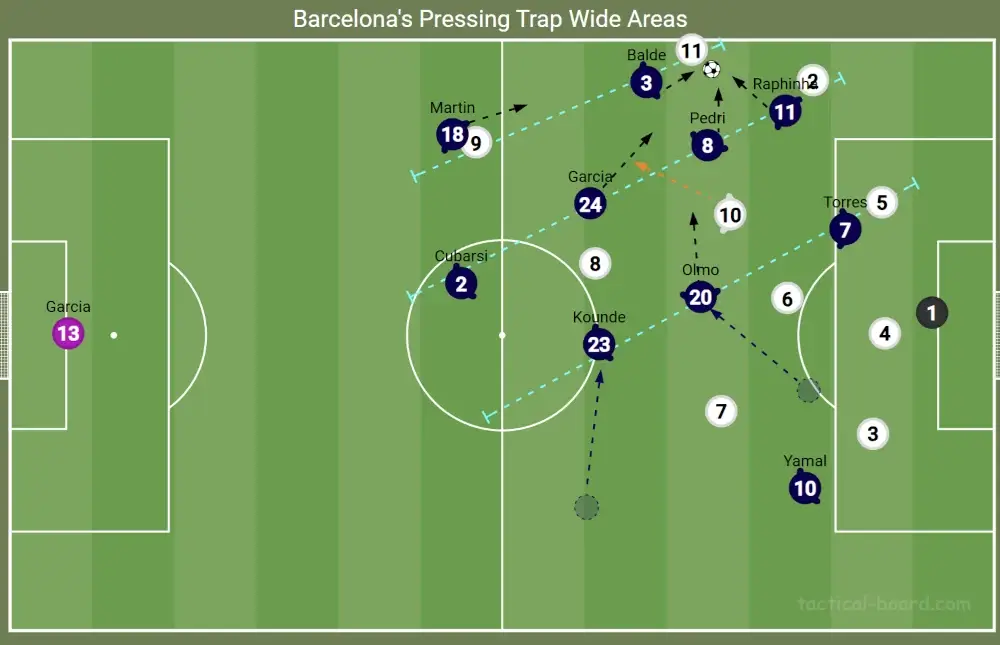
As the illustration shows, Eric Garcia provides defensive cover and is ready to push forward if the ball is played into space, which he done with great effect. For the 2025/26 season, Eric Garcia is topping the team’s statistics relating to interceptions – making 1.4 interceptions per 90 minutes, as well as topping the chart for the most tackles per game (2.1) along with Frankie de Jong.
At the same time, Jules Kounde has moved inside – acting more like a defensive midfielder than a right back – perfectly defending against switches of play towards the opposing wing.
You can watch how the high press of Barcelona unfolds, by clicking on the link here.
Eventhough the 2-3-2-3 high pressing shape is not a constant, it reveals some of the flexibilities within their system and how far they are willing to go to regain possession, often high up the pitch. For instance, if we watch the game unfolds a few minutes later, Lamine Yamal takes position next to Olmo and Pedri – swiftly altering their high pressing structure into a 3-1-1-3-2, or a 3-1-4-2.
As you can imagine, Barcelona’s structures are very fluid with players always taking up appropriate positions to provide both defensive balance and stability to enable the high press.
How to replicate Barcelona’s High Pressing in FM26?
Even though we have the opportunity to set up a out of possession tactic in Football Manager 26, it’s impossible to fully recreate Barca’s 2-3-2-3 high pressing structure when the opposing goalkeeper restarts play. We can of course position both the Wing-Backs in the DM strata to force them to defend the area between the opposing Full-Back and Winger, but this increases the risk of conceding goals as the opposition can more easily bypass our defensive lines through quick combination play and direct balls into space.
As much as I want to re-create the high pressing system just like Barcelona does in real-life, I have not dared to publish the tactic in that 2-3-2-3 high pressing shape they tend to use. Even though it aids the team’s ability to potentially win the ball higher up the pitch, it’s fragile in defensive third situations.
Summary of Tactical Analysis of Barcelona’s style of Play
Watching Barcelona under Hansi Flick is probably the most entertaining side to watch! Combining vertical passes with clever third man runs, central overloads and high intensity counter-pressing, Barça’s tactics is grounded on technical brilliance and occupation of key spaces – something that makes the team come to a lot of shots and clear cut chances.
Their entire tactic can be summarized as:
- Flexible shapes in 4-3-3 / 4-2-3-1 hybrid
- high defensive line and great compactness both horizontally and vertically
- relentless high pressing & quick transitions
- 3-2-5 attacking shape with central overloads & third man runs
With a brief tactical analysis of Barcelona’s tactics under Hansi Flick, it’s time to look closer at how to recreate Flick’s 4-2-3-1 Barcelona tactics in Football Manager 26. Head over to the next page to discover my interpretation of Hansi Flick’s Barcelona Tactics in FM26.