Do you want to create your first Football Manager tactic? Understanding what separates the different tactical styles in Football Manager can be your saviour. In Football Manager, there are several preset tactics available for you. All of them gives you a quickfire way to create a solid tactic that may guide you to success.
When creating your Football Manager tactic, it will be important for the long run to sit down and look at how you like your team to play, analyse your squad as shown in previous guide and decide on the style of play you wish to base your Football Manager tactics on. The choices are many. How you’d like to play and which playing style you fancy, will be determined by the Football Manager team instructions and the player roles you pick.
Today, thanks to the brilliant work of DarkHorseFM along with our insight and expertise into Football Manager we will guide you through all of Football Manager‘s tactical styles and preset tactics available to choose from.
From knowing what the pros and cons of the Tiki-taka style of play, and which formations or player roles to consider within your tactics, to when to choose the Catenaccio football philosophy… And if all this is jibberish to you, you will get an insight into the most essentiall football philosophies and a quick insight to the preset tactics available on Football Manager and the different playing styles of football.
No matter which playing style or football philosophy you wish to pass onto your players you will need to understand what’s required of them to make your tactic successful.
You can’t just setup a 4-4-2, 4-1-4-1, 4-2-3-1 or 4-3-3 and expect the players to dominate the match, regain possession high up the field or be good organized in defence. You will also need players who understand your tactic and have the required skills to perform in it.
By analysing the different football playing style and convert their characteristics known as tactical styles on Football Manager, we aim to make YOU able to create better tactics!
So without further ado, let us examine the different tactical styles in Football Manager and look at when to apply the different preset tactics in Football Manager.
What you’ll learn in this article!
What You’ll Learn In This Article
What are preset tactics in Football Manager?
The preset tactics in Football Manager gives you a great foundation to decide how you want your team to play. The tactical template features pre-decided team instructions and player instructions that is geared towards a particular style of play. With formations and player roles selected, you will quickly and efficiently create a balanced tactic that is simple but effective.
In Football Manager, you’ll have 10 different tactical styles to choose from – all with different formations and shapes available – meaning you can easily tailor your tactics to your current team according to how you want your team to play its football.
These preset tactics in Football Manager can be a great starting point – giving you a great foundation to specialize your tactic by changing player roles or tactical instructions according to player’s strengths and weaknesses, or according to the player role familiarity of specific players.
Modifying your preset tactic might be ideal once you get to know your players or making small adjustments in matches to counter certain opposition weaknesses.
When creating your first tactic, one of the best advises throughout the FM Community is to keep it simple!
Nothing is simpler than to choose a preset tactic that features tactical instructions that enables the team to play how you want them to play. Most often, these preset tactics uses few but effective team instructions to get the team to play a certain way. It becomes a great template to figure out what’s wrong with your tactic before adding lots of team instructions that may conflict with the player role’s behaviour.
In fact, if you already got an Assistant Manager at the club, he will provide recommendations of certain tactical styles and formations that fits your current squad – meaning you can use the first matches to see how it plays out and then make necessary changes according to their abilities according to the team or specific player’s performances.
Although you should consider picking formation and player roles that fits your team, going through the process of understanding the different tactical styles and the pros and cons of each of the preset tactics will help you to identify their strengths and weaknesses.
This knowledge can be used not only when considering your tactical approach according to the team’s abilities but also help you to decide the strategy to meet the club’s long-term objectives and the strategy to achieve your goals for the upcoming season.
If your club is set to fight in the relegation battle, you might consider a more defensive approach which looks to take advantages of turnovers and quick breaks to score goals rather than incorporating a highly complicated tactical style which demands a lot of the players.
Let us take a closer look at the different tactical styles in Football Manager and which formations and player roles each football philosophy might favour.
1. Possession Football Tactical Styles
Who doesn’t love to dominate the opposition team by tenths of shots, a couple of clear-cut chances per match, and most importantly a lot of possession by intelligent short passes which in the end opens up the entire opponent’s defensive line, so your striker can tap the ball back of the net?
Personally, it’s the favorite and preferred playing style; decreasing the opposition teams morale by being superior and tire them out by domination.
A possession-heavy tactic normally relies on an elaborated build-up play where the team looks to pass their way forward – using quick short passes as a way to tire the opposition out as they must chase the ball around. Tempo doesn’t need to be quick, but passes must be accurate and within the overall plan.
Players will take less risks but can choose to play through balls to the lone striker / false nine or inside forwards once the opportunity arises.
Secondly, to make possession football successful, players must make themselves available – giving the team the ability to decide if it’s right time to enter final third or retain possession for a longer time, in a bid to further unbalance the opposition team.
The importance of formation and shape becomes mandatory to the success of your tactic. With players closely linked, you aim to create overloads in specific areas. Their positioning, triangles and diamonds it creates, will help to dominate the match both in terms of creating chances as well as regaining possession quicker.
In Football Manager, there are three different tactical styles of possession football. Let us now look at the different tactical presets within the possession style of play in Football Manager.
1.1 Control Possession

The control possession is probably the most underrated preset in Football Manager. While everyone’s obsessing over gegenpressing, control possession is quietly dominating games in a completely different way.
This tactical style is all about patience.
It combines the identity of the any possession style of football – short passes at a lower tempo when building out from the back or patiently working the ball around the park in the final third with a mid-high defensive block.
You’re not trying to win the ball extremely high up the pitch, nor score 10 seconds after.
Instead, you’re saying to the opponent, “We’re better than you, so we’ll keep the ball until we find the perfect moment to haunt you.”
The control possession uses a balance mentality, making it suitable for most teams. As you’ll discover, it isn’t as extreme as the Tiki-Taka or Gegenpressing tactical style but gives you the feeling of dominating the opposition.
Out of possession, you will approach the game with a more urgent trigger press, urging your team to try and win the ball back. Although it isn’t as extreme as a high pressing tactic due to the mid-block which gives your players time to adjust their position before applying a strategic press, it will still try to disrupt the opposition’s build-up once the ball reaches the halfway line.
The space it leaves in front of the defensive line (1st line of defence) is what separates control possession from Tiki-Taka. Rather than suffocate the opposition into their own defensive third, team’s who uses this style of play will give the opposition more time to play – tricking the opposition to progress the ball slightly higher before you try to win the ball.
By instructing your team to apply pressure deeper on the pitch, around the half-way line, it will gift space on the pitch for breaking players if possession is regained.
In the attacking transition, the team will not rush to move the ball forward but once possession is lost, the team will try to regain possession as quickly as possible – something that is one of the basics behind the Gegenpressing football philosophy.
In many ways, the control possession is a more pragmatic tactical style that fits any sides who enjoys trying to use possession football to control the game but perhaps lack the technical and creative abilities to break down the most stubborn defensive block.
Coming up against a team utilizing the control possession can be a frustrating matter. The way they combine with lovely passing patterns, their mid-high press and their overloads and movements can cause a headache. Because, what’s their weakness?
Since they apply a slightly lower defensive line, there’s less space behind the defenders to take advantage of. It puts less demands on the centre-backs quickness. At the same time, their approach to passing is suitable despite not having the best team in your division.
Depending on the team’s qualities, the control possession can be utilized by mid-table clubs as well as those hunting for a top 5 finish.
Recommended Formation(s):
To get the best out of control possession, formations like the 4-2-3-1, the 4-3-3, and the 5-2-3 / 3-4-3 are suitable for this style of play. A back three formation that turns into a back five in the defensive phase will combine defensive protection with controlling the game using passes and movements to come to goalscoring opportunities.
The 4-2-3-1 is balanced and it works well for most teams that choose to play offensively or defensively. The 4-3-3 is slightly more attacking and works best if you’re the better team. The 5-2-3 has more players in defense and works best if you’re not the best team or if you want to protect the lead by keeping the ball.
However, all these systems using a front trio that will help you to set up pressing traps when the opposing goalkeeper re-starts play.
For player roles, I recommend the sweeper keeper on support in goal because this allows the keeper to get involved in the buildup phase. He could thereby play slightly more direct passes if coming up against a high block and take more risk at goal-kicks to catch the opposition off guard.
In defence, any player role except the no-nonsense centre back is fine. This is because the no-nonsense centre back has the tendency to clear the ball long and not retain possession. For your wide defenders, I recommend fullbacks on support as they are steady and support the midfield in possession, but you can also have great success trying out the inverted wingback role, the wingback or inverted full back role. It all depends on your rest defence – how many players you want to leave back when attacking.
In midfield, you need at least one playmaker role for this system to work. That’s because the team is so patient in possession, they need creative players to play through balls to unlock the defense.
Your striker can be a creative, dynamic player or a tall, dominating striker. What’s important, is that if using a lone-striker system, you should consider a versatile forward who can both hold up the ball, link-up play, finish off chances by providing depth and offer runs in the channels.
1.2 Tiki-Taka
The Tiki-Taka tactical style takes possession football to the next level. If there should be a grade level of styles of play, Tiki-Taka is the most extreme football philosophy.
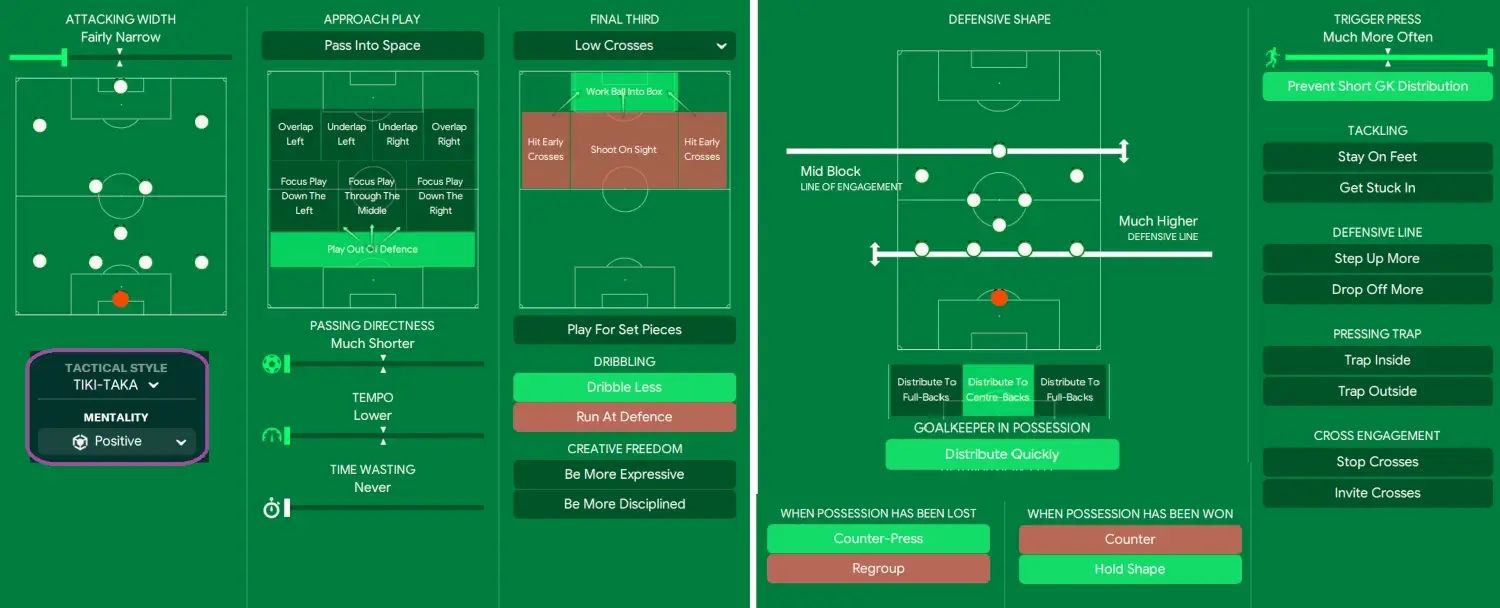
The style of play is most famously associated with the Pep Guardiola’s FC Barcelona side during the late 2000s and early 2010s but was also used with great success within the Spanish national team.
Within the Tiki-Taka tactical style a further emphasis on an extreme short passing, intense pressing and coordinated movements within a set pattern of play aims to use the ball to wait for space to erupt and break through the opponent, either when their lose focus, in specific areas of the field through overloads, or passing the opponent to death by moving the opponent to create weaknesses elsewhere.
The beauty is in the patience.
Pass, pass, pass, pass, and suddenly a player appears in a pocket of space because the defender lost concentration for half a second or is simply out of position that makes the player next to him to make a bad decision.
To succeed with applying the Tiki-Taka, focus in training is set at rehearsing passing football so all decisions are made automatic – resulting in the flow remains regardless of the pressure.
Although it requires certain players to make this style of play successful – something that might take time to incorporate at a new club as it requires great tactical familiarity of both what to do with the ball, movements and understanding of space as well as what it requires out of possession, the Tiki-Taka style of play is one of the most beautiful football philosophies ever, even though it has received a bad rumour of simply passing the ball as a way to retain possession and use it as a defensive approach.
However, the true identity behind Tiki-Taka’s quick-short passing and ambitions to work the ball through different channels is the effort set on shape, player’s positioning and creating as many triangles and rhombus shapes as possible to ensure multiple passing options.
The best way to defend in football is to have ball possession on your opponent’s half. For this, you need to play with high ball circulation and that requires as many lines of players as possible
Johan Cruyff
Through positional play aka juego de posesión, the aim is to take advantage of player’s better technical qualities and vision to dominate the game.
Unlike the control possession system, Tiki-Taka adopts a relentless pressing approach, forcing the opponent to make mistakes so your team can recover the ball as early as possible.
By setting up an intense press that aims to win the ball high up the pitch, and most desirable within the opponent’s defensive third, teams who adopts the Tiki-Taka tactical style aims to suffocate their opponents and skip the entire defensive- and attacking-transition phase by seamlessly always be in possession of the ball.’
It gives little to no time for the opponents to rest – using their great positioning and wonderful attacking shape to defend against turnovers and thereby set in pressing traps that increases the chance of winning back the ball not only as high up the pitch as possible but as quickly as possible.
Compared to the control possession tactical style in Football Manager the passing directness and tempo is much shorter and slower – meaning you focus first and foremost on retaining possession and use passes as a way to rest with the ball.
This has its pros and cons.
One of the biggest weaknesses with the Tiki-Taka style of play is how the lower tempo and the focus on retaining possession both in the build-up and immediately after recovering the ball makes it easier for the opposition.
By setting up a low block that protects the centre, the opposition team can force sideways passes – making the play both predictable and far less dangerous if they do not initiate a higher press and they maintain their collective shape.
The objective behind this entire football philosophy is trying to get one or more players to move out of their position. If one press or make a bad decision to track a players’ run, space will open up.
While it may make a less creative team look passive and you might struggle to open up the most stubborn defensive block – leaving it little space to break through their lines, your focus on working the ball into the box and attacking intent may leave huge gaps to be counter-attacked on due to the extremely high defensive line.
This requires quick defender’s and a balanced rest defence to avoid conceding goals from turnovers.
On the other hand, the Positive mentality will ensure the team takes more risk in possession and initiate more through balls when the opportunity arises.
This encourages the team to play the ball forward and try to attack rather than just keep possession for the sake of it. But here’s the reality check. This requires worldclass technical players, or some of the best midfielders in the league, quick defenders or fast forwards with the ability to win one-on-one situations.
The template has several tactical instructions applied that forces the player to look for passing options and initiate that fast one touch play the Tiki-Taka is characterized by. Active by default we got ‘Dribble Less’ that reduces individual expressions, but which moves the ball faster. Poor decision-making or low vision will easily gift the opponent the ball as passes are intercepted.
At the same time the focus of play will be at moving the ball through the middle of the pitch with a ‘Fairly Narrow Width’.
This works well if you manage to stretch the opponent’s shape. If not, you will be facing a wall of players.
The less attacking width slightly impacts what type of player roles I would select down the wing. Rather than considering the fullback role, which is decent, you will have more success with selecting the Wingback or Complete Wingback role. You need someone to overlap on the flank and stretch the pitch that opens up space in the half space channel for the midfielders and wide forwards to move into.
Recommended Formation(s):
Traditionally, the best formation for the Tiki-Taka tactic is the 4-3-3 but you can also consider the 4-2-3-1.
The reason is that you need a shape that easily creates as many diamonds and triangles as possible. Another option is the 3-4-3, which would make it more like the Dutch Total Football or relate to Johan Cruyff’s attacking vision of the game.
What roles you select for your formation is up to you. However, having one runner, one sitter and one playmaker within your midfield trio is essential – whether that is a RPM alongside a deep-lying playmaker, a box-to-box midfielder next to an advanced playmaker or a Mezzala and Central Midfielder in front of a holding playmaker.
With more emphasis on ‘passing the opposition to death’ there’s nothing wrong to use multiple playmaking roles within the midfield line – resulting in your players look to your more creative players to create chances from deeper positions.
If using a lone striker, ideally you want the striker to drop deep in the build-up to overload the midfield, e.g. False 9 or Deep-Lying Forward, but there’s nothing wrong to use a Complete Forward or an Advanced Forward with one of the wingers moving inwards to support the striker.
With the focus at overloading the opposition through the five channels, your defensive solidity will be left to your defensive holding midfielder. In a 4-3-3, the Half Back might be ideal, but you can also consider applying a more modern rest defence of 3-2-5 rather than the 2-1-4-3 and let the DM support the midfield trio a little bit more.
The half back role will be essential if you got wingback who fly forward to attack. It offers more defensive protection and will help to create an overload in the deep build-up when facing two striker systems.
1.3 Vertical Tiki-Taka
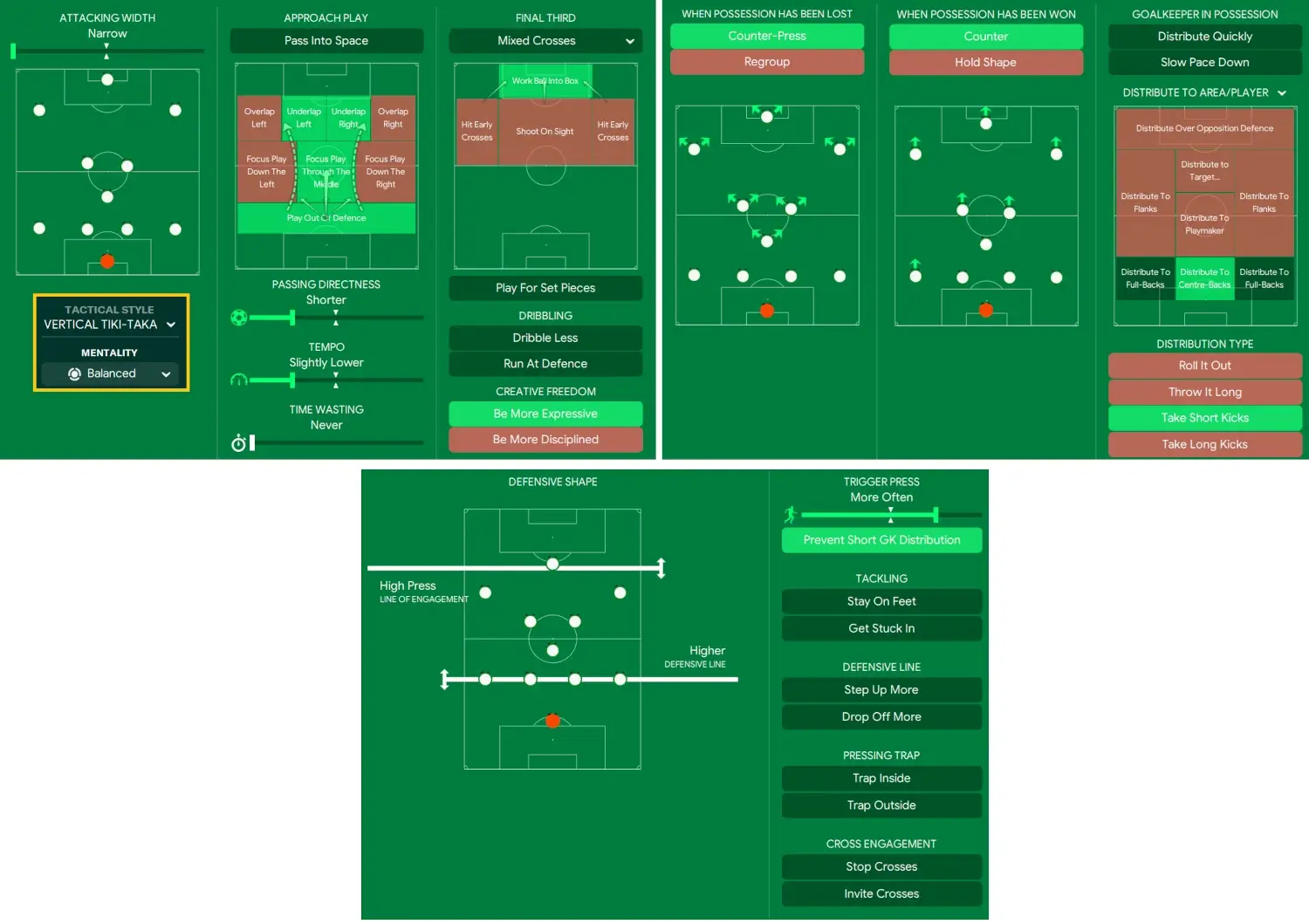
As the name applies, the Vertical Tiki-Taka is a more direct version of any of the previous tactical styles. The aim with this style of play is to move the ball forward both quicker and slightly earlier. The focus is slightly more on penetration rather than retaining possession at every opportunity.
You will still experience your team to play those beautiful short passing game but the focus within the final third is slightly different.
Not only will this football philosophy balancing play between attacking the opposition if there is a chance to progress play early in the attacking transition but take advantage of slightly more direct passes and slightly higher tempo of play to move the ball quicker into the opponent’s final third.
From passing the ball sideways in the most extreme possession football, the team will suddenly try to take advantage of these moments after regaining possession to come to goalscoring opportunities.
By moving the ball quicker both in the build-up and in attacking transition, the objective with this style of play is to make it harder for the opponent to anticipate play. More unpredictability with the ball, more penetration and quicker play make it harder for the opponent to track your players and set up a defensive block.
This is evident especially in the moment when your team has won the ball back through that relentless pressing that has been inherited from the most extreme possession football; the Tiki-Taka.
One of the fundamental changes in the Vertical Tiki-Taka compared to the extreme short-passing game is the difference in individual expressions.
Not only will you ask your players to take more risk by giving them more creativity on the ball to affect the game, but movements inside will be prioritized – resulting in your wide players to look for passing options towards the centre as ‘Look for Underlaps’ are suddenly enabled.
This can both be a strength and a weakness.
Against a box midfield, the focus on in field passes can be easily intercepted and hurt your play but if you manage to lure players out of position by off the ball movements, this football philosophy aims to create chances from where the opponent is weak – between the full back and the centre back by looking for third man runs and smart positioning in the half space channels.
This tactical style will be highly effective if you manage to create a tactic with opposite movements and overloads in key areas.
Think Pep Guardiola’s Manchester City rather than Pep Guardiola’s FC Barcelona. You dominate the ball, sure, but every pass has intent. Every movement is designed to get you closer to the goal, not just to keep possession.
The pattern of play is all designed at setting up specific players to come to goalscoring opportunities from smart movements and wonderful threaded through balls inside the channels.
The mentality for the vertical Tiki-Taka is balanced – like the control possession. However, the vertical Tiki-Taka borrows more core principles from the regular Tiki-Taka style of play. Relentless pressing, high defensive line, and shorter passing.
While the 4-2-3-1 and the 4-3-3 are good formations for a vertical Tiki-Taka tactic, the 4-1-4-1 and the 4-4-2 diamond offer a unique variety suited to the quick passing system.
You need intelligent players with good decision-making to play quick and accurate passes as well as players with high work rate and great stamina to keep up with the high pressing intensity.
Read More | Pressing in Football Manager: How to win possession by High Press or Counter-pressing
Pace is really important for wingers in this formation. This isn’t just about only technical ability. Your wide players need to burst past opposition defenders when the perfect pass arrives.
Player roles used in Tiki-Taka can also be used in this style of play, but you must consider adding more vertical movement in the heart of the midfield. Rather than use three playmakers in midfield you must prioritize adding at least one vertical runner.
Consider the Segundo Volante, a Mezzala, box-to-box midfielder, or a central midfielder on either support or attack. Up front you may want to use a striker such as the Advanced Forward who likes to run in behind your opposition’s defence and provides the necessary depth to open up space for the midfielders to exploit spaces between the lines.
One of the weaknesses with the vertical Tiki-Taka is its increased focus on a higher tempo play.
Playing too quickly can cause the team to lose possession in key areas. Keep in mind the high defensive line. If play breaks down, it will be a highway to your goal!
It’s also vulnerable to counterattacks if your press is bypassed. In fact, once players initiate a press, it will leave space behind to move the ball into.
Watch more | A New Tactical Preset for Football Manager 26?
1.4 Preferred Traits for Possession Football
To play possession football, there will be some important player roles to look at, but most importantly will the style of play be highly affected by player’s traits.
Below will we briefly look at some of the most suited player roles and the recommended traits for each role when creating a possession football playing style.
Useful Player Roles & Traits
| Role/Position | Trait(s) |
|---|---|
| Defenders: | |
| Central Defender / Ball Playing Defender | – Mark opponents tightly (CD) – Does not dive into tackles – Brings ball out of defence (BPD) |
| Fullbacks / Wingbacks / Complete Wingbacks | – Gets Forward Whenever Possible – Hugs Line |
| Midfielders: | |
| Deep-Lying Playmaker (DM-strata) Regista Half Back | – Comes Deep to Get Ball – Stays back at all times (DLP-D, HB) – Dictates Tempo |
| Deep-Lying Playmaker (MC-strata) | – Tries Killer balls Often, Dictate Tempo |
| Advanced Playaker / Roaming Playmaker | – Tries Killer balls Often – Plays One-Twos – Moves into Channels – Tries Tricks |
| Forwards & Wide Players | |
| Inside Forwards / Inverted Wingers | – Places Shots – Cuts Inside |
| False Nine / Channel Forward | – Moves into channels |
1.5 Advantages & Disadvantages with a possession style of play
1.5.1 Advantages of Possession football
By keeping possession, you will control the game as there is only one ball. As long as you maintain possession, the other team can’t score. So for them to regain possession, it forces them to chase the ball all over the pitch – hopefully with the result that it will tire them out and be fragile of making mistakes by becoming undisciplined and impatient in their will to get the ball.
Exhausted opponent will further allow you to control the match tempo.
1.5.2 Disadvantages of Possession football
By playing a patient football, your team’s build-up and how you aim to enter the final may make your attacking play predictable. You may have over 60% of possession and dominate the match, but the other team can defend easily by staying deep (packing the penalty box), reducing available space to exploit to a minimum, forcing you to shoot from long or use other tools which may force to increase the risk of losing possession, for instance by limiting your team to only make sideway passes.
Secondly, as you pin the other team back it will leave huge spaces behind the high defensive line for opponents to counter in. Facing a physical team may make it difficult to get the required flow in order to retain possession. This means that possession football may not always be that effective.
Basically, you are only allowed to advance as far up the pitch as the other team allows through their defensive block and game plan.
Recommended Attributes:
Technical: Passing, First Touch, Technique
Mental: Anticipation, Decisions, Positioning*, Vision, Composure, Aggression
Physical: Agility, Balance, Acceleration
*useful for defenders
2. Counterattacking Tactical Styles
The best teams must not only retain possession and pressurize the opposition team back to their own penalty box. A good team must also be able to counterattack with quickness, unpredictability and directness. Of course, will there be teams who won’t be able to switch between different playing styles that easy (as the players requirements and demands are totally different from what they possess). A counterattacking playing style can be very proficient to use as it strikes the opposition team when they are unbalanced – within the defensive transition.
Counterattacking football is somewhat opposite of possession football and relies very much on a deeper defensive line who looks to intercept the opponents passing play – taking merely advantage of the few seconds when no one has possession of the ball. It’s a good playing styles for teams who are outsiders to the title, who regularly faces better opponents and desires to utilize their main strength – stamina, aggression, creativity, quickness in movements to attack their opponents.
In Football Manager we got three specific counterattacking playing styles – all with their different strengths geared towards looking at turnovers to create chances from more of a direct football philosophy.
2.1 Gegenpressing aka Counter-pressing
Widely regarded as the greatest Football Manager preset of all time, gegenpressing is a style that has dominated world football in recent years.
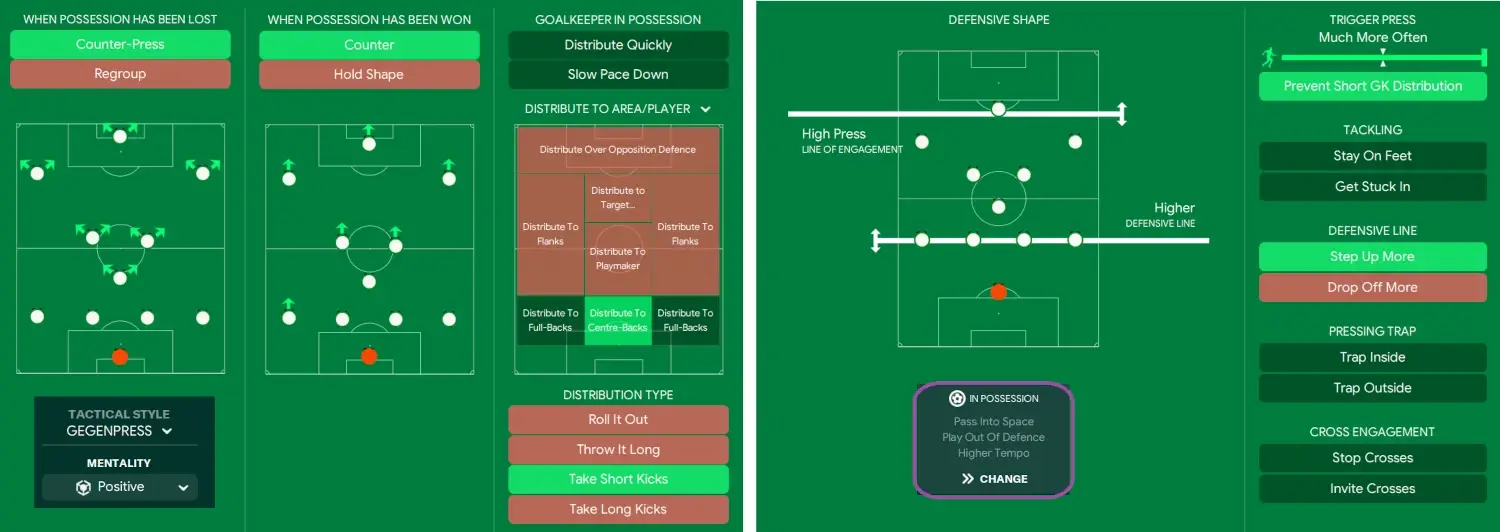
Made famous by German manager Jürgen Klopp during his time at Borussia Dortmund and later on Liverpool, the German’s gegenpressing inherits what’s best within any possession tactic and combines it with counter-attacking football.
But rather than retreat back into a defensive block, the gegenpressing style of play is a physical demanding tactical philosophy where the pressing never stops.
The system encourages your team to press relentlessly and try to win the ball back – often high up the pitch and as soon after possession has been lost.
By aggressively press to recover possession immediately after possession has been lost, it aims to counter the countering by instructing your first line of defence to initiate a high press, and thereby work tirelessly in the first seconds after losing possession to try to win the ball back.
The objective is to exploit vulnerabilities in the opponent’s shape within the transition phases and use the moment of chaos when going from attacking to defensive shape to come to goalscoring opportunities through high turnovers.
This tactical style is highly demanding as it instructs your team to work hard once the ball is lost to set up pressing traps and take advantage of their aggression, stamina, higher work rate and tactical discipline to force mistakes – either the opposing player makes rushed decisions, limits his passing options or reduce his abilities to gain control of the ball and can thereby progress play.
As mentioned, for this style of play, you need players with high aggression, stamina, work rate, acceleration and natural fitness. This will help your team to maintain their pressing intensity throughout the game. This reveals that gegenpressing football is a football philosophy that doesn’t suit everyone. You need the right players. And due to the mental and physical demands, it’s a style that might be best used when the players are closing in on their peak years, from the age of 21 to 28.
Compared to the other counter-attacking football philosophies, gegenpressing is highly proactive. You want your team to dominate in all phases of play, and use the confidence and energic football to force the opposition on their back foot.
With a positive mentality you will increase the risk slightly by increasing the player’s creative freedom as well as the passing risk.
Unlike the Tiki-Taka, the gegenpressing system does not try to keep possession with an extremely short passing game. Instead, you will progress the ball at slightly shorter passes – meaning your team will balance the game around more progressive passes when the opportunity is there, or play it short in the build-up phase by being slightly more patience than looking for a direct counter-attacking opportunity to score goals from goalkeeper kick-offs.
You win the ball back, you play it forward and you try to score a goal. If you lose the ball, you press aggressively and try to win it back.
Passes are preferred into space, meaning your quick forwards is licenced to run onto the ball, rather than stick to their position to receive the ball before they can carry the ball forward.
This has its pros and cons. While you can take advantage of the space behind the opponent’s defensive line, the risk is that passes are made too early and the timing between movements and passes gifts the ball to the opponent. At the same time, the increased passing risk and creativity may turn the game into a back-and-forth game where your team struggles to maintain possession and thereby control the match.
To help you to achieve your goals, a gegenpressing tactics takes advantage of a higher tempo of play. Whether you use the tempo to move the opposition with quick shorter passes or use it to launch more direct counter-attacks after high turnovers, the style of play is fascinating to watch and leaves no room for the opposition to recover from its intense pressing and heavy metal football where the rhythm is speed and high-octane energy used to create chances after chances.
As you might have understood, the counter and counter press instruction is fundamental tactical instructions for these kinds of tactics. It’s what separates the basic possession-hungry tactics from the gegenpressing tactics.
Recommended formation(s):
Traditionally, the 4-2-3-1 is seen as the ideal system to use in gegenpressing tactics. The reason is its front four who can easily put pressure on the opponent’s back line. However, the 4-3-3 could work well, if you instruct one of your midfielders to initiate a half press. Another alternative is the 4-2-4, resulting in that you use numerical advantage up front to limit the opposing team’s chance of progressing the ball into the midfield.
For player roles, I recommend the Ball-Winning midfielder as a key component for this system. His pressing intensity favours the high pressing style of play.
However, you may have success with the Deep-lying playmaker or the Regista too. It all depends on the player role combinations next to them.
Regardless of how you wish to set up your tactic, I recommend a maximum of one playmaker who can make those vital progressive passes but there is nothing wrong by going for more general roles such as a Mezzala or a Central Midfielder who can overload the final third with his late deep runs, next to a holding midfielder.
In defence, you could use wing backs and complete wing backs next two a Ball-playing defender. Just pick what fits the players in your squad but consider the necessity to add full backs who overlaps and provides width.
In goal, you should prioritize a Sweeper Keeper on support who can play counter-attacking passes. However, the Sweeper Keeper attack will be ideal due to the high defensive line and his tendency to sweep up through balls and play more risky passes.
In attack, the pressing forward is a superior role for this system as he leads the press. Personally, I would avoid both the Enganche, the Trequartista or the Target Man. You want a forward who gets forward, moves into channels and can both create chances and score goals.
To assist the striker, you should consider the Inside Forward on attack, Inverted Winger or an Advanced Playmaker. Use roles who cut inside and will drive towards the centre of the pitch and thereby overload the opposing back line with coordinated movements.
2.2 Fluid Counter-Attack

If you want to base your tactics around quick short passes and counter-attacking football, the fluid counterattack is the alternative for you.
The Fluid Counterattack could be summarized as a mix between possession football and counter-attacking football. Done right, it’s a fascinating style of play used both between top clubs and mid-table clubs who wants to rely on the transition phases to hurt their opponents.
It gives you the chance to hit your opponents on quick breaks but offer the solution to progress the ball neatly between the lines and into the channels – giving you the feeling of playing a version of fluid possession football.
However, the tactical instructions within the Fluid Counter-Attack emphasizes individual expressions such as progressive carries, taking advantage of counters in the attacking transition and get the ball forward to exploit weaknesses early on with the Cautious Mentality and team instruction ‘Run at Defence’.
This enables the team to be defensive solid out of possession by instructing the players to take less risk and hold position until the breakthrough occurs.
If you want to play counter-attacking football but still want to maintain some kind of beautiful attacking football, then the Fluid counter-attack is the way to go.
Think Real Madrid under Carlo Ancelotti. They’ll sit back, absorb pressure, but when they win the ball, it goes to Modric who finds Vinicius, or from Frederico Valverde who sets up Jobe Bellingham.
That’s fluid counterattacking. Patient but deadly – giving your front line licenced to roam and utilize their quickness and excellent ball control to dribble in one on one situations and play that pass and move football that’s fascinating to watch.
Looking closer at the fluid counter-attack, you will discover the tactical style attempts to soak up pressure and turn over possession deep in your own half before making quick attacks to hurt the opposition team when they are most vulnerable.
However, it’s a noticeable difference between the Fluid Counter-attack and the Direct Counter-attack. When the direct Counter-attack uses a low block that invites the opposition deeper into your own defensive third, the Fluid Counter-attack will defend in a mid-block.
It instructs the team to initiate their press around the halfway line and trigger press onto the opposing players more often. If your team loses possession, you will ask your players to immediately apply pressure in a bid to try to recover the ball as fast as possible.
However, if the opposition gains control of the ball, the defensive line will drop off to adopt a safety-first approach with the result that their positioning may concede more space ahead of them.
With a mid-block and a retreating defensive line, you balance your tactic equally around defending and attacking play – making it an all-round solution for any teams.
Traditionally, this tactical style works best with a 3-4-2-1, 3-4-1-2, 4-3-3 or 4-2-3-1 – again suitable for most teams.
In terms of player roles you have the opportunity to pick from most of the player roles eligible in Football Manager. If using a back three defence, you may fall in love with the wide centre back who helps to overload the flanks and helps to stretch the opposition.
Box to box midfielders and other midfield roles who runs in the channels will be desired.
Personally, I would prioritize players who are expected to perform a variety of tasks and is not limited to a specific role. That means you should stay away from specialist roles such as free roaming roles, such as the Trequartista, the Engance or the Raumdeuter.
You can get creative with ball playing defenders and win backs on defense much like you would in any expansive system, but your players need the discipline to keep their shape when out of possession and the technical ability to create explosive counter-attacks when you recover possession.
When to use the Fluid Counterattack?
The fluid counter-attack is suitable for most teams, but I recommend you to use it when your opponent is only slightly better than you, when you feel like you can hurt them on a counter-attack. It’s perfect for that sweet spot where you are not the favourites to win the game, but you’re also not the underdogs either.
It may be a great strategy to use when protecting a lead, and you want to invite your opponent slightly higher up the pitch to take advantage of the extra space behind their defensive line with some quick short passes and progressive carries through more individual expressions from your forwards to open up the opponent’s defensive block.
2.3 Direct Counter-Attack
Listen to this quote. You can have the ball for 70 minutes, but we only need 3 seconds to hurt you. This is the direct counterattack playing style! This is Jose Mourinho’s pragmatic football. Or Claudio Ranieri and his Leicester City’s title winning Premier League football. A football philosophy that can easily help you to win major trophies!
While your opponents are passing it around their back four for 2/3 of the match, you are instructing your team to patiently wait for an opening to recover the ball.
As soon as they make a mistake, boom! Ball to the striker or ball to the winger, cross and a tap in or header into the back of the net. Quickly and effectively.
The beauty of this system is in the simplicity.

At the base of the tactic, the team will adopt a cautious mentality. This urges your team to sit deep and stay compact with more players behind the ball. The cautious mentality will instruct players to take less risk with the ball and use slower tempo and more men behind the ball to frustrate the opposition.
To get success from the direct counterattack playing style, you should prioritize a formation that offers defensive solidity. Either the 4-4-2, 5-3-2, 3-4-1-2 or the 3-4-2-1 can be recommended as they provide a compact defensive block which helps you to defend well for longer periods of the game, as well as providing opportunity to hit the opposition from quick turnovers.
In difference to any possession football style, the direct counterattack looks to take advantage of more direct passes at a higher tempo. Once the ball is retained, it’s a matter of getting the ball forward at the earliest opportunity – meaning you hit the opponent when they are unbalanced due to transitioning from attacking to defending shape.
If your team losses the ball, either high up the pitch or in the middle third, player’s main duty is to move back quickly and set up their defensive shape.
Be aware that there is no counter-pressing. Instructing your team to counter-press will quickly disrupt your team’s defensive shape, creating gaps for the opponents to exploit. This differs from the fluid counter-attack tactical style.
Although you defend deeper, the team will initiate a press more often and will be combative and aggressive in their tackling and determination to regain possession. In difference to a high pressing tactic, the team will win back the ball deeper on the pitch due to their lower line of engagement and lower defensive line – most often in their own defensive third.
To make your tactic even more defensive solid, you can reduce the Trigger Press to Balanced. With such a change, your instructions for triggering press enables your team to pick the right moments to make a tackle and win the ball. This is important knowledge. Despite you are instructing your team to press less, they won’t stand off. Depending on the player’s role and position, the team can still regain possession.
Overall, the direct counterattack will be more of a reactive football philosophy where you give the initiative to the opponent and react to their mistakes and weaknesses.
You don’t need possession to be in control of a game!
Jose Mourinho
This tactical philosophy suits teams who are expected to enter any matches as the clear favourite, not in terms of keeping possession nor rank up all the points once the referee blows the full-time whistle. Instead, the playing style and tactics fits those teams battling in the lower half of the table and believe they can use turnovers and quick breaks to cause problems for the opposition.
With their low-mid block, your team’s shape is compact with few metres between the lines. Using the correct formation and defensive shape, you can force the ball down the flanks and protect the middle with more men than the opposition.
By instructing your team to defend in a low block, the vision is to open space in the opponent’s defensive third to look for breaking players.
This means your focus should go at prioritizing a proper rest attack – the number of attackers you leave forward when the team is out of possession.
Leaving two players up front with a central midfielder ready to get forward in the attacking transition can help to provide quick support for the attackers and thereby take advantage of the space behind aggressive wingbacks or wingers in the opposition team.
The direct counterattack favours smaller teams with less technical players since you don’t have to rely on retaining possession. However, you do need physical players like pacey wingers who can carry the ball forward and strong physical defenders who can win headers, make tackles, block shots or intercept passes. Just look at the success Burnley have had with such a philosophy – forcing the opposition to take shots from less dangerous positions – from wide areas and bad angles.
The midfielders must be tactical smart, put the team ahead of individual expressions and work hard to help the team to limit the space for the opposition. Teamwork and tactical intelligence such as positioning, concentration and decision making for the defensive unit, is as important as speed, off the ball movements and close control for the forwards.
Be aware that this tactical philosophy encourages your team to rely on set-pieces as a strategy to score goals, so keep that in mind when signing players even though a good corner tactic and excellent free kick deliveries are essential for any teams to rank up points.
For player roles, a standard goalkeeper, or a Sweeper Keeper on defend duty is recommended, as these player roles are designed for counter-attacking football.
In defence, you should consider the strength of a no-nonsense centre back at the base of your back three but use it wisely. A no-nonsense centre back will launch those longer and more direct passes which can start counterattacks.
You can pair the NCB with a more technical defender who progresses play wisely, for instance a ball-playing defender.
In the midfield, I would consider hard-working player roles such as the Ball-Winning midfielder, the box-to-box midfielder, Defensive Midfielder on support, or the Segundo Volante, who can play help with defence along with offering some attacking threats with their late forward runs and the attacking support their provide in the attacking transition.
On the flanks, you should consider either the Inverted Winger or Winger on attack duty, which starts wide and can exploit spaces in the opponent’s rest defence, and can be a direct alternative for quick turnovers.
Up front, you have many alternatives depending on what you favour. However, I would focus on a striker partnership where one drops slightly deeper while the other provides depth and will move behind the defensive line as quickly as possible without being offside.
The Direct Counterattack could be a great alternative for any inferior teams who is expected to battle in the relegation zone. It could be used in the last 15 minutes of the match to protect a lead or steer the match to a vital point.
A team can be chosen according to two points of view. Either you have eleven individuals, who got the natural ability to beat their opponents. Or you have eleven average players who must be integrated into a plan. The plan aims at getting the best out of each individual to the benefit of the team. The difficult thing is to enforce absolute tactical discipline without taking away the players’ freedom of thinking and express themselves.
Karl Rappan, Inverting the Pyramid by Jonathan Wilson
2.4 Preferred Traits for Counterattacking Football
Below will we briefly look at some of the most suited player roles and most useful traits when creating a counterattacking tactic or apply this type of playing style.
Useful Player Roles & Traits
| Player Role(s) | Player Traits |
| Defenders: | |
| Central Defender / Ball Playing Defender Libero / No-Nonsense Centre back Wide Centre Backs | – tries long range passes (NCB) – tries to play way out of trouble – stays back at all times (CD/BPD/NCB) |
| Fullback / Wingback Complete Wingback | – Gets Forward Whenever Possible (WB/CWB) – Hugs Line (FB/WB/CWB) – Runs With Ball Often (WB/CWB) – likes to switch ball to other flank (FB/WB) – Uses Long Throws to start counter-attacks |
| Midfielders: | |
| Anchor Man / Half Back Segundo Volante / Defensive Midfielder Ball Winning Midfielder / Regista | – Tries to play way out of trouble – Marks opponents tightly – Tries long range passes (REG) – Stay on feet when tackling a player (BWM/REG) – Plays short simple Passes (A/HB) – Arrives Late in the Opposition area (VOL/DM) |
| Central Midfielder Box to Box Midfielder Ball Winning Midfielder Wide Midfielder | – Arrives Late in the Opposition Area (CM/AM) – Play One-Twos (BBM/CM) – Runs with ball often (BBM/CM) – Runs with ball through center (BBM/CM) – Likes to switch ball to the other flank |
| Wingers / Attacking Midfielders: | |
| Attacking Midfielder / Shadow Striker Defensive Winger / Winger / Inverted Winger | – Tries killer balls often (AM/SS) – Play One-Twos – Runs with ball through center/left/right – Hugs Line (W) – Gets forward whenever possible (W/IF) – Moves into channels (SS) – Try long shots whenever possible (SS) |
| Forwards: | |
| Deep Lying Forward / Pressing Forward Advanced Forward / Complete Forward | – Runs with ball through center – Moves into channels (AF) – Knocks ball past opponent – Tries first time shots – Likes to try to break the offside trap |
2.5 Advantages & Disadvantages with counterattacking football
2.5.1 Advantages of Counter-Attacking Football
By organize the team to defend deeper, you will draw the opposition team onto you, forcing them to leave huge spaces to exploit behind their defensive line. The opposition team will of course look to score goals by unpredictability = risky play. By taking advantage of their willingness to score and attack, the hope is that they forget about defending. Herein, taking advantage when players are out of position or the team’s shape is unbalanced, for instance when opposing wingbacks rushes forward and leaves huge spaces behind them to attack in.
Besides the attacking intent leaves gaps to penetrate in, the tempo of the game may eventually tire the opposition team out, making it easier to create late goals.
2.5.2 Disadvantages of Counter-Attacking Football
As always, when lowering defensive line, you will increase the probability for the opponents to strike at goal. When facing a technical good team, it may be difficult to regain possession at all. Players will need excellent understanding of play and take whatever chance they got in order to attack. This extremely risky play may come at the expense of losing possession in dangerous areas or increase the probability of mistakes being made as the team will rush play forward by using a more direct passing style.
Playing counterattacking football will be both physical and mentally demanding as the high match tempo (required to succeed) may backfire tiring out your own players.
Recommended Attributes:
Technical: Tackling, Marking & Heading (for defenders), Crossing, Passing, Technique (for midfielders and wingers), Dribbling, Heading and Long shots (for attackers)
Mental: Positioning and Concentration (for defender), Off the ball, Decisions, Work Rate (for midfielders and forwards)
Physical: Acceleration, Pace, Stamina, Strength, Jumping Reach & Natural Fitness
3. Defensive Tactical Styles
Even the best teams must defend from time to time, however some teams are forced to do it more often than others – perhaps due to their worse abilities or disadvantages of playing a more specialised football philosophy.
Defensive systems are sometimes overlooked on Football Manager. You may even say they are useless, but that is because we set up a team to defend and expect the team to dominate other teams and break the game.
That’s unrealistic.
But with deeper understanding of when and how to use defensive system, I’ve started to respect them more. Over the following chapters we will explore the three primary preset tactics in Football Manager geared towards the defensive tactical styles that enables you to defend deep and ‘play that ani-football’.
3.1 Route One
The Route One strategy is the complete opposite to the Tiki-Taka or any other possession football tactical styles.
This is football reduced to its absolute basics: Win the ball, get the ball to the big man, cause chaos in the box, and score.

When you think about a route one tactic, your mind might quickly wander to the success of the Norwegian National team in the 90s under Egil ‘Drillo’ Olsen’s leadership. Influenced by Charles Reep ‘long ball’ philosophy and the studies he had done in the 1950s, where he found out that 80% of all goals scored in the 1954 World Cup was scored after three passes or less.
The route one style of play can be an effective strategy for underdogs to come to goalscoring opportunities.
In Football Manager, this tactical preset instructs your team to play the furthest pass available with the intent of penetrating the opposition’s penalty box as early as possible with not only a much more direct passing approach but with a slightly higher tempo of play.
The players are instructed to be highly disciplined out of possession and conform to the tactical plan. There is no space for individual expressions and flair. Instead, player’s teamwork abilities, positioning and tactical intelligence is favoured.
The playing style of Route One encourages the goalkeeper to take long kicks and aim for the target man – trying to hit the ball over the opposing defensive line, or over the high press to set up the attackers for a more ideal numerical advantage as it might be 2vs2.
The route one adopts a balance mentality. This is to allow for the extreme team instructions used in this style of play. The passing is much more direct with the goalkeeper and central defenders clearing the ball to the strikers and wingers in attack. Meaning you can use its highly direct passing style to bypass the opposition’s midfield.
On the other hand, this tactical philosophy will also rely on fullbacks, or wingers, who can make crosses into the box as early as possible – in a bid to surprise the opposing defenders.
By making crosses in behind the defensive line that makes it hard for the retreating defenders to gain control of as they are moving backwards, the team can come to goalscoring opportunities from wide areas after a limited passes in the attacking transition.
However, if the counterattack breaks down, the team is asked to regroup into their defensive block rather than trying to chase the ball-carrier in a bid to quickly and swiftly regain possession.
This is highly important to get success from this defensive tactical philosophy.
Together with its low-mid block, the ‘Route One’ tactical philosophy will focus on maintaining its defensive shape, stay compact and don’t leave any spaces for the opposition to progress through their lines.
The slightly lower triggering of press and asking the team to regroup into their defensive shape once possession is lost, instructs your players to pick their moments wisely in order to initiate a press. You don’t want a player moving out of the defensive shape to try to regain possession but wait until a clear opportunity arises.
With the lower defensive line and the defensive approach to pressing, the team will invite the opposition into their own half – meaning you need to be patience.
As play progress into your own defensive third and longer spells for the opposition to have the initiate to score goals, your strategy is to create huge acres of space in the opposition’s half to exploit on the counterattack.
The route one is suitable for teams with inferior tactical players. Your players don’t need to have 16 vision or passing attribute. They can just clear the ball into space and hope that the attackers get to it first. It might feel like a style of play where you have the least control over what happens during a match but can be highly rewarding for newly promoted teams or inferior teams who might look for the long ball approach to come to goalscoring opportunities.
To get success from the long ball strategy on Football Manager, you should consider using the 5-4-1, 4-5-1, 4-4-2, 4-4-1-1 or the 5-3-2 system.
Regardless of what defensive shape you favourite, it might be useful to defend with a back five or a box midfield in order to defend all vulnerable zones and channels.
Recommended player roles for a ‘Route One’ tactic football is quite similar to the direct counterattack. You should avoid any player roles where the team will look for that player to progress play, e.g. DLP, AP or Roaming Playmaker.
Ideally, you’d like to have more traditional player roles who work hard and helps as much in the defensive phase as in the attacking transition and in final third.
One winger on an attack duty, coupled with a Target Forward who can win aerial duels is important.
A fullback who can overlap and provide more crosses from deep will also be useful. Just imagine having a fullback like Stig-Inge Bjørnebye who can make accurate crosses and longer direct passes from deeper areas straight towards a Wide Target Forward or Deep-Lying Forward on the opposite side of the pitch.
Ideally, this tactical philosophy is proficient against possession heavy teams who likes to press high and play with a high defensive line.
For instance, it may be an advantageous strategy to consider applying to protect a lead or acquire a well-fought draw in the last 10-15 minutes of the match.
This tactical style may look simple but require specific abilities and role combinations that is particularly geared towards playing this highly direct football.
Football is not about possession or playing a nice passing game. Football is about winning games.
Michael Ballack
3.2 Park The Bus
Park the bus is the most defensive system in all of Football Manager. There is no intent to attack, only to defend and protect the lead. If the team sees a window to attack, fine. If they don’t, they stay in their shape and try not to concede a goal.
Think of Jose Mourinho’s Chelsea against Liverpool in 2014 or Chelsea against Bayern Munich during the Champions League final in 2012.
Unlike other systems we’ve discussed, park the bus is the only system that is situational. What that means is you can’t play a whole season parking the bus.
It’s a system you use to defend the lead or secure a point in a match.
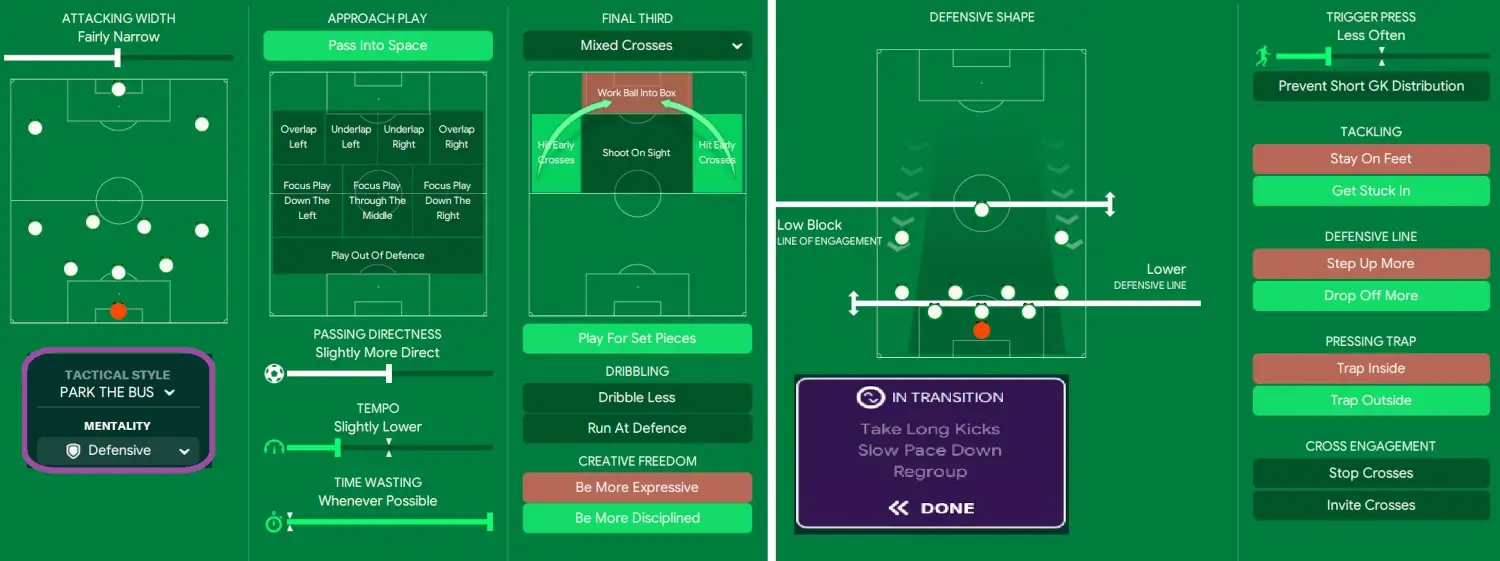
In a Park the Bus tactical philosophy on Football Manager, you will instruct your team to waste time whenever possible when the team is in possession of the ball. At the ball, tempo is slower, and the passing style is more varied than in counter-attacking styles or the other defensive tactical philosophies.
By applying a Defensive Mentality, you expect the opposition to be clear favourite to win the match and you’re quite inferior to your opponent.
With a lower defensive line, a low block and instructions to be more disciplined, the park the bus strategy can be a frustrating style to come up against.
By applying it you instruct your team to keep men behind the ball and restrict both the space between the lines and behind your defensive line to reduce the spaces the opposition can attack.
Once the team has regained possession, probably after opposition mistakes or shots off the mark, your team will patiently look for openings and entice the opposition onto you before relying on sharp quick passes towards the attackers.
This means that the team will balance their passing approach around retaining possession and take time with the ball to frustrate the opposing side before swiftly making more direct passes into open space when a more direct opportunity arises – for instance if the opposition team is unbalanced.
The defensive approach is to use the team’s shape and compactness to force the opposition to progress play down the flanks.
The team will look to set up pressing traps down the flanks to try to recover the ball in wide areas and thereby regain possession cleverly.
To get success from such a defensive approach as park the bus is, you need to balance your formation and system cleverly between a great defensive foundation with four or five at the back and a proper rest attack.
Remember, you’re not trying to hit the opposition on a counter-attack. You just need to defend. You play in a low block, low defensive line and force your opponent out wide.
You might want to look at the 5-4-1, 4-5-1, 5-3-2 or the 4-4-1-1. Ideally, you want your system to provide a double width since you want to set up a pressing trap onto the wings.
To regain possession down the flanks, you might fancy the Defensive Winger player role and fullbacks who first and foremost defends but may get forward when the opportunity arises. The DW is only available in a traditional 4-4-2 system.
If you fancy trying out the 4-2-4 system, which is one of the default tactical presets for route one, consider one Wide Target Forward along with an Winger or Inverted Winger on the opposite side.
When setting up a park the bus tactic, most of your player roles should be set at a defend duty to maintain the compactness.
Due to the initiative to make progressive passes from deep, you could use a maximum of one playmaker, where the Deep-Lying Playmaker is encouraged for its more risky passes. But if using the DLP-S, make sure you got a holding player next to him, a ball-winning midfielder or a defensive central midfielder.
In your attacking line, you should consider one defend and one attack duty, for instance by using either two Pressing Forwards, one Target Forward coupled with a Poacher, or a Deep-Lying Forward (support) paired with a Pressing Forward (attack).
3.3 Catenaccio
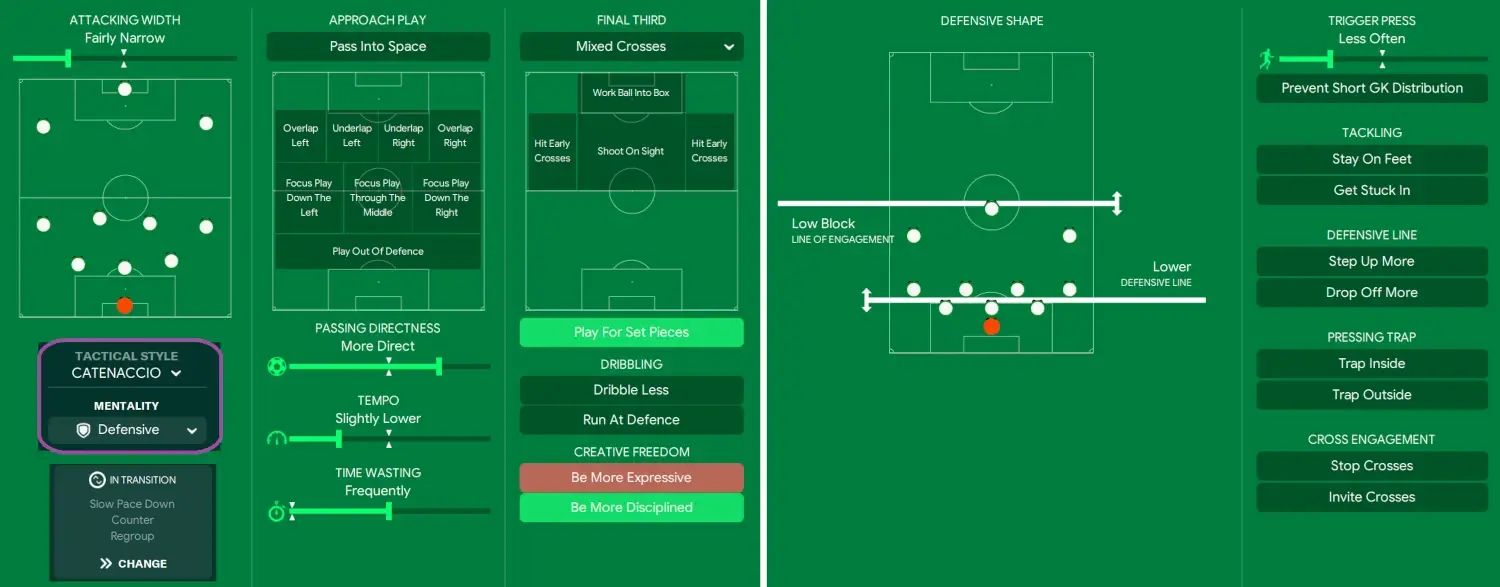
The Catenaccio tactical style is one of the most classic football philosophies in world football.
Made famous by Italian manager Heleno Herrera after his success at leading Internazionale to a European Cup final. However, the history of the Catenaccio style of play started with Karl Rappan’s Verrou.
The term Catenaccio initially means door-bolt or chain and was a development of the 2-3-5 formation and the W-M shape. The strategy behind the Verrou was to use a 1-1-3-3-3 shape with an extra player behind the defensive line.
This was later adopted and modified in Italian football where the primary idea was to have one last covering defender closing the gaps between the goalkeeper and the centre backs with the primary duty of sweep up through balls and add an extra layer of defence.
In such, the Libero or sweeper role was born.
The Catenaccio was an effective system until the mid-80s but once all teams in Italy started to play the same strategy, football became boring due to its rigid style. Normally used in a total man-marking strategy, the Catenaccio erupted to frustrate their opponents and use an defensive approach to get space to attack.
In Football Manager, the Catenaccio tactical style is one of the most interesting defensive football philosophies. Emphasizing your team’s style of play around a highly organized and effective defence which looks to protect the goal with a numerical superiority at the back, the Catenaccio prides itself of being a tactical philosophy which wins trophies after trophies – often after ruthless defending, hard tackles and control.
Worth to know, the Catenaccio style of play in Football Manager will ask your players to regroup as soon as the ball is lost – something that emphasize defensive solidity ahead of recovering the ball. The players must be disciplined and protect their zones – meaning individual expressions and creativity is frowned upon.
However, the Catenaccio is perhaps a misunderstood football philosophy, at least according to Helenio Herrera who said that those who copied his style often copied him wrongly.
They probably focused on the defensive aspects of the tactic but underestimated the attacking side of it, neglected or frankly forgot about it.
For instance, in Herrera’s 5-3-2 tactic, the fullback, Facchetti, scored as many goals as the forward.
In fact, Helenio Herrera’s Grande Inter (1960-1967) scored a huge number of goals after quick breaks – using quick sudden counterattacks to score goals. The key ingredients in his tactics were the implementation of attacking and overlapping wingbacks.
This can also be replicated in your Football Manager Catenaccio tactic with a 3-4-2-1 wide formation.
In reality, the Libero role will work best in a traditional back three system, e.g in a traditional 5-3-2 system but can also be experimented with in 3-3-1-3 system. Using the Libero role alongside a no-nonsense fullback in a more traditional 4-4-2 system or a 4-3-2-1 system could also be considered.
In this style of play, you need a formation that offers both defensive compactness, protects the middle with numerical superiority and can work the ball forward with pin-pointed direct passes and counter-attacking initiatives which tears the opposition apart when they are unbalanced.
The Catenaccio tactical style uses a defensive mentality which aims to deny giving the opposition to come to goalscoring opportunities. Like any other defensive approach, it’s reactive football at its best.
By using the low block and lower triggering of press, it leaves less space for the opposition to attack in – whether it is behind their back line or between the channels. The players must be patient in their bid to regain possession but will pick their moments.
The strategy is to force the opposition to play sideway passes which increases the likeliness of recovering the ball and take advantage of the larger acres of space behind the opponent’s defensive line to break through their lines.
A notable feature within the Catenaccio football philosophy is the frequent time wasting and the focus at using the time to frustrate your opponents. While the 3-5-2 could be a ‘boring’ system that results in many draws – especially against sides who apply a similar strategy, the attacking initiatives from the Libero role could make it into a fascinating tactical style to incorporate and watch your team playing.
Although, the Catenaccio football philosophy is most known for using the Libero role or sweeper to add an extra layer of defence, you could consider a Wide-Centre back alongside two more traditional centre-backs.
Player Roles and Recommended Traits for Defensive Playing Styles
Below will we briefly look at some of the most suited player roles and the most beneficial traits when creating a defensive tactical style similar to parking the bus, or the Catenaccio.
Useful Player Roles & Traits
| Defenders: | |
| No-Nonsense Centre Back Central Defender Libero / Wide Centre Back | – tries long range passes – tries to play way out of trouble – marks opponents tightly – Stays back at all time – Does not dive into tackles – brings ball out of defence (L/WCB) |
| Fullbacks: | |
| No-Nonsense Full back Fullback / Inverted Fullback | – Gets forward whenever possible – Knocks Ball Past Opponents |
| Midfielders: | |
Anchor Man / Defensive Midfielder Ball Winning Midfielder Defensive Midfielder / Segundo Volante | – Tries to play way out of trouble – Marks opponents tightly – Stay on feet when tackling a player |
Central Midfielder / Box to Box Midfielder Ball Winning Midfielder Deep-Lying Playmaker / Attacking Midfielder | – Tries long range passes (DLP) – Runs with ball occasionally (CM/BBM) – Tries long shots whenever possible (BWM/BBM) – Gets Into Opposition area (CM) – Arrives Late in Box (CM) |
| Wingers / Forwards: | |
| Wide Midfielder Defensive Winger / Winger / Inverted Winger Deep Lying Forward / Target Forward Pressing Forward / Wide Target Forward Complete Forward / Advanced Forward | – Shoots from distance (PF) – Tries First Time shots (W/IW/DLF/PF) – plays with back against goal (TF/DLF) – Moves Into Channels (CF/AF) – Runs With Ball Often (AF/W/IW) |
4. Wing-Play Tactical Styles
Playing wing-play style of play in Football Manager is probably a nostalgic feeling for most of you.
Made famous by Sir Alex Ferguson’s Manchester United in the 90s and used by other traditional managers who relies on double width and focusing play down the flanks, this tactical style will look to get the ball out wide as early as possible with overlapping fullbacks and the team trying to exploit wide areas.

The philosophy is beautiful but simple. Why go through the middle where there is no room, when you can go around?
Prioritizing at working the ball down the wings and get your fullback to sprint forward and whip crosses into the penalty box for the tall forward to attack.
The plan behind this tactical style may quickly recall the wonderful combination play between Gary Neville and David Beckham who find Ruud van Nistelroij with accurate delivered crosses from wide areas.
This style of play is perhaps traditional English football at its best – where wingers actually stayed wide rather than cut inside and you had players who was asked to stay as close to the touchline as possible.
This is football where crossing is an art form and not an afterthought.
Using the Balanced mentality, you’ll discover that it’s a versatile concept – not too attacking – not too defensive. The result is that what duties you select and how the role behaves gains more importance.
The tactic is primarily focused around adding extra width, more direct passes and channelling play down the flanks. From the goalkeeper got the ball, to when the team is entering the final third, the team will work the ball quickly around the park but with a greater emphasis on moving the ball towards and down the flanks.
The plan is to stretch the opposition and thereby use quick switches of play from one side of the pitch to the other to effectively take advantage of the spaces between the lines, both vertically and horizontally.
The beauty is in the chaos it creates. While everyone is trying to work the ball into the net, you’re launching 25 crosses per game and letting havoc rain in the penalty area – taking advantage of your technical abilities and physical superiority in the attacking line to come to goalscoring opportunities.
In a bid to progress play and create chances, your team will move the ball urgently from back to front – often seeking to make passes into space for the attackers and wingers to run onto. This provides an extra layer to the team’s attacking intent.
To make a wing-play tactic effective, you need a tall and strong striker, who can win almost every aerial duels. At the same time, your team requires pacey wingers who can beat their opposing marker in one-on-one duels and got the excellent close control, ball control and agility to create space on his own before launching a cross from deeper areas of the field.
The wing-play style of play is more a tactical concept than a football philosophy. Although you need to sign the right players for the system, it can be used situationally.
Imagine if you have difficulties at breaking down the opponent as they are highly compact in the centre and thereby forgets to defend the flanks. Imagine if you come up against a 3-5-2 system with only one single player protecting the wide channel.
The recommended formation for a wing-play tactic is a 4-4-2 formation but also the 5-3-2, 4-3-3 or 4-2-3-1 formation could be used.
The system is designed to get maximum width and crossing opportunities – meaning you need a formation and shape that provides greater width whilst also be balanced in the middle.
The strategy when applying the wing-play tactic may be to instruct your team to stay narrow but use wide-centre backs, overlapping fullbacks or complete wingbacks behind inverted wingers or attacking wingers to create goalscoring opportunities from crosses and through balls from wider areas.
Some, might even enjoy a central midfielder who moves wide, such as the Mezzala, to help overload the opposition on the flanks byusing this player role in a narrow 5-2-1-2 formation.
In a wing play tactic, your tactical instructions asked your team to defend in a mid-block with more triggering press active by default. This means that it’s a concept which can be used both for teams chasing a top 3 finish as well as mid-table clubs.
Effective for teams in the lower divisions, the playing style requires players with great stamina, off the ball movement, quickness and aggressiveness. It wouldn’t hurt if the goalkeeper got good levels of Kicking or Throwing as he will aim his goalkeeping distribution towards the flank – meaning you can easily bypass the high press with a bit longer GK delivery.
A wing-play tactic does not necessarily need to be a defensive system. In fact, you should consider applying one attack duty on each flank – meaning you overload the flanks with several different of runs.
Your striker duo should pair one big and tall striker with a quicker more spearheaded attacker. Think the DLF-s / AF-a partnership, or the PF-a and TF-s partnership.
Since the team will look to get the ball onto the wings at the earliest opportunity as possible, the system will be highly reliant on the fullbacks or wingbacks ability to get up and down the flank. They will require great crossing and technique to deliver them accurately onto the tall striker’s head.