Modern football is defined by what teams do both with and without the ball. The best sides in the world understand that success isn’t just about attacking flair or defensive solidity – it’s about how smoothly they transition between the two. Positional rotations and fluid tactics that evolves through the match is paramount to a successful tactic these days.
After lots of request, Football Manager 26 arrives with one of the greatest tactical evolutions in the game’s history; the ability to set different in & out of possession formations.
The addition of In & Out of Possession formations in Football Manager 26 offers you more tactical flexibility to adapt your shape to the opponent but also the freedom to recreate real-life football tactics from your favourite manager.
What formation you select when your team is on or off the ball and the tactical system you prefer with your choice of player roles will have a huge impact on how well your team will defend, or attack, on Football Manager. From selecting a shape that ensures you can progress the ball through the middle and into the final third that fits your football philosophy and tactical style, to providing the right balance to defend against counter-attacks and quick turnovers, and set up your defensive block – having the ability to select different formations and shapes for in and out of possession will be a huge game-changer on FM26.
In this guide, we’ll take a closer look at why this groundbreaking feature is so necessary, and how to approach choosing dual formations in Football Manager 2026. The aim is to give you the foundation to create better tactics for Football Manager 2026 – offering you our thoughts about what to consider when selecting an In Possession Formation & an Out of Possession Formation.
Guide to In & Out of Possession Formations
The Dilemma with Formations & Shapes in previous iterations of Football Manager
From the traditional 4-3-3 formation to 3-5-2, pundits have often referred to a manager’s tactics as rigid formations with either four or three defenders, three, four or five midfielders and one, two or three forwards. However, tactics are more than just the nominal positioning of the players on the pitch. Although their basic structure might seem they play in a 4-3-3 formation, the team may attack in a 2-3-5 shape in possession and defend in a 4-4-2 or 4-1-4-1 but with greater variations in shape in the defensive or attacking transition – with some manager’s preferring a 3-3-1-3 or a 2-1-4-3 shape.
In previous iterations of Football Manager, you started out by creating a tactic with the defensive shape in mind by spreading and balancing the player role duties (defend, support or attack) throughout your tactics. Several attack duties on one side enabled you to create overloads and numerical superiority in specific areas to come to goalscoring opportunities. Similarly, you had to keep in mind your defensive shape and the balance of your team’s structure to defend appropriately by considering the default player role behaviour and how many players should be more cautious or defensive.
What’s often been the issue is that it’s been difficult to create a tactic which is both flexible in the transition as fluid in the attacking phase to overload certain areas. You were basically limited by the player roles and duties, and their default movements on or off the ball – resulting in that positional rotations and huge change in player’s positioning between all phases of play was impossible to recreate.
If you wanted to defend and press high in a 4-4-1-1 / 4-4-2 shape, you had to use an attacking midfielder / shadow striker, or a striker partnership where one is pressing and the other comes deep to get the ball – or roam around.
You would then need to pick specific roles if you wanted to attack in a 3-2-5 shape – perhaps creating an asymmetric shape – or pick certain roles such as the inverted fullback to defend the counter with a back three within that 4-4-2 formation.
Although I found the previous tactics creator decent, it had limited opportunities to fully reflect how modern teams’ tactics morph between different shapes to exploit certain areas or protect parts of the pitch. It even set limitations on our pressing structures and how we wish to press high up the pitch – or instruct players to position themselves if counter-attacking opportunities arises, or when transitioning from the build-up phase to the attacking shape by letting certain players rotate or roam into certain spaces.
As modern football has evolved, players are often completing several different roles throughout the match depending on the match situations. One might be a ball-winner in the defensive transition phase and act like a playmaker on the ball. Others might stay wide in the build-up but move towards the centre to overload the middle and thereby provide better support for the lone striker.
Regardless of how you intend to create tactics in Football Manager 2026, it will be without needing to consider duties.
With duties gone, Football Manager has refined the player roles to act similar to how certain roles behaved with a specific duty. It gives you multiple roles to pick from – but also more player roles to comprehend as player roles is now split into in possession roles and out of possession roles with different instructions and behaviour patterns between on and off the ball.
Instead, when changing your formation and shape, selecting or altering team instructions and carefully picking player roles for in and out of possession you will literally change everything in regard to how your tactics will play out!
We will of course take a deeper look at the different player roles in Football Manager 26 and how to create your FM26 tactics later, but so far, it’s important to remember that duties have been removed.
This alters the picture of tactics creation on FM26 slightly.
Selecting Your In Possession Formation
As you probably have understood, in Football Manager 2026 you’ll need to create two different tactics – one for when your team is on the ball and the other for off the ball situations.
As before, you’ll have several of formations to pick from depending on your preferred formation. Your assistant manager will still recommend a desirable formation for both on and off the ball according to the players at your disposal and their abilities.
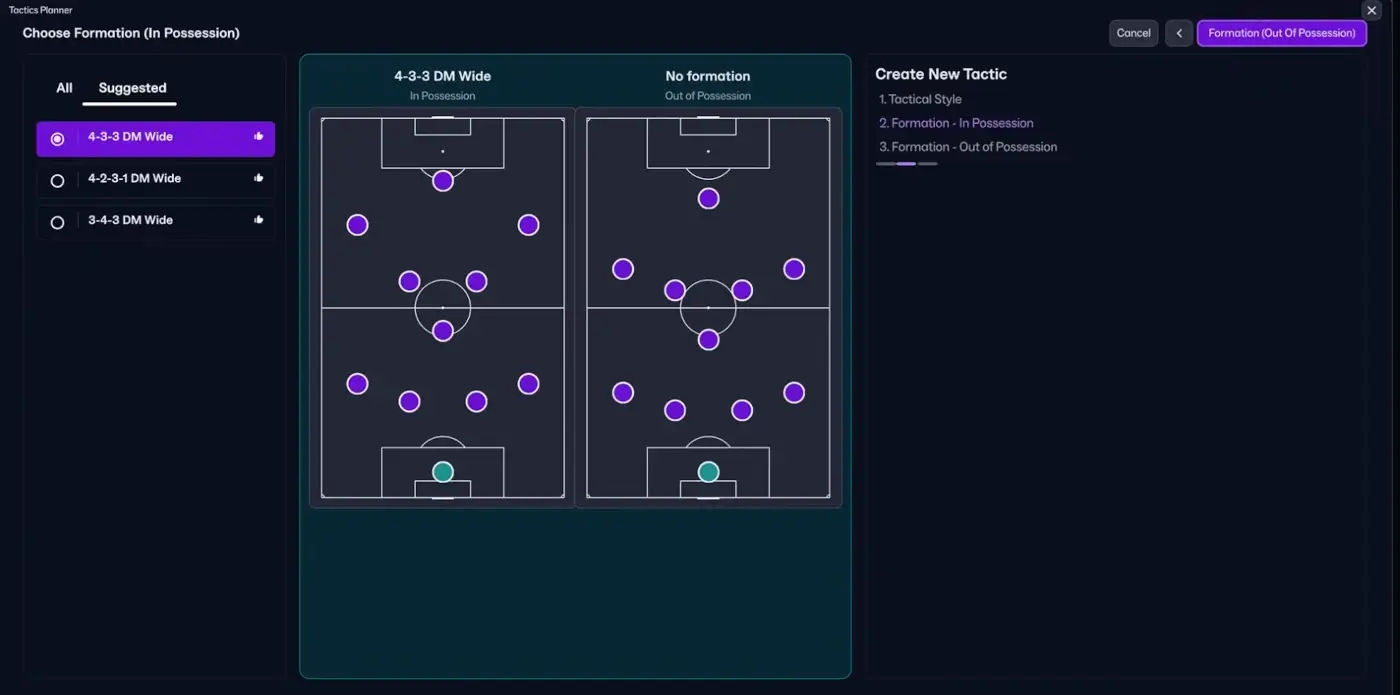
When starting out, your Assistant Manager will suggest three formations that suits your team, but you can also pick from a list of all other formations and shapes.
If selecting one your team are familiar with, the quicker the team will perform to their abilities.
Anyways, when setting up your team’s in-possession formation in Football Manager 26 you will have more freedom than before.
When I first started hearing about the rumours of in and out of possession formations, I immediately believed we would be able to set up our desired shape in the attacking third, (2-3-5, 2-1-4-3, 3-2-5, 3-6-1 or 2-3-2-3) depending how you wish to align your players in the final third.
That is not the case unless you are willing to take huge risks.
However, just like before, you will choose roles within your preferred IP formation.
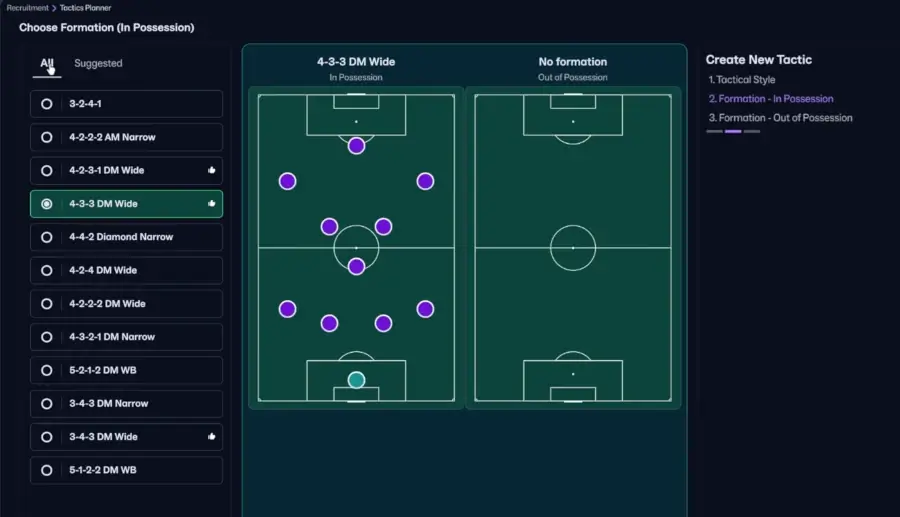
In Football Manager 26 you will have a total of 12 preset formations, but you are free to assign the players in the preferred formation you desire – whether you wish to use a more asymmetrical variant with players in different strata, or the good old fashionable 4-3-3 or 4-2-3-1.
Understanding the different formations, their strengths and weaknesses will be vital – especially when choosing your in-possession formation.
How your tactics play out will be affected by the player’s positioning, their behaviour and the different instructions you set relating to the options you got for In Possession Team Instructions.
How much width you desire is both a question of your instructions to ‘Attacking Width’ but also what formation you choose. Some formations such as the 4-3-3 or 4-4-2 will naturally encourage wide play as you’ll be playing with a double width – fullbacks and wingers who can overlap and create those 2vs1 situations.
On the other hand, a 3-4-1-2 or a 4-2-3-1 AM DM will naturally be narrower – encouraging to progress the ball through the middle rather than take advantage of overloads down the wide channels.
Regardless of your desired formation in possession of the ball, your tactical instructions will influence on how you go about several strategies with your game plan, such as:
– Buildup
– ball retention
– progression
– penetration
– final third
– overloads
– chance creation
How you set up your team’s in-possession tactics will need to be considered on behalf of how you want to build out from the back, enter final third or progress the ball through the lines.
What team instructions you choose will play as important role as the player roles you choose – their movements and positioning in the different phases.
That means you still need to consider the dynamics of your shape both in terms of spacing your players for improved ball retention, progression, penetration, overloads and chance creation with what type of player roles you choose. You will put the type of player role you choose in the front seat of applicating a tactic that fits your style of play, of course together with your chosen team instructions.
Do you desire a defensive midfielder dropping deep while the centre backs move wide to create more passing patterns and shapes that encourage ball retention and quick short passes that progresses between the lines and at the same time limits the opposing team’s forwards capabilities to press high and mark out the defenders, or do you desire to initiate more direct play that tries to get the ball over the first line of pressure.
At the same time, you need to consider third man runs and off the ball movements in your midfield line to provide penetrations and overloads that free’s up a striker.
For instance, you might want to benefit from the Channel Midfielder in the AMC spot – a player who moves into channels and offers more forward runs in possession but ask the same player to behave as a Pressing Central Midfielder out of possession – enabling you to ‘dramatically’ switch from one shape off the ball, as the player is positioned in a five-midfield line, to a more fluid 2-3-2-3 shape on the ball just to improve your high-pressing tactic.
How you spread the roles will matter. You need to keep in mind the team’s balance, how many should protect against counterattacks, or how many should move inside the penalty box, or stay in support. Then, you should also consider how and where you want to create space and where you want to create chances. From wide areas? From quick-short passes and through balls between the lines and channels, or from more direct play.
When selecting your in-possession formation you need to have multiple thoughts in mind – how do you want your team to build out from the back, how should you progress the ball into the final third and finally what types of chances should you encourage? Crosses, through balls or combination play after a more patient play where you aim to work the ball into the box?
How you spread your midfield roles is often a key to your attacking shape.
Traditionally, a midfield trio is often featuring one sitter, one runner and probably one playmaker – depending on whether you favour a tactic based on a single pivot or a double pivot.
The question could be who shall attack where, who do you want to cover for forward runs, and where do you want overloads to happen.
What will be your team’s rest defence?
At the same time, the question could also be – how do you want your rest defence to look like?
If you’re not familiar with the term, rest defence is used to describe the attacking team’s structure and the positioning of the defensive unit to defend against counter-attacks and prepare for a potential defensive transition.
For instance, Manchester City has previously used a 3-2-5 shape with one of the fullbacks inverting inside – acting like a second controller behind the front five, or one of the centre backs pushes up like a Libero to get two defensive midfielders in front of a back three when the team is in possession. This free’s up the defensive duties of the midfielders – meaning you can attack with one player in each of the five channels.
Are you willing to take the risk of leaving a 2-1 rest defence at the back to defend against counter-attacking opportunities. Do you dare to take more risk by asking only three players to hold position whilst you opt for both runners and roaming players who can offer both rotations and opposite movements which provides certain positional advantage throughout different zones and in different phases of play, or do you prefer a more rigid tactic which emphasizes certain key positions and what you can get out of them.
What to Consider for Your Out of Possession Formation

Once your IP formation has been selected, it’s time to select the desired out of possession formation.
In the process of setting up your out of possession formation you got the opportunity to choose from 4-1-4-1 DM, 4-2-2-2 DM wide, or 4-3-3 DM Wide, and so on – all depending on the three suggested formations based on your IP formation and your team’s abilities.
When choosing your out of possession formation you might want to use a similar shape as in possession – 4-3-3, 4-2-3-1 or 5-3-2 but it enables you to go even further by dramatically change your IP shape to be 4-3-3 whilst you defend in a 5-2-3.
However, when setting up your out of possession formation you do not need to take drastic measures to create a defensive solid block. Reverting your wingers in a 4-2-3-1 formation from the AM-strata to the MC-strata could be enough, and thereby simply change their player role for better defensive solidity.
Considering the built-in duties of the player roles will be necessary when determining how you want your team to recover their shape out of possession.
In this stage, it’s important to consider how many players you want to defend with and try to keep in mind your rest attack – the number of players you’d like to leave forward in case of a counter-attacking opportunity.
The rest attack helps you to prepare your team’s attacking structure during the defensive phase.
Normally, it’s a question of using a back three, four or five defenders with either two or three players ready to get forward in the attacking transition.
Similarly to when you created your in-possession formation, you will need to consider how your tactics will play out with the tactical instructions and player roles you select for when the team is out of possession.
Questions like how do you want to set up your defensive block, how do you want your pressing shape to look like and how many men should be given more attacking freedom to get forward in case of counterattacks?
At the same time, you must consider which areas of the pitch you wish to defend – do you got the abilities within your team to experience a lot of crosses into the box by using a defensive shape which forces the opposition to play down the wings, or are you stronger in the centre of the pitch which might make you want to set up pressing traps in the middle.
It’s about understanding where weak zones and spaces can arise while considering how your tactics play out in the low block, mid-block and the high press in relation to cross- engagement, triggering press and whether you want your team to counter-attack once the ball is lost, or track back immediately to be more defensively solid.
How you position the players within your out of possession formation depends on how you wish to defend. Personally,
The Importance of Roles for IP & OP Formations
How you spread the player roles within your out of possession formation is as important as within the IP tactic.
When creating your out of possession tactic in Football Manager 26, you need to consider the duties of the player roles. Now we have a huge range of new player roles to understand but in general the out of possession roles can be split into five broad categories:
– tracking
– screening
– splitting
– outlet
– pressing
From the early playthroughs and first look at tactical creation in Football Manager 26, a tracker will behave quite similarly to the defensive duty as he will be cautious and track back immediately and support the defence – providing extra numbers to your defensive block.
A pressing role will push out of their zone to try to engage the opponent with a higher triggering press instruction given. A screening role will hold position to improve defensive cover to let other players push out of their zone or become an outlet for counter-attacking situations as he stays higher and are more ready to get forward as soon as the opportunity arises.
When setting up your out of possession formation you need to balance your tactics with a mix of both players who will screen, press and track back – how you envision it will be totally up to you.
On the other end of the spectrum you will also have several roles will be more dynamic or hybrid than others – enabling them to execute their role in both in possession and out of possession – e.g. the dynamism of the Wing-back who will track back naturally in the defensive transition whilst getting forward if the opportunity allows it in the attacking phase, or the Centre Forward who can both screen passes through the middle or initiate the press by being the first line of defence.
Hybrid roles may have a signifant advantage in Football Manager 26 – meaning you can set up quite a similar in and out of possession shape and still be both attacking dangerous as defensive solid.
It’s a similar situation for the attacking phase, where some roles will naturally move very specifically when the team is in possession of the ball – such as the ‘Inside Wing Back’ who will move inside and towards the centre of the pitch when the team is trying to progress the ball into the final third. The same applies to the ‘Channel Midfielder’ or the ‘Inside Winger’.
One thing to keep in mind is that all players in FM26 will have role preferences for both In Possession and Out of Possession. You need to think about both aspects – consider their attributes and positional abilities when selecting your IP & OP Formation and creating your overall tactical shape on or off the ball.
Regardless of which roles you prefer, I feel it’s important to pay attention to all those roles who will transit from one channel to another – or shift positions greatly from the overall team’s shape. The further a player must travel between the ‘In Possession’ phase and ‘Out of Possession’ phase, the more unbalanced your structure will become.
What could be strengths in one phase of the game becomes a weakness in the other.
“You can, technically, ask your centre back to run up to centre forward when in possession and back to centre back again when you lose it. But just because you can doesn’t mean you should! You’ll get a little yellow warning sign from your assistant manager telling you they’ll struggle to move between such distant positions if you really push your luck”
What’s important to consider is the overall balance of your tactics between the phases of play. The further a player needs to travel from defensive play to attacking play – the greater weaknesses within your tactic, as the drastic change in shape creates weak spaces and holes the opposition can attack in.
What roles to select for in & Out of Possession?
Personally, I believe it will be recommended to consider certain out of possession roles according to their movements in possession. For instance, if a player advance forward and into the final third such as an Advanced Playmaker, it might be appropriate to use a Pressing Midfielder in the OP formation.
If you use a holding midfielder, it might be better to use a screening role rather than one who shall initiate a press.
This would better relate to his key attributes for both the in-possession and out of possession roles as the player will require good Positioning, Tackling, Concentration and Anticipation in both cases.
A similar event is those wide players and wide central midfielders. While you instruct one of the players to track back, the player on the opposite flank could be used as an Outlet for counterattacking moves. These Outlet roles will be more important for Fluid Counter-Attack tactical styles than possession-based systems.
Read More | Breaking down Football Manager’s Tactical Styles – From Gegenpressing to Tiki-Taka
At the same time, you need to consider the strengths of the opposition relative to how good your team are. If you are one of the weakest teams in the league, a more defensive approach aimed at protecting against counterattacks with a more cautious tactic may be favoured over an all-out-attack strategy where you instruct players in your defensive unit to act as a striker in the attacking phase.
As you might envision, your 4-3-3 tactic may greatly differ between you and your mates depending on the tactics’ out of possession formation and the instruction you select.
With greater flexibility comes more complexity.
More things to take into account, more things to envision and more things to analyse in matches to discover how your tactics play out with the chosen player roles. Then, it will also be more important to adjust your tactics – the defensive or attacking shape – according to the opposition and react upon tactical changes during matches.
Luckily, Football Manager 26 has incorporated a brand-new tool that helps you to analyse your tactics – meet Football Manager 26’s brand new feature, the Visualizer.
Through the new feature Visualiser, you’ll be able to see how your tactics evolves between the different phases of play and how your player roles behaves either relative to each other or moves individually – from one zone of the pitch to the other or as play progresses forwards or backwards on the pitch depending on the team is in or out of possession.
We will get back to how to use the Visualizer to analyse your tactics at a later point.
How does it works? The benefits
The benefit of dual formations in Football Manager 26 is that you can create shapes that are vastly more fluid than ever before with greater positional rotations and better flexibility as players’ roles can vastly differ from when they are on or off the ball.
Whilst Football Manager incorporated positional play for FM24, Football Manager 26 increases the chance of creating more Relationism tactics where positional rotations, numerical superiority in key areas of the pitch and exploiting spaces is paramount to more fluid football tactics in FM26.
For instance, a player can be a goal threat when the team is in possession of the ball but support the defence once possession has been lost.
Basically, you can ask one of your wide forwards to play as a second striker and move him into the AM spot in possession, whilst he tracks back as a winger out of possession. Or ask your central midfielder to press higher by moving him from MC spot in possession to AMC spot out of possession – providing that 4-4-2 shape out of possession whilst you play with a 4-3-3 tactic in possession.

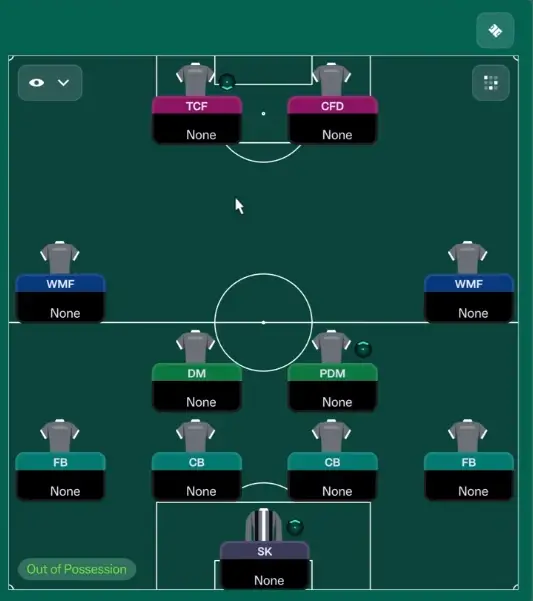
The ability to set different positions and roles for when the team is in and out of possession will change the entire picture of tactics creation in Football Manager 2026.
You can take it to the extreme or be cautious. Be creative or stay rigid – all depending on your football philosophy.
You can take drastic measures in the last minutes of each half to chase a lead – or go for that all-important equaliser by pushing more players forward, or retreat into a more defensive shape to protect a lead by adding an extra defensive midfielder and retreat the striker into a wide outlet attacking midfielder to try to hit the opposition team on counter-attacks.
Although most of it is done for practical reasons, the freedom you get by splitting the formation into in-possession and out of possession tactics, helps you to get a greater picture of how your tactics will play out. It enables you to gain greater control by fine-tuning every aspect of play – from how players are positioned between buildup and final third to their low block or high pressing structure to interchange of positioning and rotations to create more fluid tactics through the Visualiser and the four different tactics views.
As you know, modern teams often use a base formation but have the ability to shift to different shapes during a match to adapt to the opponent. Splitting tactics into in-possession and out of possession formations is the first step to create different shapes to combat certain opposition team’s strengths and weaknesses.
In & Out of Possession Formations is one new feature we are excited to try in Football Manager 26! More flexibility, more freedom but also more complexity – everything we desire in tactics creation on Football Manager!