A guide to one of the most fascinating player roles in Football Manager 26: the Overlapping Centre-Back and why it’s so powerful. Get a deep-dive into the strengths and weaknesses of the Overlapping Centre-Back (OCB); one of the Best FM26 in possession player roles: perfect for back-three systems.
If you’re looking to gain a tactical edge in Football Manager 2026, mastering the Overlapping Centre-Back role could be the difference between a predictable system and a truly elite one. As modern football continues to evolve, positional fluidity has become essential, and FM26 reflects this shift more than ever! Now, the game we’ve loved for so many decades finally gives us more tools to create flexible tactics through not only splitting tactics into in and out of possession formations but adding more player roles to cater your tactical vision.
One of the major trends in football over the past few years is the rise of back three tactics and player’s performing dual roles. Suddenly centre-backs is not purely confined to defensive duties, but drives forward in the attacking phases, stretching the opposition’s structures, and create overloads in wide areas – adding more dynamism to the tactics.
For anyone who wish to create the perfect back three tactics on Football Manager 26 or just need more width in your narrow three-at-the-back system, the overlapping centre-back could be the solution you’ve searched for!
Whether you’re building a possession-dominant side or looking to disrupt rigid defensive blocks, the overlapping centre-back offers a unique way to add width, unpredictability, and progression from deep – everything you desire to build a successful tactical system.
In this guide, we’ll explore the fascinating Overlapping Centre-Back role, and how it functions within your tactics.
Over the coming chapters, you’ll learn what formations and shapes the overlapping centre-back is best suited for, common player role combinations to get the most out of the OCB, how to identify the perfect players to fit the role, which tactical instructions unlock the role’s full potential, and how to avoid the common pitfalls that leave you exposed defensively.
By the end of this guide, you’ll understand not just how to use this player role within your tactic, but how to make it a cornerstone of your tactical identity in Football Manager 2026.
Following up from my guide to the Channel Midfielder, a role perfect for 4-3-3 tactics, let us take a deep-dive into one of my favorite in-possession roles in Football Manager 26; the Overlapping Centre-Back, a player role which offers both wide overloads and positional rotations alongside control and dominance when building out from the back. Everything you desire to create the best tactics in Football Manager 2026!
Table of Contents
How the Overlapping Centre-Back Role Works in Football Manager 26?
The overlapping centre-back role is part of one of the most intriguing evolutions within Football Manager 26 – making the match engine available to replicate modern day tactical trends. While most of the focus has been on establishing the foundation to use positional play within your tactical toolbox through the movements of certain player roles over the past few years, FM26 takes it another step further! It enables players to move seamlessly from one end of the pitch to another, drastically transforming your team’s shape from the build-up phase to the attacking third, through the inclution of in and out of possession roles.
The overlapping centre-back is a major part of this groundbreaking shift in tactics creation on Football Manager 26, and beyond.
The use of the overlapping centre-back has been one of the tactical innovations within back-three formations over the last few years after its re-emerging trend at clubs like Sheffield United under Chris Wilder, Atalanta under Gian Piero Gasperini who favoured a 3-4-2-1/3-4-1-2 formation, or within Simone Inzaghi’s 3-5-2 system at Inter Milan. In most cases, it has helped these teams to both punch above their weights, and become the secret ingredients to their success as it brings more dynamism to their tactics.
In Football Manager 26 the Overlapping Centre-Back role is defined like this:
The Overlapping Centre-Back combines the responsibilities of a Centre-Back and a Winger, looking to provide protection to the team during the early phases of the attack, while also getting into crossing positions by making overlapping runs in the final third of the pitch.
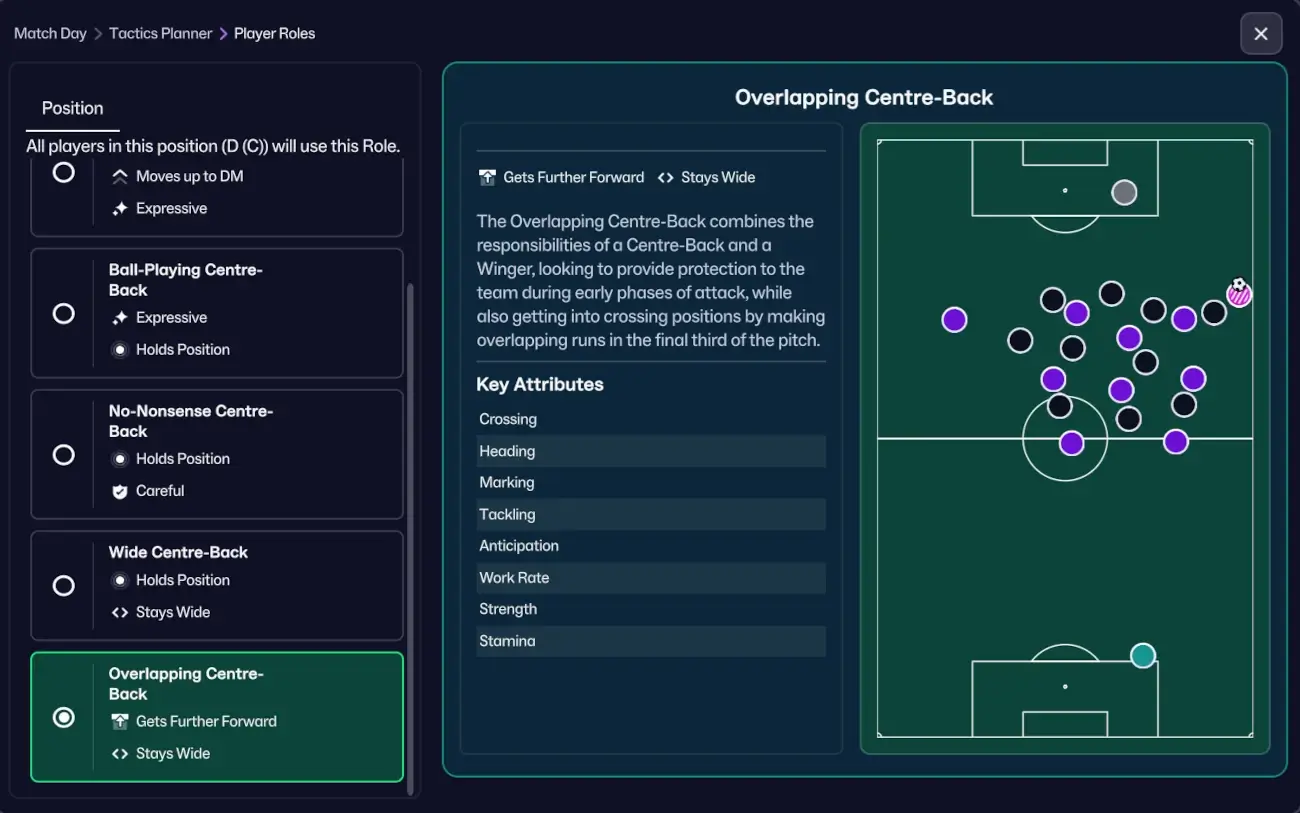
As one of the new player roles in Football Manager, the overlapping centre-back transforms a nominal defender into an auxiliary wide or midfield presence during attacking phases – from here he can become an additional attacking threat – making it harder for the opposition to pick up all players.
In Football Manager 26, this role is available for one of the outer centre-backs in a back three shapes, either on the left or right, where the player is instructed to ‘bomb forward’ and push high and wide in the attacking phase to overlap the wing-back. By entering the final third by aggressively step up from their ordinary defensive position, the overlapping centre-back can push up into the half spaces to make assists and create goals – becoming an additional threat the opposition may not have anticipated.
This brings another layer of fluidity to your tactics – blending positional control as it won’t leave your defence exposed in one phase of the game, by adding an extra defender, with wide overloads and extra crossing opportunities when the team enters the final third – helping your side to get an extra attacker when they have possession of the ball.
As you may anticipate, this is a rather complex tactical strategy that provides an extra element to the team’s attack.
For anyone who are searching for a tactical solution to stretch the opposition and disrupt defensive organization, the overlapping centre-back can be a wonderful option to increase width in your narrow, central overload dominated tactic. When that is said, it’s also a smart strategic solutions when you want to create more wide overloads if you’re struggling to create goalscoring opportunties through the middle – perhaps due to the opposition’s defensive block and their defensive organization.
Best Formations & Shapes for the Overlapping Centre-Back
In Football Manager, the overlapping centre-back is a sophisticated role most common within three-at-the-back formations. For any managers who favours defensive structure and numerical superiority in all phases of play it’s a player role with a lot of cleverness which adds an extra layer to your team’s attack through both tactical discipline and penetration.
One of the greatest benefits of the Overlapping Centre-Back role in Football Manager 26 is through the positional rotations the player role can offer to your tactical shape.
To get the most out of the role, it’s most powerful in a back three system such as the 3-5-2 or 3-4-3, and all its variants, but is also suitable within a 3-3-3-1 / 3-3-1-3 formation.
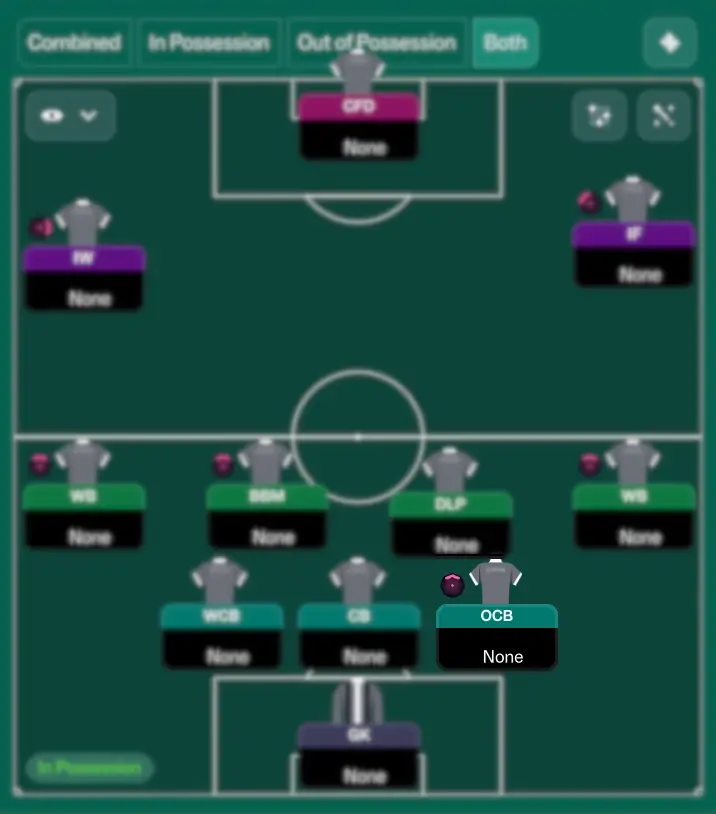
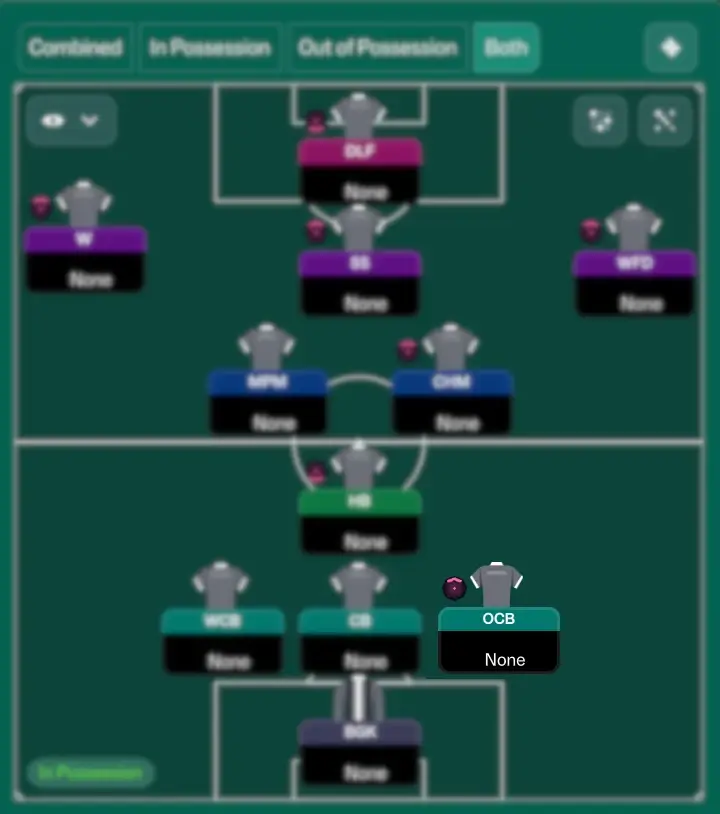
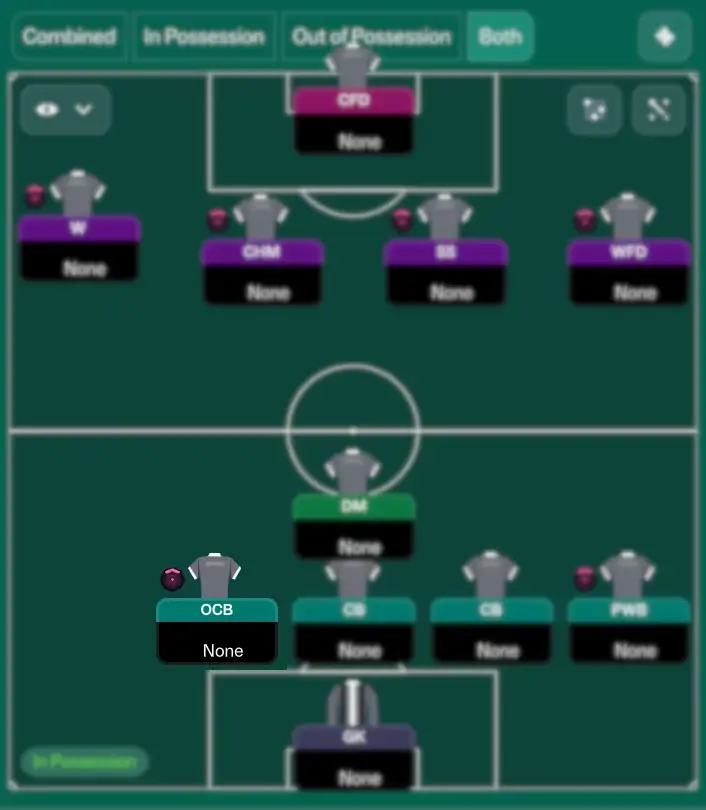
Within a Johan Cruyff-esque 3-4-3 diamond system, this role becomes especially powerful due to the structure’s inherent central density since there are none natural Wing-Backs within the system but choosing it adds even more risk to a highly attacking structure.
Overall, the role becomes a tactical solution to stretch and disrupt the opposition’s defensive organization and shape – enabling you to get numerical supriority in the attacking third by freeing up the defensive responsibilities of one of your centre-backs when the team is entering the final third.
Although it can be a highly powerful role in a back three system, this role can also be used in an untraditional back four system to replicate certain 3-2-5 positional play systems where you opt for the overlapping centre-back rather than the Inside Full-Back.
In fact, I initially tested the OCB to replicate the role of Jules Koundé for my interpretation of Hansi Flick’s Barcelona tactics but discovered it didn’t fully replicate the correct shape when building out from the back, so was forced to scrap that role for the most realistic tactical recreation.
However, the role can be used to replicate a 3-2-4-1 attacking structure if you’re using a Playmaking Wing-Back or Inside Wing-Back on the other side, as seen in the illustration above.
Which tactical styles fits the OCB role on Football Manager?
The nature of the role makes it probably best suited for managers who favours to control the game through possession and work the ball patiently up the field. However, it can be used across other tactical styles than just possession-based football philosophies, for instance in a more fluid counter-attacking system, gegenpressing tactics or within Wing play tactics, as it’s a highly dynamic role that fits the modern trend of universalism in positions.
As you’ll discover, the overlapping centre-back is quite a versatile role in terms of tactical style, but can be seen as a rather specialist role – one that requires specific abilities of your defender(s) and limits your preferred formation into a three-at-the-back system.

The Quiet Game-Breaker: Channel Midfielder Player role Guide
Sometimes, the most dangerous player on the pitch isn’t the one on the ball, but the one attacking the space no one else sees. Just like the Overlapping Centre-Back the Channel Midfielder is one of the meta roles in FM26.
Learn how to incorporate the CHM role in your tactics.
What’s required of the Overlapping Centre-Back? Key Attributes
Unlike the traditional centre-back role, the OCB is quite a physical demanding role, which requires both great tactical intelligence as well as decent ball control. It’s not a role that fits every player and who you choose to play in the role may have a huge impact on how well the player executes the role.
As you’ll experience, an effective overlapping centre-back must possess a hybrid skill set:
- Ball Carrying Ability: Confidence in advancing with possession
- Spatial Awareness: Understanding when to overlap versus hold position
- Crossing and Passing Range: Ability to contribute meaningfully in the final third
- Recovery Pace: Capacity to transition quickly into defensive phases
- Tactical Intelligence: Awareness of team shape and rotation responsibilities
Key Attributes: Overlapping Centre-Back
In Football Manager, the key attributes for the Overlapping Centre Back is:
Technical
- Crossing
- Heading
- Marking
- Tackling
- Technique (Secondary)
- Dribbling (Secondary)*
- Passing (Tertiary)
- Long Shots (Tertiary)
Mental
- Anticipation
- Work Rate
- Off the Ball (Secondary)
- Aggression (Secondary)
- Positioning (Secondary)
- Decisions (Secondary)
- Bravery (Secondary)
- Composure (Secondary)
- Concentration (Secondary)
Physical
- Stamina
- Pace
- Strength
- Acceleration (Secondary)
- Agility (Secondary)
* Unlike traditional overlaps from full-backs, centre-backs often begin deeper. Therefore, they must be comfortable carrying the ball forward over longer distances, breaking lines through dribbling rather than immediate off-ball runs.
The Perfect Overlapping Centre-Back?
If we’re taking a closer look at other players who have thrived in that role over the past few years there are often versatile defenders who might as well perform as an Inside Full-Back or as a traditional Full-Back. However, these players may lack excellent attacking abilities but is better than a traditional centre-back in regards to those on-the-ball skills, e.g Dribbling, Crossing, Finishing and Long Shots.
If you’re looking for the perfect Overlapping Centre-Back in Football Manager 26, one player stands out: Yann Aurel Bisseck. Apart from being able to dominate in aerial situations both with his Jumping Reach, Strength and height (196cm), the German defender has decent Off the Ball Movement, great Stamina, decent Dribbling and Crossing apart from those key attributes for a Centre-Back.
Another interesting prospect is Kanta Doi, the 20-year-old Japanese wonderkid who stands out for Dribbling (12), Vision (14), Passing (16), Aggression (16) and Flair (12) – making him a great candidate to play as Advanced Centre-Back or Ball Playing Centre-Back apart from in the OCB role.
As you’ll see from the screenshots below, I’m using 18-year-old promising Schalke talent Mertcan Ayhan as Overlapping Centre-Back – a player who could also be used as a Half Back.
If you wish to use the Overlapping Centre-Back within your Football Manager tactic, you can either retrain defensive Fullback with decent attacking abilities, or prioritize turning Defensive Midfielders into an aggressive Centre-Back who pushes forward.
What’s the Difference Between the Overlapping Centre-Back Role & The Wide Centre-Back? How the OCB Behaves Within the Match Engine
So far we’ve given you a brief insight into the overlapping centre-back role in Football Manager but to fully understand the strengths and weaknesses of this new player role in FM26 we need to examine his movement patterns within FM’s match engine. Over the next chapters we’ll look at what you can expect from this role within the match engine, and how it may relate, or differ, to one of the other centre-back roles – the Wide Centre-Back.
In the Build-Up Phase
On the surface, you might discover that the Overlapping Centre-Back role in FM26 seems quite similar to the Wide Centre-Back, but there are some important differences that accelerates the role into one of the most overpowered roles in Football Manager 26.
In the build-up phase, the overlapping centre-back will stay in line with the rest of the defence just like any other centre-backs. Similar to the Wide Centre-Back, the OCB role will stay wider in the build-up phase – moving into their respective half space channel. This helps to protect against movements between the channels and other counter-attacking initiatives as it occupies the half space channels.
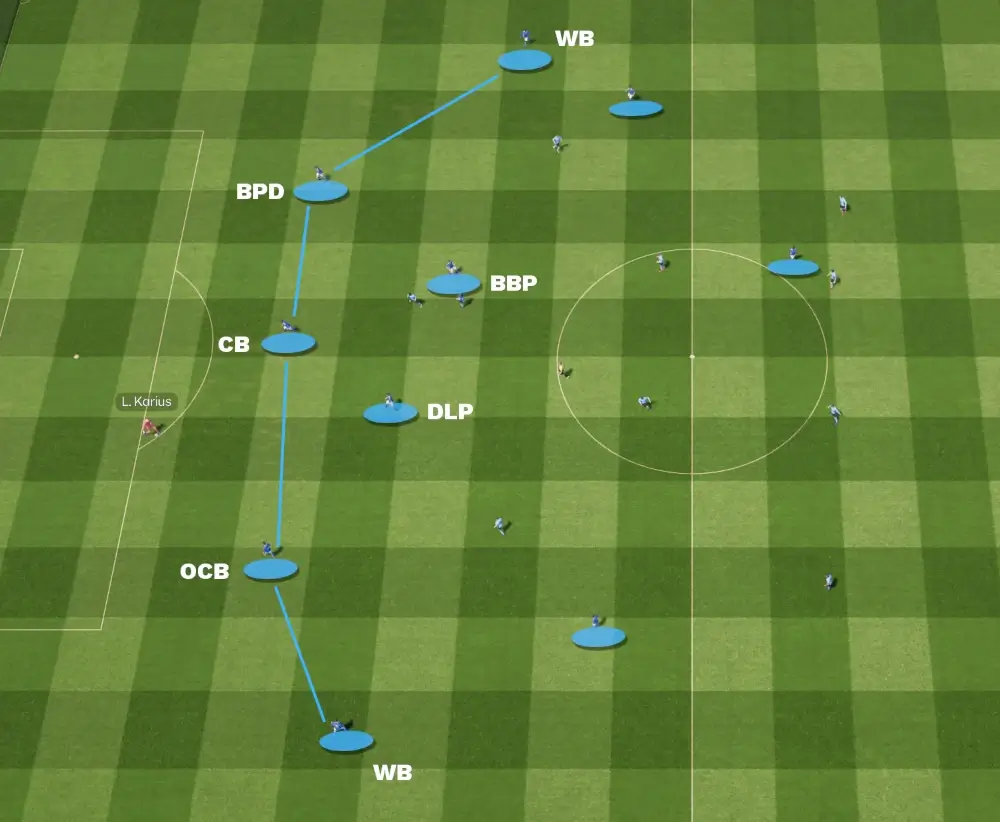
When building out from the back, this player role in Football Manager, aids ball circulation and switches of play as there are more passing options for both the goalkeeper and the middle centre-back. It also provides perfect cover for the wing-back and offers back passes and defensive cover if the attack breaks down, as the player can receive cut backs and diagonal back passes.
The Overlapping Centre-Back role is along with the Wide Centre-Back a strategic role against teams who presses high by enhancing ball progression as the player provides triangles and angles that makes it more difficult for the opposition team to effectively press all potential ball receivers. In many cases there will always be an extra player for the team to bypass the press, either in the middle if using a double pivot or through the outer centre-backs.
If you’re using a Defensive Midfielder in front of the back three, it will generate that deep diamond shape that many top teams use these days, for instance if you wish to replicate Paris SG’s deep diamond shape with a 3-1 structure at the back.
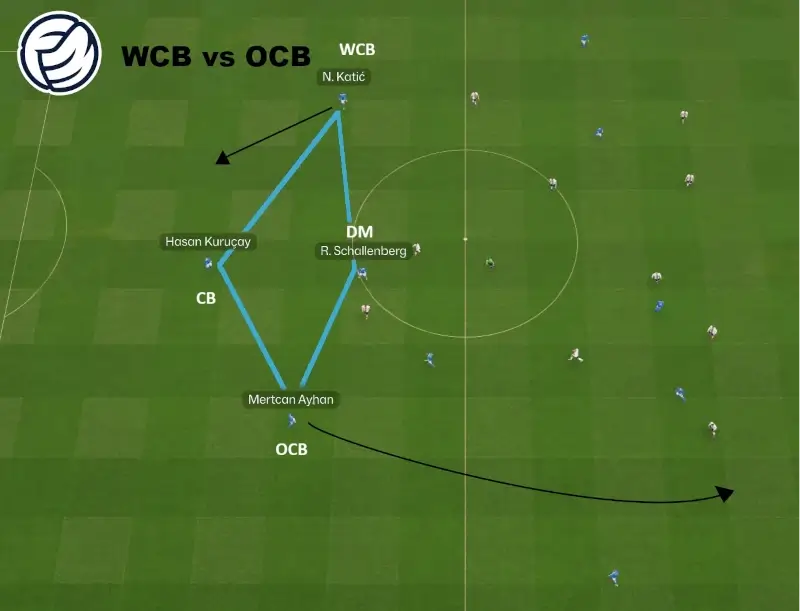
Both roles will enable your team to offer better, cleaner progression from the middle of the pitch towards the flanks – enabling the team to switch the point of attack more easily through the back trio and use the width to come to goalscoring opportunities.
What’s interesting with the overlapping centre-back role in Football Manager is how it can be used against high-pressing team. Not only to effectively stretch the opposition’s high pressing structure, but also as a way to bypass their high-press.
Up against a 4-2-3-1, the wide attackers can man mark the outer centre-backs within a back three system but this leaves the Wing-Backs free of marking – forcing the opposing Full-Backs to push forward and zonally mark the area between the DRC/DCL and the AMR/AML.
Due to the profile of those players who are capable of being used as an Overlapping Centre-Back, these players can easily bypass pressing lines, either by carrying the ball forward, or through progressive passes, taking advantage of their technique and vision.
In Progression & Final Third
Another element besides aiding the ball progression against teams who presses high, the role also offer a clever tactical strategy which may surprise the opposition team through his off the ball movement as play enters the final third.
It’s in the attacking phase the role comes to its force. Rather than using rigid overlaps where Wing-Backs overlap an Inside Winger, the Overlapping Centre-Back helps to create more fluid rotations – adding more width and overloads in a more untraditional way.
As the ball progresses up the field, the OCB will continue to follow the ball path but how far up he moves will depend on the Mentality you use and how he anticipate the following situation – balancing his duty between providing cover and defending against potential counter-attacks and provide extra passing options through completing a passing triangle with the Defensive Midfielder and the Wing-Back.
If you’re patiently working the ball up the pitch through short passes, he will in the progression phase position himself as an extra defensive midfielder – pushing up into the midfield line to overload the half space channel just like the Wide Centre-Back.
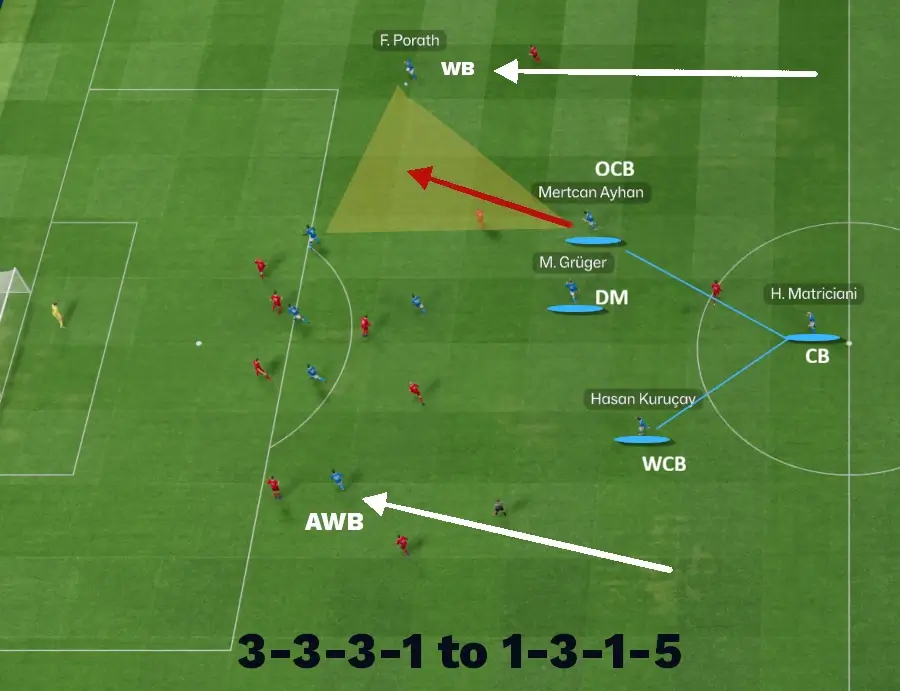
In an attacking shape where central overloads is the primary intentions where half spaces are occupied by #8s and #10s and wingbacks invert into DM, the overlapping centre-back, as the player role’s name perfectly suggest, will advance beyond the wing-back and into wide attacking areas during the possession phase and make more overlaps on that side.
One of the greatest differences between the Wide Centre-Back and the Overlapping Centre-Back is in their behaviour when the team is in the attacking third, for instance in settled attacks.
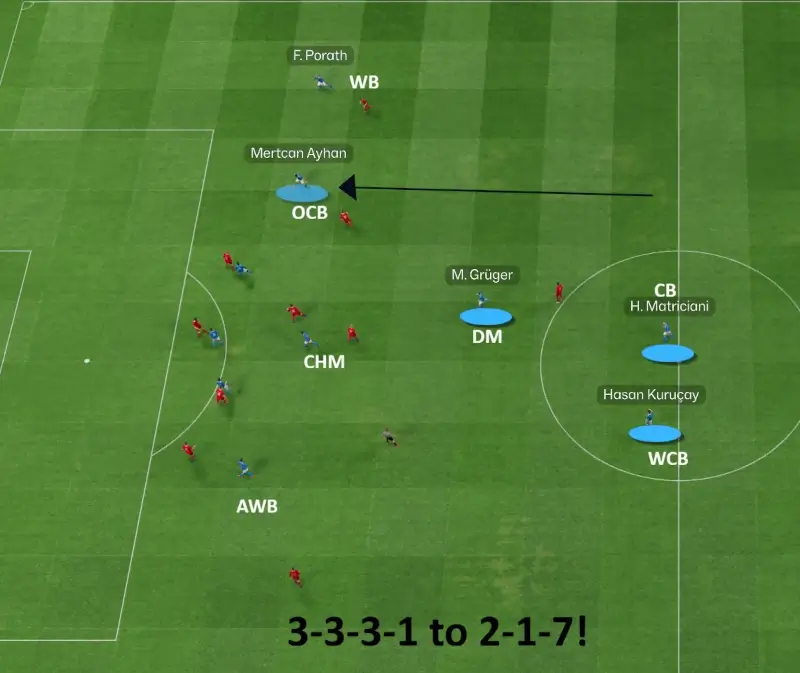
If you’re using the WCB, you’ll discover that this role will be slightly more conservative than the OCB. While the WCB will hold position the OCB will make more forward runs – either running with the ball (e.g trait brings ball out of defence), moving on the inside or outside of the winger / wide midfielder – all depending on the type of selected supporting runs you desire for your team.
Once he decides to move forward, there will be one less defender in the rest defence – for instance turning your 3+2 shape into a 2+2 shape depending on what roles you use within your double pivot as it may also become a 2+1 shape if using a box-to-box midfielder/playmaker next to a holding midfielder.
Once the Overlapping Centre-Back advances forward, acting more like an extra attacking midfielder than a centre back, he becomes an additional creative or goal threat, which may be very difficult for the opposing team to pick upon.
Once advanced, the overlapping centre-back has multiple options:
- Deliver crosses from wide areas
- Combine with the winger or attacking midfielder
- Make decoy runs to create space for others
In settled attacks, the player will often camp on the edge of the penalty box – being in position to take control of bouncing shots, lay offs, or back passes from the wide player or other supporting passes from those under pressure.
His smart positioning between the lines makes the player come to goalscoring opportunities – often trying long shots from the edge of the penalty box, or can be on the receiving end of crosses, whilst the Wide Centre-Back holds position to cover for the aggressive forward runs from the Overlapping Centre-Back.
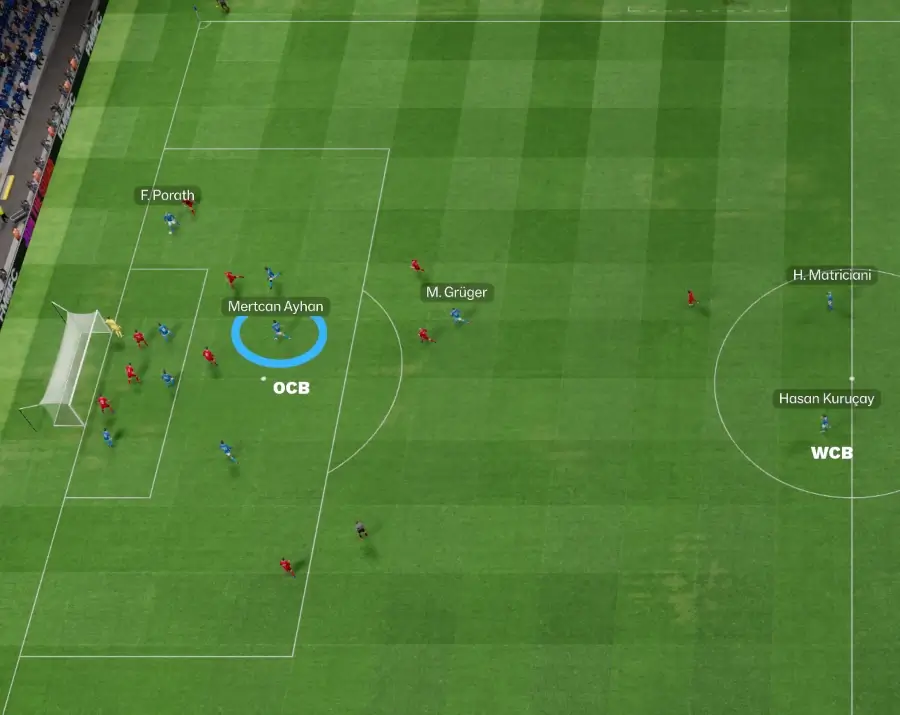
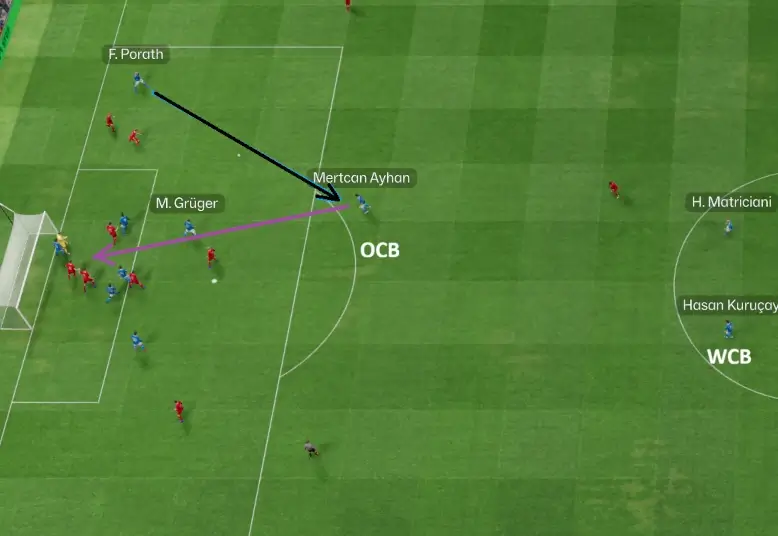
As this illustration reveals, my tactics has transitioned from a 3-3-3-1 formation to an unbelieable 2-1-3-4 / 2-1-7 shape once play enters the final third.
It’s important to note that these illustrations has been captured with an Attacking Mentality. If I had used Positive mentality, the OCB may not have pushed as high up the pitch that early – perhaps considerating risk versus reward by pushing so far out of his position to help his side in the final third.
Overlapping Centre-Back: The Perfect Fit for High-Pressing Systems
One of the most fascinating aspects of this Football Manager player role is not only the ability to have an extra player both in defensive situations and as play enters the final third, turning a centre-back into a goal threat. Since the role pushes so high the pitch when the team is in control of the ball, the OCB role is the perfect fit for any sides who wish to dominate the opposition in their own half.
It’s a smart strategic solution if you’re considering using an high press where an higher defensive line and counter-pressing to regain possession of the ball as high up the pitch as possible, or to recover possession as soon as the ball is lost, is part of your tactical identity.
Traditionally, centre-backs has often the aggression, anticipation and positioning, timing in tackles and dives to regain possession switfly, and help his side to delay the counter-attacking initiatives from the opposing team if the ball is lost in the attacking or middle third.
The Strengths & Weaknesses of the OCB Role: Tactical Advantages & Disadvantages
Taking advantage of what the overlapping centre-back role has to offer, can quickly turn your average Football Manager tactic and elevate it into one who dominates over your opponents. As we’ve briefly touched upon, there are several strategic advantages with the role in FM26:
- Unpredictability: Opponents are generally unaccustomed to tracking centre-backs making advanced wide runs. This creates hesitation and confusion in defensive assignments.
- Centre-backs stepping into midfield or wide areas can bypass pressing lines, particularly against high-pressing teams.
- Width without structural compromise
- Numerical superiority in wide areas – enabling teams to create 2v1 or even 3v2 situations against opposition full-backs and wingers.
- Enabling more positional rotations when the centre-back advances which disrupts and/or confusing the marking scheme of the opposing team through the player roles you choose around the OCB, for instance if you ask your wing-back to invert and your central midfielder to move into wide areas.
The Risks?
Despite there are several benefits by using the overlapping centre-back within a three-at-the-back tactic, the role carries inherent risks.
If you’re building a tactic in Football Manager, I would suggest to be conservative with the number of overlapping centre-backs you use within your tactics.
Defensive Exposure
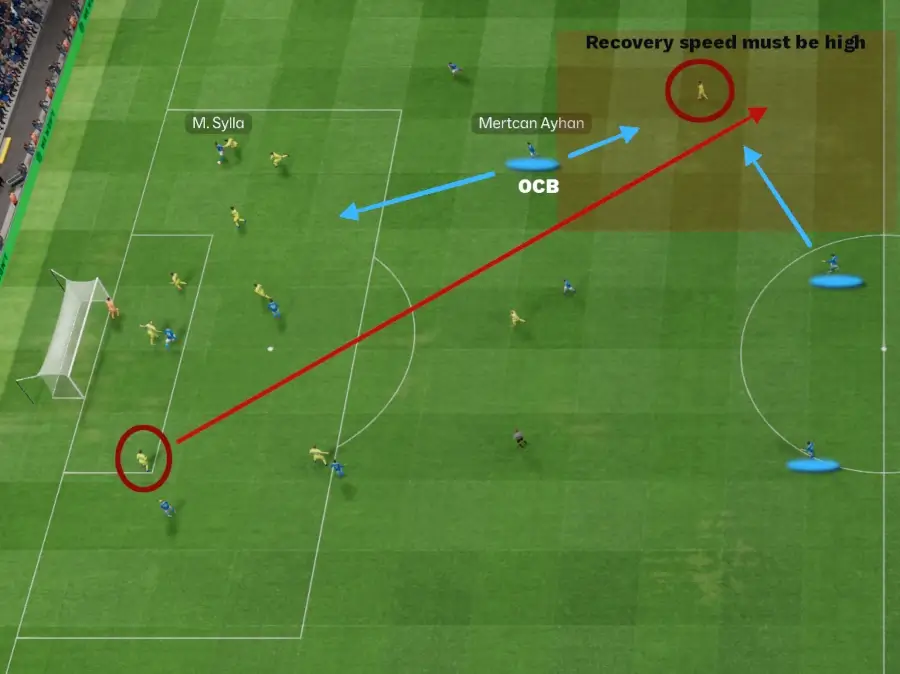
One of the greatest concerns is relating to the defensive exposure the role carries. Just imagine how exposed you are if possession is lost while the centre-back advances forward as the team may be vulnerable to counter-attacks, particularly in the vacated channel.
Since the role increases the vulnerability at the back, it puts extra demands on you to carefully balancing your tactics with player role combinations that fits each other to get the most out of the overlapping centre-back without leaving your defence exposed for counter-attacks.
Personally, I would shy away from using two overlapping centre-backs within your tactics because of how much they push out of position. Even when using one OCB in your FM26 tactic, you would need good defensive cover through the role you choose for your defensive midfielder(s). Ideally, when using the overlapping centre-back role in your Football Manager tactic, I would prioritize using it within a system with a double pivot where at least one of them are holding position.
Physical Demands
With a role that travels so far out of their ordinary position, the player requires good recovery speed, stamina and acceleration to get back into position if possession breaks down. These are not necessary attributes traditionally associated with centre-backs – meaning the pool of suitable players is limited. Therefore it’s not a role for any teams.
Tactical Discipline
Another element is the player’s tactical discipline and intelligence. You need a smart player in that role – one who understands when it’s useful to get forward or stay in cover. Poor timing or miscommunication within the back line can destabilize the defensive structure, especially if covering rotations fail.
His tactical discipline, decision-making and ability to position himself correctly is not only relating to out of possession. The player must also understand when it’s logical to try to shoot from long range, when to get forward, or when to pass the ball. In one of my matches, Mertcan Ayhan completed 4 key passes in one game – showcasing the OCB’s fascinating role as a creative threat – one who generates chances for others.
If you can find a player with good technique, vision and passing, you’ll discover that the player in the OCB role can make lots of key passes, assists and basically become that tertiary creative threat.
How to Get the Best out Of The Overlapping Centre Back on FM26?
As you’ve discovered, this role can offer something unique to your Football Manager tactics and catch the opposition off guard through the role’s default behaviour both on and off the ball but to fully make the role as its most powerful, there are certain things to do to improve his performances.
Let us take a closer look at how to get the most out of the overlapping centre-back on Football Manager.
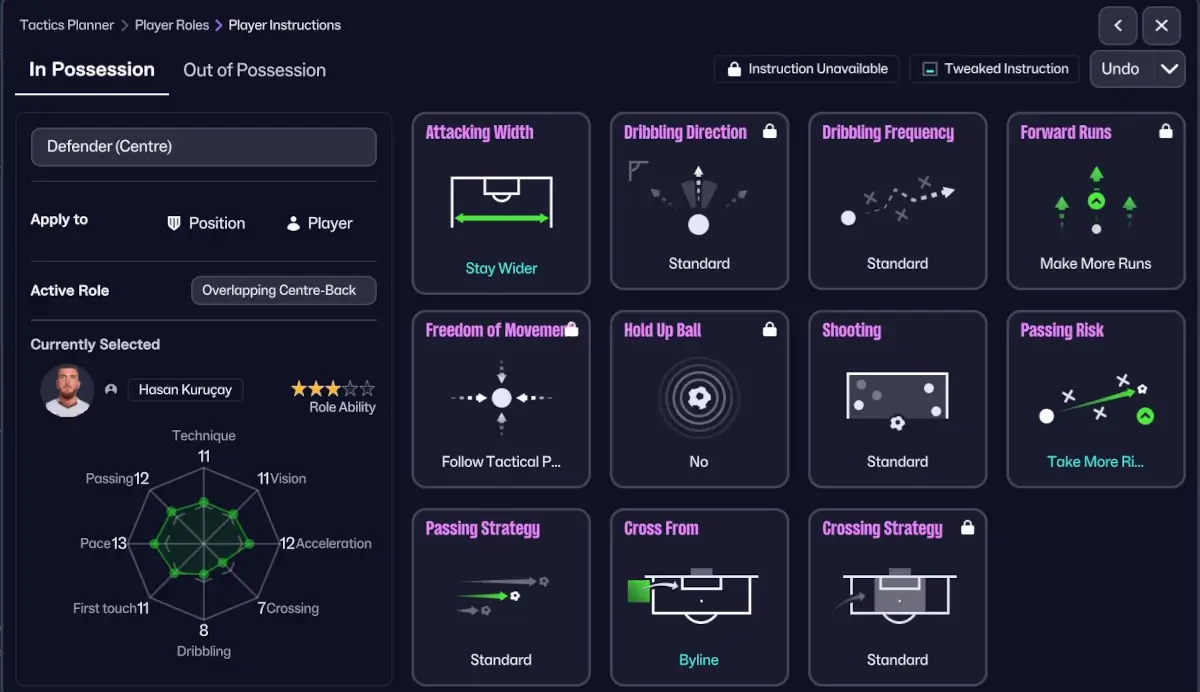
If we look closer at the player instructions of the Overlapping Centre-Back, his default behaviour is to Get Forward Whenever Possible but to fully take advantage of what this FM player role has to offer, there are certain player instructions to enable.
One option is to ask the player to Stay Wider.
This looks to stretch the opposition and make him into a creative threat who moves slightly further. It’s especially effective if you’re using a Wing-Back who moves inside into DM position, or you’re not using any Wing-Backs within your system at all.
By asking the player to stay wider you’ll also be able to maintain an higher wide coverage within your system – more easily creating 2v1 or 3v2 situations down the flank.
If you want the player to come to more crossing opportunities, making the player act more like a Full-Back in the attacking third, I would recommend you to select Team Instruction: Overlap (on the side he’s playing on).
If the player possesses good Crossing, you could instruct the player to Cross from the Byline. This will further push the player out of position as you’ll be instructing the player to move towards the byline to get into crossing positions.
NB! Cross From Deep is unavailable since it’s incompatible with the player’s position, which limits the possibilities of editing player instructions to Shooting, Attacking Width, Passing Risk and Passing Strategy.
Conclusion
The overlapping centre-back represents a sophisticated evolution in positional play, redefining the responsibilities of defenders in modern football. Within a 3-4-3 diamond system, the role addresses structural width limitations while enhancing attacking fluidity and unpredictability.
Its successful implementation depends on precise timing, coordinated rotations, and players capable of executing both defensive and attacking duties at a high level. When deployed effectively, it not only expands the tactical toolkit of a team but also exemplifies the broader trend toward positional versatility in elite football.
Ultimately, the overlapping centre-back is not just a role – it is a reflection of football’s ongoing shift toward dynamic, interconnected systems where every player contributes across multiple phases of play.
The overlapping centre-back is particularly effective against:
- Low Blocks: Adds width and crossing options
- Man-Oriented Presses: Exploits rigid marking structures
- Narrow Defensive Shapes: Forces horizontal stretching
However, it may be less effective against teams that:
- Maintain strong wide defensive coverage
- Counter-attack quickly into vacated spaces
- Use wing-backs or wide midfielders to track runs diligently