


Around 50 years after Viktor Maslov and Rinus Michel revolutionized football by using pressing as a tool to regain possession, the rise of technological enhancements and use of statistical data through science has made the art of pressing not only smarter but a key component to success in today’s game.
Whether the managers relies at mastering the press to win back the ball high up the pitch, which was made mainstream by the success of Total Football, or are embracing the chaos of the first seconds of an attack by using pressing traps as a way to score goals from turnovers, pressing the opposition is vital to win back possession regardless of how integrated it is in the team’s tactical identity.
After the dominance of Pep Guardiola’s Tiki-Taka style of play between 2009 and 2013, which was an evolution of the Dutch Total Football, how team’s aim to counter the opposition to win possession has really seen a great change.
While managers like Pep Guardiola, and his disciples, uses pressing as a tool to control and dominate the opposition by turning to a high press that squeeze the play into the opposition’s defensive third, others like Marcelo Bielsa and his disciples e.g Andoni Iraola, uses pressing to instil chaos. Their approach to counter the opposition is to try to eradicate all pre-made plans the opposition has, both when building out from the back or in their quest to enter the final third.
While the core intention of pressing the opposition still lives, what is evident is that there are several ways to success!
Today we will take a closer look at the different pressing styles and how to master pressing in Football Manager.
In this Guide to Pressing in Football Manager
From taking a deeper look at how to use the high press effectively on Football Manager to what’s the core principles behind counter-pressing, we give you the ultimate guide on how to win possession and regain possession of the ball effectively and intelligently through understanding the art of press.
By continue reading you will not only get a deeper understanding of the different pressing styles, their weaknesses and strengths, what’s required of your players to take advantage of a high pressing tactic on Football Manager and how to press the opposition using the high press, mid-block or counter-pressing.
So if you have ever wondered how pressing actually works in Football Manager, this is your chance to comprehend one of the most fundamental aspects of modern day football, and take that knowledge into the beloved game.
What is pressing?
Throughout the entire history of football, the objective of the game has been to score goals and thereby win the match. But what do you do if you’re not in possession of the ball?
Pressing is a tactical strategy where the team works at regaining possession of the ball whether directly by aggressively close down the opposing player with the ball, or indirectly by squeeze the play and create numerical advantages around the ball zone to try to win back the ball in the next phases of play with correct player positioning and tactical understanding of the game’s situations.
Pressure can be applied either by certain individuals, specific units or as a team but it will be more successful if pressing is done collectively with a strategic approach where all players press the opposition according to a plan, rather than chasing the ball aimlessly all over the pitch, as we did in our childhood days on the playground.
Although there are circumstances where an individual player initiates the press with a purpose, there are more cons than pros when an individual chase the ball aimlessly. Not only will the player be pulled out of his position and make the team’s shape unbalanced, but he will also use a lot of energy by closing down the ball carrier at every circumstance which will tire him out quicker than if pressing was done as a coherent unit.
Pressing the opposition requires a greater level of communication between the players to take up sensible positions to initiate a pressing action. Therefore, it’s a skill that requires time and adjustments to ensure the players fully comprehend the team’s pressing style and intensity.
What are the objectives & benefits of utilizing pressing?
The intention of pressing the opposition is to apply pressure on the player with the ball and limit their options, forcing mistakes or hurried decisions, for instance by actively using pressing traps.
The objective with pressing as a tactical tool are threefold:
- Limit space or time available for the opposition and the opposing ball carrier
- Regain possession in favourable zones that might lead to better goalscoring opportunities
- Result in turnovers and launching quick counter-attacks by winning possession when the opposing team is unbalanced
In many ways, it’s a rather proactive tactical skill where pressing is used to try to regain possession – quite the opposite of teams who sit back in a low block and simply waits to recover possession after loose balls or opposing errors.
For managers one of the objectives with the principles of pressing is to try to influence the opponent’s decisions with the ball and thereby control the situations by how the team apply pressure.
Pressing the opposition can be utilized in all areas of the pitch, either as a strategy to win back the ball, by closing down the ball carrier, to delay the opposition and their quest to enter the final third, or as a tool to dictate the play. Besides that, utilizing pressing has many other benefits outside just trying to win possession.
- To disrupt build-up play & use pressing as a tool to cause chaos in preset situations where the attacking team might have a solid plan to progress the ball towards certain players, or into certain areas of the pitch.
- To force errors, hurried decisions or instil insecurity for the ball carrier that eventually leads to misplaced passes, poor touches & other favourable situations to initiate a press
- Controlling the tempo of the match by forcing square passes or backward passes that reduces much of the sting in their attacking play. Pressing can help to dictate the pace of the game by unsettling the opposition and thereby prevent them from settling into a comfortable rhythm that may be advantageous for them to out-play their opponents.
The Different Variations of Initiating a Press
Regardless of the pressing intensity, any teams use a variety of pressing styles – often within the same match.
To entice the opposition to make an action on the ball, it requires that the team uses several variants of the press throughout the course of the match.
Basically, there are three variants of pressing: full press, half press and fake pressing.
Throughout matches, any teams will use some kind of variant of these three methods.
It all depended on how the match evolved and whether the team required to conserve energy, re-find their balance or chase the ball for the important equaliser. Then it’s a matter of the strengths of the opposition and how you envision it’s best to counter it, when chasing for the ball.
Full Press
Some managers may favour an aggressive press which looks to harass the opposing player as soon as they receive the ball to force mistakes and hurried decisions by pushing up and limit space and time for the man on the ball, which is known as the full press.
Half Press
Other managers may favour to be smarter in their pressing strategy by setting up pressing traps that aims to reduce the passing option of a certain player in a specific zone of the pitch – enabling the team that is hunting for possession to win back the ball in favoured areas of the pitch – something that may enable the team to attack in a specific way once possession is won.
Perhaps denying the opposition to play their game as soon as they enter a specific part of the field.
By utilizing the half press, the team might draw an imaginary line that invites the opposition to play until they reach that part of the field before the defending team tries to prevent them from entering more dangerous areas of the pitch by blocking off progressive passing options.
Fake Pressing
Finally, the third variant of pressing is the fake pressing. It is often used to trick the opposition into rushing their actions – for instance when playing out from the back or when holding up the ball and slowing the tempo down.
By utilizing fake pressing, one or two players within the team tries to close down the ball carrier while the rest of the team drops off in a coherent manner – making sure it forces an action, a rushed decision, from the ball carrier that might enable the defending team to intercept a poor inaccurate pass. As you might envision, this might be a highly successful if using the high block and there are few metres between each player.
However, fake pressing could also be used in the important seconds after losing the ball in crucial areas of the pitch and thereby delay the transition. While the two players closest to the ball zone presses the ball carrier and perhaps forces square passes or a backward pass, it gives the team the opportunity to re-group into a more balanced shape – meaning it’s a crucial part of aiding the transition from attack to defence.
Although some managers have certain tactical philosophies they favour, how or when to press the opposition will vary both in intensity and length over the course of the match according to how the game unfolds – making the team utilize different pressing styles over the course of the match.
We’ll examine the different pressing styles more closely later in the article.
What is pressing triggers?
A key component of the art of pressing is to use pressing triggers to increase the chances of regaining possession.
Pressing triggers are situations where the team receives a cue of when it may be favourable to initiate a press.
They work like a tactical instruction where a favourable situation arises that alerts the defending players to initiate a press. It enables the team to know when to press in different areas of the pitch – according to the upcoming situation and what may be most favourable according to the team’s tactical plan.
By increasing the intensity and aggressiveness of closing a player down in these situations, it increases the probability of regaining possession.
In many ways, pressing triggers enables the team to structure their overall pressing scheme but can also be a signal for the defending player to close an opponent down by limiting the space and time for the ball receiver. At the same time, the team can establish specific triggers that coordinate the movements of the players according to the action from the first defender, the location of the ball on the pitch, or the desired game model. Perhaps you want specific players screening an opponent at build-up and pushing up onto that player immediately after a pressing trigger at a certain positions happen.
They enable the players to know how to react to certain situations where it’s a greater chance of winning back the ball, whether it’s a signal of when to close down, tackle, force the player to a specific side, or simply stand off – all depending on the strategy the team favours, and the increased risk it represents to press compares to holding their shape according to how the match unfolds.
The most common pressing triggers are:
- Poor touch or hesitation by the opposing player, which may signal poor concentration or ball control
- When the opposite player receives the ball with the back to the attacking direction – when the player faces the goalkeeper and is struggling to comprehend what is happening behind him, or in any situation receives a slow pass that might not reach him
- When an opposing player makes a backward pass or a pass into space, it may be used as a signal to press. This enables the team to squeeze play and push their defensive line higher up the field.
- In situations where the player receives the ball out wide, towards the touchline and there are fewer options to progress the ball due to the restricted playing area.
Other pressing triggers are:
- If a player looks down on the ball and focuses more on controlling the ball rather than what’s happening around of him.
- High balls, hard passes, bouncing balls and other circumstances where it may be difficult to get control of the ball for the receiver
- If a player makes a slow or slightly inaccurate pass which is made horizontally or diagonally. At the same time, poor passes can be influenced by the defending team. For instance, by forcing the attacking player to use his weaker foot which may increase the probability of making an inaccurate pass that can more easily be intercepted
- If a player is forced to receive the ball with his weaker foot and needs to turn to face his teammates.
As you’ll discover, most of these pressing triggers are situational but can also be influenced by the defending team based on their pressing intensity and level of engagement to force the ball into desirable areas to aggressively chase the ball.
For instance, the defending team might try to show the ball onto a player’s weaker foot to increase the probability of a poor pass. Or a player might close down the ball carrier to force him to turn and make a backward pass, which enables the defending team to close down passing lanes, or in general restrict passing options in the next stage of the attacking play for the opposition team.
Although, a player may naturally react to a ‘trigger’ that makes him believe there is a greater chance to win possession and thereby run forward to close the player down, it may be more advantageous if the manager instructs his players to only react to certain pressing triggers in specific areas of the pitch. This ensures that pressing is done as a collective action rather than one or two individual players pressing the opposing ball carrier when they feel like it.
In this aspect, it’s important to remember that whenever a player run forward to close down the ball carrier, it will leave vacant space behind him to exploit for the opposition team – meaning the defending team must consider risk versus reward when reacting to these situations.
For instance, just imagine how unbalanced the defending shape would be if an individual chase the ball all around the pitch. Not only will the player be jaded after a while of chasing the ball, but against a great possession-based side, they will easily play around any team initiating individual pressing. Instead, pressing is more successful when it’s coordinated and planned.
What are pressing traps?
Pressing traps are any action the team actively seek to make to increase the probability of regaining possession. A pressing trap is usually executed by several players at once where they squeeze play or deny passing options by taking up appropriate positions that forces a pass towards certain players or specific positions.
Teams can set up pressing traps all over the pitch, but it’s probably more effective to target weak positions or weaker players by limiting his options and thereby try to reduce his effectiveness with the ball, for instance by affecting their passing range or accuracy.
One of the most traditional pressing traps is to force passes towards the flank by setting up a narrower front line that block off central passing option. Aided by the touchline and with two or more players in the first line of defence squeezing time and space for the fullback (or winger), pressing the player may reduce the number of available passing options to perhaps only one viable solution that the defending team has control of.
For instance, setting up pressing traps out wide against teams who uses a shape with a single wide player, e.g the 3-4-3 narrow or 3-5-2, can be an advantageous strategy to regain possession.
Another advantageous pressing trap may be to force the ball towards a player who lacks the technical abilities, composure, concentration, vision or anticipation to find the appropriate solution in stressful situations. For instance, if the team is playing out from the back, it may be useful to target the weakest player in the back line and force the less technical player to build out from the back by opening passing lanes towards that player.
To achieve this, the team may set up a hybrid press where certain players are man marked whilst the weakest target is left unmarked, but his positional area is zonally marked. This aims to force passes towards the player and block off any other passing options available for the ball receiver.
Then the team can execute a pressing trap towards the only viable passing options for the player who is tasked to play out from the back, for instance the defensive midfielder.
To succeed at setting up pressing traps it requires the players to make correlated movements where a player initiates a light press onto the ball carrier to force an action that moves the ball into a more desirable area where the team has a numerical advantage to press more intensively for a short time.
Often, this is achieved by the forward, or any other specific position. When and how he initiates the press will work like a signal for the rest of the players behind him to initiate the pressing trap. If one player doesn’t commit to the plan, the pressing trap will fail.

It may be as little as the player is a few metres too far away and reacts to slow – meaning he doesn’t manage to push forward and help his teammates to set up a working pressing trap.
While pressing triggers can be used regardless of the opposition, pressing traps will often vary according to the opposition’s strengths and weaknesses, their current shape or balance within specific match scenarios. It’s often used to counter specific strengths within the opposing line-up.
The key is to create superior numbers around the ball zone by ensuring all players are taking up sensible positions that helps to limit time or space for the opposing receiver.
It requires that the manager considers the strengths and weaknesses within his own system before considering where it’s appropriate to set up pressing traps. A narrow 4-2-3-1 system may be compact in the middle of the pitch, meaning it’s easier to win possession if pressure is applied to the single holding midfielder in a 4-3-3 system.
Here the team can take advantage of back pressure from the forward along with synchronized movements from one of the wingers, the attacking midfielder and one of the players in the double pivot to block off any notable passing lanes for the playmaker.

With several players closing the player down, the player might be forced to turn and a player coming from the blind side could try to steal the ball by pinching the ball out of his control or intercept any passes he makes.
As you can see, your understanding of formations and their strengths and weaknesses over other formations will come to force.
The different pressing types in football
In modern football, pressing has become a crucial aspect of the game. It’s not just about attacking and defending—how a team presses and when they press can define the rhythm of the match.
For some manager’s pressing is a strategy used to win the ball back as quickly as possible, disrupt the opposition’s play, and/or initiate counter-attacks. Over the years, different pressing styles have evolved, each with its strengths, weaknesses, and tactical nuances.
Let’s dive into the various pressing types in football and explore how they are implemented on the pitch.
High Pressing

The high press is one of the most intense and aggressive forms of pressing in football.
First brought to the world scene by Viktor Maslov in the 1960s and eventually became a dominant feature for any possession-based side, the aggressive high press has become a way of control without the ball.
By aiming to put pressure on the opposition deep in their own territory, the team’s using a high pressing tactic uses fast but highly co-ordinated movements to force errors in the opposing back line and thereby use the second of chaos between attack and defend to create goalscoring opportunities after regaining possession deep in the opponent’s half.
“You win the ball back when there are 30 metres to their goal, not 80.”
Pep Guardiola
This statement reveals one of the major pros behind initiating a high press.
The secret is player’s positioning – both in terms of creating the ideal passing patterns to advance the ball into the final third but their positioning and passing style helps the team to set in a collective press if the attack breaks down.
The founding principle is having good coverage around the ball zone. With players in support and good defensive cover when the team is in possession these players will be paramount if the attack breaks down. Their ‘active’ positioning enables the team to set in an effective press on the opposing ball carrier far easier as they do not need to sprint far to close the space.
Just imagine if the ball is lost in the final third. With players swarming the opposition it enables the team to regain possession in their own defensive third – resulting that the team skip the defensive transitioning and thereby can be in a proactive state of mind in the entire match.
One of the most important concepts behind the high pressing strategy is to instruct the defensive line to advance up as close to the half-way line as possible. By pushing up the defensive line, it will create a compact unit with little space between the attacking and defensive line.

By restricting the vertical space between the lines, it will make it harder for the opposition to play through the lines.
This can be a smart strategy not only in terms of regaining possession in the opponent’s half, but also in the circumstances where the attack breaks down – making the team able to counter-press effectively by swarming the ball carrier immediately after possession is lost.
The managers who apply a high pressing strategy considers the risk of leaving space behind their defensive line with the reward of winning back the ball closer to the opponent’s final third – meaning it is easier to create chances and come to goalscoring opportunities from turnovers, if the ball is won.
For any teams favouring to use a high pressing tactic, finding the appropriate balance of compactness within their shape will be one of the fundamental reasons behind how successfully they are able to press.
“Do you know how Barcelona win the ball back so quickly? It’s because they don’t have to run back more than 10 metres as they never pass the ball more than 10 metres”
Johan Cruyff
The manager must also consider the extra risk of pushing up the defensive line extremely high. The opposition can bypass the press by playing over or around the high press and thereby exploit the extra spaces on the field by playing a rather direct football with long balls over the top and quick transitions using fast-paced running from their forwards to beat the press.
This means that the teams who seek to employ a high pressing tactic requires the right players to get success from such a risky strategy. Not only must the defenders be relatively quick over the first few metres, but their concentration and anticipation should be good in order to intercept moves and long balls before the opposing forward gets control over it. If he does, they should try to push him out wide and further away from dangerous zones in front of the penalty area.
At the same time, the manager must consider the risk of being counter-attacked if the opposing team manages to beat the press and balance his shape with decent defensive cover. Then, it’s important that every player looks to restrict space once the press is initiated.
As Arrigo Sacchi explains it in the Inverting the Pyramid, “the key to everything is to squeeze the space between the defensive and forward line. By using an aggressive offside trap, it made it hard for the teams to play the ball behind them (read AC Milan), while teams looking to play through them (AC Milan), had to break down three barriers in quick succession. This allowed us to not expend too much energy, to get the ball first, to not get tired. […] If we played with twenty-five metres from the last defender to the centre-forward, given our ability, nobody could beat us. The team had to move as a unit up and down the pitch, and from left to right.”
An important part of the high pressing strategy relies on the huge reliance on the players within the first line of defence to put immediate and direct pressure on the ball carrier ‘as often as possible’ and at the right moment.

Not only will the compression of the space in the middle of the pitch limit the space and time for the potential receivers, but also the effect of the opposition’s ball progression when building up play.
By ‘closing down’ the opposition both quickly and regularly, the opposing ball carrier should have less time to figure out purposeful passing options and viable solutions to progress play into more advancing areas of the field.
Over the years, several successful teams have utilized the high pressing tactic to dominate the opposition, either by harassing the opposition in spells to delay the transition, or as an effective way of regaining possession in pre-described situations, for instance when the opposing goalkeeper restarts play.
When to use the high press?
The high press is a tactical concept that most football clubs use these days. While several successful teams and managers have prioritized to use the high pressing tactics more often than others, e.g Manchester City under Pep Guardiola, Liverpool under Jürgen Klopp, Ajax under Erik ten Hag or Benfica under Roger Schmidt, the strategy is most often used at pre-set situations where the team can take advantage of rehearsed movements to initiate the high press.
Our instruction has always been to win the ball back as quickly as possible; to try and win the ball back in six seconds. If you can’t, then set up your block. There are three types of block: low, medium and high. Usually, after these six seconds you can set up your block after not winning it high. The key to pressing is covering your zones, and the system of 4-3-3 gives you good coverage on the pitch, allowing you to press in the right zones of the pitch rather than just chasing around.
Chris Davies, Liverpool FC – Coaching the Tiki Taka Style of Play by Jed D. Davies
For instance, teams may favour to use the high pressing tactic in situations when the opposition tries to play out from the back and uses this tactical concept to disrupt their ball progression when building out from the back.
Others may try to recover the ball as high up the pitch as possible by limiting the number of viable passing opportunities and thereby set up pressing traps closer to the opponent’s goal with the help of the high block.
Aided by the high block and reduction of space in the middle together with man-marking of certain players and close proximity between the players as there are few metres between the lines, it enables the team to close off space and initiate a full press when the appropriate situation to try to regain possession arises.
Utilizing the high block is also beneficial in circumstances where the opposition lacks both speed and creativity in the attacking line to beat the press. By forcing the opposition to make square passes and layoffs, the pressing team can control the game by restricting the opposition to advance as far up the pitch. They are basically forcing the opposition to play a static football that might pressure them into making mistakes closer to their own goal.
We’ll get back to how to apply the high press in Football Manager later on in our guide to pressing in Football Manager.
Counter-Pressing or Gegenpressing
In the wake of the success of Pep Guardiola’s Barcelona Tiki-Taka tactics which relied on a possession game that used pressing as a tool to dominate the opposition in their own third, came another evolvement of the pressing style.
As a nuance to the high-pressing tactic, gegenpressing aka counter-pressing was first popularized by Jürgen Klopp’s heavy-metal football. However, it was Ralf Ragnick who should be credited for labelling this energic pressing tactic despite other managers in the past, such as Arrigo Sacchi, looked at the advantages of pressing in the defensive transition.
The concept of the counter-press is to not only press the opposition high up the field but to prioritize their focus on the first seconds after the ball is lost to regain it as fast as possible. While others may move back into a mid-block or a deep block once the ball was lost, the advocates of the counter-pressing want to take advantage of the unbalance and chaos when the team is transitioning from attack to defence.
“The best moment to win the ball is immediately after your team just lost it. The opponent is still looking for orientation where to pass the ball. He will have taken his eyes off the game to make his tackle or interception and he will have expended energy. Both make him vulnerable.”
Jurgen Klopp
The idea was to counter the counter-attack by quickly and efficiently press the opposite ball carrier as soon as the ball was lost. Rather than simply press at preset situations, e.g. when the goalkeeper should restart play, disciples of Gegenpressing looked at the chaos within the defensive transition to recover the ball and come to goalscoring opportunities.
At this stage, the opposition is most likely unbalanced and there are spaces to penetrate, since the opposition has mostly likely opened up the field to create space to progress the ball through – meaning there are larger spaces between the players making it easier to isolate the ball carrier and cut off passing options if your shape is compact and the pressing is organized.
Just like Pep Guardiola did at Barcelona, they took advantage of their high line and compactness in shape to close down the ball and use their close proximity, great defensive support behind the attacking line to provide the perfect circumstances to win possession as high up the pitch as possible and catch the opposition off guard by utilizing quick and more direct turnovers.
Although Barcelona under Pep Guardiola wasn’t as direct as Klopp’s Liverpool once possession was won, both instilled a rule that pressing should only last for a given time before the team regrouped and dropped off into their desired defensive block.
Pep’s use of the 5-second rule for their high pressing scheme made Barcelona dominate the opposition in their own half as they suffocated the opposition.
Klopp on the other hand, took pressing to the extreme with an even higher intensity in their pressing as they saw pressing as a tool to initiate an attack.
“If you win the ball back high up the pitch and you are close to the goal, it is only one pass away a really good opportunity most of the time. No playmaker in the world can be as good as a good counter-pressing situation.”
Jurgen Klopp
With particular plans for defending against the counter-attacks, the focus was set on positioning, synergic movements and collective pressing that ensured all players are in an ‘active position’, to quote Arrigo Sacchi, to recover the ball.
Pressing is not about running after the opponent or to work hard but about controlling space. […] Our pressing was always collective. I wanted every player to be in an ‘active’ position, effecting and influencing the opposition when we did not have the ball.
“If we let our opponents play in a way they were accustomed to, they would grow in confidence, but if we stopped them, it would hurt their confidence.
Arrigo Sacchi
One of the key components behind gegenpressing is to utilize the speed, aggression, stamina and fitness of the forwards. By asking them to close down as often as possible, or when the situation allowed it, the rest of the team could zonally mark deeper areas of the pitch.
With two to three forwards working in close proximity to each other with the agenda of harassing the opposite ball carrier and use their aggressive press to limit both the time and space for the opposition to make progressive passes, the second line of defence would cut off any obvious passing options.
The idea is that once a player receives the ball, he becomes an easy target and is therefore vulnerable as he needs to control the ball, anticipate movements of his teammates, decide on what is best to do, use his vision and technique to execute the pass, all in the same seconds the opposing marker is rushing towards you.
While you had the players closest to the ball zone frenetically pressing the opposite ball carrier, certain players were ready to get forward as soon as possession was won and thereby attack the opposition when they were unbalanced or in transition.
By pressing from the front with such surgical precision that often ended up the side to regain possession by intercepting loose balls or inaccurate diagonal passes in the midfield line, the only task for the players in the middle was to make a more direct progressive pass towards the front trio immediately, unless the forwards managed to recover possession themselves and could either combine or carry the ball into goalscoring opportunities.
However, with a number of players ready to make direct movements towards the goal as soon as possession was won, they could overload a retreating back line. This differed greatly to Pep’s philosophy when possession was recovered.
For him, he wanted defensive organization to be the cornerstone of his possession-game. Once the ball was recovered, he restarted the build-up and used intricate passing patterns to come to goalscoring opportunities rather than looking for the breaking player by launching a quick counter-attack.
Since then, the transitions have grown in importance!
More and more teams these days favour to disrupt the opposition by utilizing counter-attacks as a way to hurt the opposition once the ball has recovered – something that has reduced the impact of Pep’s extreme possession football.
This season, Iraola’s Bournemouth side, as well Liverpool under Arne Slot, has dazzled the pundits and their opponents by using an intensive high counter-pressing style as a tool to force turnovers high up the pitch and thereby launch fast and direct breaks.
“The first thing we try to do when we recover the ball is play to the number nine. Because that is usually the moment when the opponent is less well positioned, and you can find better spaces.”
Andoni Iraola, Bournemouth
What’s evident is the importance given to pressing traps for teams using the counter-pressing strategy in order to score goals from high turnovers. More about that later on!
As you might expect, Klopp’s gegenpressing football is not only physically but also mentally tiring and just like Biela’s influence on the game, the risk of burnout after a three-to-five-year period looms over the team as a dark cloud.
Although the overall concept behind gegenpressing is nothing new, it’s interesting to see how different teams throughout the last few years have perfected it to the team’s football philosophy and abilities within the team.
Key Characteristics:
- Aggressive, fast, and high up the pitch.
- The focus is on winning the ball back quickly in the attacking half.
- Requires high fitness levels and coordination between players.
- Often used by teams that play possession-based football and aim to dominate the game.
Mid-Block Press
The mid-block press is less intense than the high press but still aims to disrupt the opposition’s buildup play. In this approach, teams aim to prevent the opposition from advancing into their half by pressing in the middle third of the pitch.

The major difference between the mid-block press or midfield press is the modification of the line of engagement and potentially defensive line.
For instance, the defensive line can still be rather high – otherwise known as the mid-high block. However, normally, teams using the mid-block will set up their defensive line in the middle of their own half.
Rather than press high up the pitch, the team will look to press their opponents deeper on their pitch. Often, initiating their press around the halfway line compared to the high press where the team initiate the press as high up the pitch as possible.
The result is that the opposition is allowed to play more passes between each other and progress the ball further up the field since more players are holding the shape.
A manager who applies the mid-block press look to prioritize better defensive organization over the reward of winning the ball closer to the opponent’s goal.
The clue here is how far the team should allow the opposition to play.
In this pressing style, the imaginary line of engagement is also lowered – resulting in that they maintain their structure before setting up a pressing trap closer to their own goal.

By pressing in a mid-block, there will be less space behind the defensive line for the opposition to attack in – meaning it suits more teams as the defender’s positioning triumphs over quickness and mobility.
At the same time, with a deeper defensive line the team will invite the opposition to progress play further up the field – resulting in more space to counter-attack if the ball is recovered around the half-way line.
This variation of initiating a press can be one of the tools the team uses throughout the match, or throughout the season. It might be ideal to use this concept to protect a lead or conserve energy.
Then, it may be more useful to lower the defensive line and the line of engagement by pressing in the midfield rather than let the opposition get the mentally advantage of pushing your team back into their own defensive third – meaning you’ll invite them closer to the penalty area if retreating into a low block.
The midfield press is also better for any teams who has a numerical advantage in the middle of the pitch. Perhaps you are using five midfielders compared to the opposition’s three or there are a 3vs2 advantage in the middle meaning you can try to set up a pressing trap to win the ball as soon as the ball arrives in their midfield line. By inviting passes from the fullbacks or centre backs into the middle of the pitch, a ball-winning midfielder with the aggression and determination can aim to win back possession by pushing out of their position and intercept those progressive passes.
The key here is to eliminate any dangerous through balls between the lines and capitalize on midfield pressing to avoid passes to reach certain attacking threats.
With an organized shape that forces the opposition to make square passes and other sideway passes that moves from one fullback to the next, or from centre back to single pivot and back again, the team can control the game with some kind of Mourinho-esque approach.
According to Jose Mourinho, “you don’t need possession to be in control of the game”.
This is something that could also be mentioned for the low block.
For instance, you can use pressing to force the game to move into a stage your team prefers. Whether that being using false pressing to force the opposition to play mostly sideway passes – and thereby wait on the right moment to recover the ball and thereby hit them on the counter. Or you use it to force the ball into specific areas of the pitch.
With midfield pressing, it opens more space and room for your team to attack in. By inviting the opposition further up the field, there are more space behind their defensive line to take advantage of.
The deeper the defensive line, and the deeper you recover the ball, the more demands are put onto the players. Either they must use speed in transition and more direct passes to get into goalscoring opportunities, or they must use more intricate passing patters that revolves around clever movements, such as third man runs and longer carries to create space to come to goalscoring opportunities from turnovers.
As you’ll imagine, it requires a certain type of players – but free up the duties of the forwards in the defensive phase as they do not need to press and harass the opposition with such a frenetic intensity as if they played with a high press.
If the forwards don’t press the ball carrier in a high press, we will experience much of the same troubles Manchester City have struggled with in much of the 2024/25 season – being hit on the counter as the ball carrier got time and space to find progressive passing opportunities that turns build-up to a goalscoring opportunity in an instance.
However, a mid-block pressing system can also be used to invite the opposition to counter-press once the ball is won. The perfect example is how Xabi Alonso used short-passes once the ball was won in the middle of the pitch to lure the opposition out of a low block and commit more players onto them – thereby creating space between the lines to attack in, and an opportunity to isolate the opposing defender in a 1vs1 situation with the forward by instructing the player with the ball to use the opponent’s counter-pressing as a trigger to execute a long ball towards one of the forwards.
As Fabian Hürzeler has experienced with his 4-2-4 high pressing tactic at Brighton, committing players to the attack with the aim of winning the ball high up the pitch, it may create spaces to exploit between the attacking and defensive line. Although Liverpool manages to protect against passes towards a forward dropping deep, a midfield press can be advantageous for any teams struggling to provide enough defensive support for their high pressing strategy.
Instead, it allows for a more compact shape where the lines are playing closer together – Often forcing the opposition to go long, out wide or try more risky passes to advance play deeper onto the pitch.
The concept of midfield press is therefore often used by teams favouring a 3-4-3 (3-4-2-1 narrow), 3-5-2 (5-2DM-2AM-1) or other variants such as the 4-2-3-1 system, where the manager wants to avoid passes through the middle.
With a narrow shape and few metres between the lines, it will become difficult for the opposition to progress the ball cleanly – without taking more risk.
At the same time, this pressing strategy ensures that the players are closely linked to each other – something that makes it easier for the team to initiate a pressing trap once the ball arrives the desired zone.
Key Characteristics:
- Pressing is done from the middle third of the pitch.
- Focus is on preventing the opposition from penetrating through the middle.
- More compact and structured, with less space between players.
- Allows for more controlled pressing than the high press.
The Low Block
Finally, we have the low block where the defensive pressing allows the opposition both more space and time to advance further into their attacking half.

In this approach, the team falls back into a more defensive shape, allowing the opposition to have the ball, but seeking to stop attacks and limit space when the opposition comes close to their goal.
The low block is essentially a defensive setup, with the team sitting back and only engaging the opposition when they enter the defensive third. The primary aim is to limit space for the attacking team, particularly in dangerous areas, and make it difficult to break down the defence. When the ball is lost, the team will fall back into position and regroup – rather than immediately trying to counter-press.
The low block pressing strategy is most commonly used with a back five shape and is a natural choice for anyone seeking to apply the Catenaccio tactical style where the team seeks to regroup as soon as the ball is lost.
The team’s manager favour to use defensive organization to control the game with a less often pressing intensity that means fewer players pushes out of their position to close their direct opponent down.
Although, I don’t want to put a lot of attention to the low block and its defensive pressing, the lower defensive line along with the reduced line of engagement will mean that pressure is applied as soon as the opposition enters the defensive third.
The primarily advantage of such a strategy is to control the opposition from entering dangerous zones whilst also capitalizing on better defensive structure, good positioning and physicality to defend the goal.

Here we can imagine the defensive control a low block represents as 10 players are positioned in front of their penalty box.
If you play with a box system like a 4-4-2, 5-4-1 or 4-5-1 formation – the opposition will have two banks of four to get past. Resulting that the only space the opposition can take advantage of is found in the wide areas.
This is also why most teams defend in a 4-5-1 or a 4-4-1-1 defensive structure as it leaves very little room to penetrate between the channels as there are four playeers creating a box shape which enables them to squeeze space by narrowing their position, or deny vertical passes between the lines.
With their deep defensive positioning that gifts the opposition more space and time with the ball until they reach the defensive third, the defending team forces the opposition to rely on crosses into the penalty box, shoot from distance, which has a lower probability of scoring a goal than if shots were taken inside the penalty box, or basically restart their attack by pushing them side to side and backwards by pressing in their own half.
It requires the opposition to be more creative in their attacking play, using unpredictability, opposite movements and overloads to beat their compact defensive shape and outstanding balance. This is achieved normally through a zonal marking.
I convinced Gullit and van Basten by telling them that five organized players would beat 10 disorganized ones… And I proved it to them. […] They had 15 minutes to score. The only rule was that if we won possession or they lost the ball, they had to start over from 10 metres inside their own half. I did this all the time, and they never scored. Not once!
Arrigo Sacchi
This statement proves the importance of defensive organization as a tool to control the game.
Just like we talked about in regard to the midfield press, the low block pressing is a tactical strategy that fits teams with quick forwards. Perhaps they lack the creativity and technique to pass their way into goalscoring opportunities but stands out for their physicality. Perhaps they are inferior to the opponent and just need to use this strategy to stifle the opponent for most of the game. Anyway, a defensive tactic doesn’t mean they can’t score.
Instead, they use their low block as a way to initiate counter-attacks. One of the cons is that they need to overcome minutes of intense pressure and rely on mistakes and inaccuracies to recover the ball.
Whether that comes from making turnovers after intercepting loose balls, use heading and tackling to regain possession, blocks or interceptions from the centre backs or the defensive midfielders to win back the ball from the opposing attackers, or take an approach like Burnley where the opposition can shoot from certain ‘undangerous’ zones to recover the ball.
Once they recover it, they can launch quick counter-attacks that catches the opponents off guard as they hit when they are unbalanced. Just remember how Mourinho’s Inter Milan managed to beat Barcelona in the UEFA Champions League semi-finals in 2009/10 and eventually win the treble.
Anyway, utilizing the low block could be a useful strategy for any opposition that feel the need to conserve energy, ride out the match by protecting a lead, or altering their pressing style in the dire minutes of the match to control the game.
Key Characteristics:
- A deep defensive shape, often with two banks of four players.
- Focus is on preventing the opponent from creating chances in the box.
- Relies on a strong defense and counter-attacking opportunities.
- Can often lead to teams conceding possession but still being difficult to break down.
Hybrid Press
In reality, many teams who wish to press high uses a tactical concept called hybrid press. This is a great strategy to use also in Football Manager.
Hybrid press is the concept of combining zonal marking with man-marking to disrupt the opposition’s build-up play.

As you know from reading this guide to pressing in Football Manager, pressing is effective when the players behind the first line of defence compact space and zonally mark zones on the pitch that prevents the opposition from cleanly progressing the ball from defensive third to attacking third. But it’s also necessary that the pressing team keep control of certain players that may be an outlet for their build-up play.
This is where hybrid press comes in.
The idea with hybrid press is to use a mix of zonal and player-oriented press to set up pressing traps. The team will try to tight mark all the players around the ball zone to increase the probability of a high turnover – something we’ve witnessed Bournemouth have done with excellence or orient their press towards specific positions in order to win back the ball.
In Football Manager, the players will defend in a zonal marking system by default. By instructing a player to man-mark another player, the defensive structure will be more like a zonal man-marking system. They will only tight mark the player once the player moves into his defensive zone.
Then, if you only apply tight marking via the player instructions, the player will simply tight mark any opposing player that enters his defensive zone.
In Football Manager, you might experience the winger suddenly man marking the wide central midfielder in a 3-5-2 system…or track back and position himself according to the wide midfielder in a 4-4-2 system.
Mark Tighter asks players to stick particular tight to their assigned opponent in defensive situations so as to limit the space they have in which to attack the ball.
Tight marking, or a highly player-oriented defensive strategy, has its strengths and weaknesses.
Although the aim is to cover a player and put pressure on him as soon as he receives the ball, tight marking all the opposing players can easily be countered through opposite movements, switches of positions or progressive ball carries that drags players out of position.
One of the meta instructions in Football Manager 2024 is to instruct your wingers to tight mark the fullback by utilizing the player instruction tight mark specific position, e.g. DR for AML position. This can be a beneficial approach as you can combat overloads on the flanks and make sure the winger tacks back into the defensive phase and helps their fullback to protect crosses and runs down towards the byline.
However, as I see it, this creates a weakness in the defensive structure when pressing high. Rather than zonally mark the half space channels and be able to restrict passes towards the flank, the player will stick to their opposite position, which may hurt the coherent unit we desire in the middle of the pitch.

It forces the central midfielders (if using a 4-3-3 system) or the attacking midfielder (in a 4-2-3-1 system) to join the press more. The solution is to consider at least one of the wingers, desirably both, to consider them hybrid players – tasked to zonally mark the area between the centre backs and fullbacks.
When deciding on your pressing system the question will always arise.
Should you prioritize defensive balance and your team’s defensive structure over taking the risk of trying to win back the ball high up the pitch? In the end, that’s up to you to decide. However, let us give you some more flesh to the bone so you can decide your team’s pressing strategy on Football Manager by providing you with an insight on how pressing actually works on Football Manager 2024.
How Pressing Works in Football Manager?
Pressing in Football Manager is defined by several under-the-hood factors that will influence on the pressing intensity and when and where the team is prompted to press.
When creating a tactic there are five things to considerate which will affect the team’s pressing intensity and how likely the team is to stand off and thereby hold shape or press high.
- Match Mentality
- Line of Engagement & Defensive Line Settings
- Level of Triggering Press
- Other Tactical Instructions
- Player Roles / Duties
- Opposition Instructions
1. Match Mentality
Pressing in Football Manager is first and foremost directed by the match mentality.
As you might remember, the match mentality will not only affect the creative freedom, passing directness, tempo, time-wasting and attacking width but also make under-the-hood changes to tactical instructions. In this instance it lowers or increases the defensive line and line of engagement according to how defensive or attacking you want your team to behave.

A higher match mentality will not only increase the defensive line but also affect the player’s individual mentality which in conjunction to their player role and duty affect their positioning in all phases of play both in terms of width, verticality and diagonal space between the players.
When creating a high-pressing tactic, you can come a long way by setting the appropriate match mentality. A ‘Balanced’ or ‘Positive’ mentality is often a great foundation for any sides desiring to create a high-pressing tactic but the higher the match mentality the further up you will push your defensive line and thereby the line of engagement.
Then, depending on the team’s abilities you can consider applying the Attacking mentality, perhaps in spells within the match, to further affect where the team is prompted to initiate the press. It all depends on the level of risk you are willing to take according to your team’s qualities. Some might find the ‘Attacking’ match mentality and go from there.
However, you can fine-tune your pressing strategy further by making modification to the tactical instruction – making the style of play more specialized and unique.
2. Defensive Line & Line of Engagement

To modify how you want your team to press and how frequently pressure should be applied on the opposing players, you must change the instructions relating to the defensive line, line of engagement and triggering press.
Let’s quickly summarize what these tactical instructions does:
According to the in-game tutorial, your setting to the defensive line will instruct how deep, or how high your team, and its defenders, shall position themselves when the opposition team have the ball in their own half, and when they have possession themselves.
A higher defensive line will ask your defenders to hold position closer to the halfway line – perhaps in a bid to congest the playing field for your opponent, or reduce the space between the defensive and midfield unit – making it easier to create appropriate passing patterns.
The line of engagement will instruct how far up the field your team is prompted to press the opposition team – hereby where the forwards within your team should actively seek to regain possession.
In Football Manager you will notice that the defensive line and line of engagement work in conjunction with each other. When you make changes to the line of engagement, you will also notice that the defensive line is changing.
The defensive line along with the line of engagement allows you to determine the team’s vertical compactness out of possession. Basically, it’s the distance between the lines that you’re willing to allow the opposing team to potentially play in if they’re able to beat your press and move the ball into attack.
As you will notice, you will have some freedom to determine how close the lines within your shape should be – meaning you can affect the compactness within your formation by reducing or increasing the defensive line within the different types of defensive blocks.
In Football Manager, just like in real life we have three different types of defensive blocks:
- the low block (not available if you choose Attacking or Very Attacking Match Mentality). In these match mentalities the mid-block is the maximum allowed pressing strategy
- the mid block (available for all match mentalities)
- the high block (not available if you select Very Defensive or Defensive Match Mentality). The mid-block is the minimum allowed pressing strategy
Besides the defensive line and line of engagement which provides a foundation for your pressing strategy comes the level of triggering press.
3. The Trigger Press Instruction
The trigger press instruction in Football Manager will determine how urgent your players are pressing the opposition in a bid to regain possession according to how well they spot a potential chance to win back the ball relating to the previously mentioned pressing triggers.
By increasing the tactical settings of triggering press, your players will push out of their position and chase the ball carrier more often. The pressing intensity will not only determine the urgency of the press but how far out of their position a player may close down the opponent.
As you might expect, this may leave holes in the defensive block the opposition can take advantage of. So, it’s necessary to balance the risk and reward when determining how often the team shall press the opposition.
In Football Manager, the trigger press is available in five different stages but with several under-the-hood levels that ties into the match mentality and default player role behaviour.

- Much Less Often: the team will be more patient in their pressing strategy and wait for a more clear-cut chance to disrupt the opposition’s play. This prompts your team to press and engage the opposition much less often with the result that the players within the team holds position and stays within their zone rather than close down their opponent.
- Less Often: The team will press the opponent a little more often but will still be patient and choose the moment to engage the opponent wisely.
- Slightly Less Often: will prompt the team to press according to the match mentality. An attacking mentality will increase the pressing intensity and aggressiveness to close down the opposition more often than on a defensive mentality, which is more focused at holding position and stand off the opposition until there is a clear chance to recover the ball.
- More Often: At this pressing intensity the players are instructed to disrupt the play more often than not.
- Much More Often increases the likelihood ofengaging the opposition in possession with the result that they are prompted to press and seek to win possession at every possible opportunity.
Your preferred pressing intensity must fit the overall pressing strategy – meaning you should consider your setting to defensive line and line of engagement when deciding on how often the team shall press the opponent.
When increasing the pressing urgency and match mentality, the pressing intensity becomes more physical demanding.
For an effective pressing scheme there are a lot of things to consider apart from just the tactical instructions of trigger press and compactness relating to defensive line and line of engagement.
Your team’s defensive and attacking width will also affect where they are prompted to press from and how well players are connected horizontally and diagonally both in terms of their positioning when initiating a press but also in a bid to block off passing lanes. Although your desired shape and choice of formation will be fundamental for your team’s defensive structure, how you position the players, and the choice of player roles will be equally important.
4. Other Tactical Instructions to Consider in Football Manager
Apart from how urgently you want to press the opposition there are other tactical instructions to consider when determining your pressing scheme.
Earlier we talked about the different types of defensive organisations, which are affected by the defensive line and line of engagement.
In Football Manager, you got an additional option to control the behaviour of the defensive line out of possession through the option to instruct your defensive line to ‘Step up more’ or ‘Drop off more’.
These settings bring another layer to determine how your defenders shall control the space either in front of them, or behind them.
By instructing your players to Step up more you will consider the risk of asking your defenders to push out of position in a bid to not only squeeze play and make it harder for the opposing team if they manage to beat the initial press but try to set an offside trap that leaves the opposing forwards on the wrong side of the defensive block.
The offside trap can be an advantageous tactical option in any high-pressing tactics on Football Manager.

Although the defenders must be highly coordinated as they push out of their position, asking your defensive line to step up more ensures the defenders will put more pressure onto the attackers in front of them and thereby reduce the time and space for the opposing forwards to go unchallenged through the defensive lines.
The opposite is to instruct your defenders to drop off more. In this instance, they will prioritize defending the space behind the defensive line and will rush back in the defensive transition to protect the vulnerability between the goalkeeper and the defence.
Whilst the step up more concedes more space behind the defensive line for a highly fluid attacking team to take advantage of, the drop off more concedes more space in front of the defensive line. This may result in the opposition getting more time available to find passing options between the lines but may be a better solution to protect the defensive third against through balls.
What shall happen in the first seconds after ball is lost?
Besides whether you wish to set an offside trap, or not, comes the instruction of what shall happen in the first moment after possession has been lost and the play enters the defensive transition stage.
For any teams desiring to replicate the gegenpressing of Jurgen Klopp or the way some teams swarm the opposition in the important seconds after the ball is lost, the Counter-Press option will be useful.
It instructs your players to immediately apply pressure on the ball carrier as soon as possible in a bid to recover possession both quickly and perhaps high up the pitch.
The nearby players of where the ball is lost will aggressively and with great urgency initiate a press and depending on your settings of triggering press, one or more players will leave their position to constrict the time and space for the ball carrier.
As they push out of their zone or does not move back into the desired defensive organization, there’s a greater risk, especially against possession-sides, that they are able to beat the press by quick-short passes and intricate passing patterns that outsmart the intense pressure.
Whether you decide to apply the counter-press instruction may depend on the profile of your players and how you want your team to behave in the first seconds after losing the ball.
The opposite of asking your players to counter-press is instructing the team to regroup. This is a viable solution for any teams using the low block or wish to protect from counter-attacks for instance when using the mid-block.
The players will immediately get back into their defensive shape and prioritize their efforts on setting up the instructed defensive organization over the risk of being countered on if prompted to press aggressively.
This will give the opposition time and space to build up the attack, but they will need to play through the lines of your system to enter the final third, which may be difficult if your shape is defensive solid and compact both horizontally and vertically.
For a high pressing tactic, it might be an effective solution to help you to regain possession high up the pitch and thereby dominate the opposition in their own third, whilst a more inferior team forced to take advantage of counter-attacks may want to sit back and protect the space behind them by moving back as soon as possession has been lost.
Triggering Press at Goal kicks
Just like you ask your defenders to push out of their position in the defensive phase, you can instruct how your forwards shall defend at goal kicks and when the opposition is building out from the back.
In a bid to win back the ball high up the pitch, the prevent short goalkeeper distribution may be a viable solution for any teams looking to utilize the high press. It instructs the forwards to press the opposing defenders and thereby force the opposition to try low-percentage passes to restart play.
By ticking this instruction your forwards will stay higher than normal to prevent the opposing team to build out from the back. If not, the active positioning of the forwards may increase the likeliness of recovering possession deep in the opponent’s half after forcing sideway passes.
The positioning of the forwards when the opposing team is building out from the back may increase the space between the forward and midfield line. It’s in these instances a hybrid press could be an effective strategy.
The Attacking & Defensive Width
Your team’s defensive and attacking width will also affect where they are prompted to press from and how well players are connected horizontally and diagonally both in terms of their positioning within the formation when initiating a press but also in a bid to block off passing lanes.
Your settings to the defensive width and attacking width must be considered.
In the game you will have the option to determine the team’s cross engagement – or in other words how wide the team will defend.
How to customize the defensive width?
Stop crosses will see your team defend the flanks by trying to avoid passes onto the wide areas. They will stay wider than default in order to seek to avoid crosses into the penalty box. This may result in greater spaces to be exploited between the centre backs and fullbacks. Something that should be taken into account before applying the instruction.
However, this tactical option is useful against any teams with less cover down the flanks. For instance, the 3-5-2 which relies on one wide player providing the entire width.
To protect against passes through the middle, or between the half spaces, it may be better to apply Invite Crosses. It will allow more crosses into the penalty area, but your team will defend narrower.
It may be useful strategy against opponents with less aerial abilities for instance due to lack of height in the forward line, or due to their tendency to work the ball into the box and look for underlaps.
By reducing the horizontal compactness by limiting the space between the wide players and those protecting the middle, you will be able to set up a more defensive solid unit that forces the opposition to attack in a way that may be their weakness.
Although your desired shape and choice of formation will be fundamental for your team’s defensive structure, how you position the players, and the choice of player roles will be equally important.
Other elements that may help to regain possession
Finally, when it comes to recovering the ball how forceful the players are when coming up against the ball carrier can have a huge impact on the success of your pressing strategy.
Asking your players to tackle harder or get stuck in, may be a useful strategy to regain possession quicker.
By enabling the ‘Get Stuck in’ team instruction, or applying Tackle harder in player instructions, the players will be more combative when challenging for possession – meaning the players will limit the distance to their direct opponents and along with “close down more” or “tight mark” breath down the opponent’s neck.
Along with the Counter-Press instructions, asking the players to tackle harder may help to regain possession quicker and win the battle of the midfield by reducing the impact of those progressive ball carriers within the opposition team.
Asking your players to be more forceful in tackles may come at the expense of committing more fouls and thereby experiencing your players picking up yellow cards. Against an opponent good at set-pieces this may be a risky approach.
However, you always have the ability to ask your players to time their tackles more closely and stay on their feet rather than diving to the ground to pick the best possible moment to try to recover the ball.
5. Player Roles / Duties
Apart from the selected formation and tactical instructions, your choice of player roles and duties will have a huge effect on your pressing strategy. While you should always consider the defensive balance and solidity of your tactic when choosing the player roles and duties, their default behaviour within the match engine should be considered.
What type of role you prefer for each of the positions within your tactics is slightly dependant on whether you wish to install a high-pressing tactic, go for a mid-block or park the bus in a low block.
Or, in other words: which player roles you select will have a dramatic effect on where you wish to recover the ball.
To make a high-pressing tactic work there are certain suitable roles that you should consider above the rest. These player roles are instructed to initiate a press more often than not, either due to their position, default player instructions relating to trigger press, or how the role is instructed to behave within the match engine.
In Football Manager, there are a few particular roles that are hard-coded to press more often.
The Ball Winning Midfielder (Defend/Support)
The Ball Winning Midfielder is one of the few player roles with maximum pressing intensity hard-coded into their default behaviour. They will look to disrupt the opposition’s passing play at any time possible by pushing out of their zone to close down the opposing player as soon as the ball arrives within his zone.
This means that you have to consider his tendency to leave holes within your defensive structure when creating your tactics with the choice of player roles and duties around the BWM.
The duty you select for the Ball Winning Midfielder is important when choosing your pressing style. The BWM-Defend will be better suited for a mid-block press as he tries to recover the ball within the centre of midfield and thereby lay it off for a more creative player to continue the attack. The Support duty is better suited for counter-pressing systems as he wishes to win the ball high up the pitch and uses his aggressiveness and positioning to squeeze the play – making the distance between defensive line and attacking line more compact.
The BWM could be a suitable role for a number of formations and shape.
Effective at regaining possession when up against a playmaker in the opposing line up, his aggressiveness, determination and bravery might be key to effectively press the opposition in a mid-block press as he is instructed to tackle harder and will push out of his zone to close down the opponent and try to win possession around the half way line.
Due to their default behaviour to press at an higher urgency, you can’t use player instructions to make them more cautious – something to keep in mind when selecting the roles around him. To provide a good defensive balance, you might wish to use a holding player either behind him or next to him.
The Pressing Forward (Defend/Support/Attack):
The Pressing Forward’smain duty is to put pressure on the opposition when they are in possession of the ball.The PF is another role hard coded to press as often as possible with maximum urgency.

Given the licence to chase any loose balls or close down the opposing ball carrier to prevent the opposing player having too much time on the ball, he will be an important player in the attacking line to initiate the press meanwhile other more supporting players are blocking off passing lanes. When or where he is prompted to press will depend on your setting of the line of engagement. However, the Pressing Forward can be a suitable role both in a mid-block or in a high press.
Select him as the lone striker in a 3-4-2-1, 4-3-3 or in a striker partnership with either a player dropping deep in the build-up or a quick Advanced Forward who can provide depth and forward runs in either a 4-4-2, 3-4-1-2 or 3-5-2 system, the Pressing Forward could quickly become your favourite role.
The Defensive Winger (Defend/Support)
The Defensive Winger is the third role hard-coded to close down more often than not. He might be the the perfect player role if you’re considering a 4-4-2, 3-4-3 or 3-5-2 system and you wish to trap the opposition down the flanks or reduce the effectiveness of an opposing wide player.
The Defensive Winger will aim to press the opposing fullback and will try to recover possession high up the pitch by using his aggressiveness, quickness and decision-making to push out of their position to close down the opposing player on the flank.
This role is only available in the WM-strata (MR/L compared to AMR/L.

This means that you will be more restricted in how you position your players and the systems you can choose from when withdrawing the winger to the midfield-strata.
Other suitable player roles:
- The Advanced Forward (Attack) or Complete Forward (Support/Attack) will not close down the opposition as often as the Pressing Forward but might be a great alternative up front depending on the abilities of your striker as he can spearhead the attack and provide depth – resulting in that his positioning is naturally close to the opposing centre-backs and can thereby be a valuable resource at blocking off passing lanes, or trigger press towards the ball carrier when they are building out from the back.
- Behind the striker(s) you can take advantage of the Shadow Striker or an Attacking Midfielder (Support/Attack) if you are facing a side with a single or double pivot – meaning you can try to reduce their impact by asking the player within the hole to tight mark the opposing playmaker.
- The Mezzala will do his defending further up the field and will be slightly more aggressive in their positioning – resulting in the opportunity to press higher up the pitch. Asked to stay wider his angle of pressing may help your side to recover the ball by setting up pressing traps out wide. As you will experience, the Mezzala could be an ideal role for any high-pressing tactics on Football Manager, especially when using a 4-3-3 system.
- In the defensive midfield strata, you may consider the Regista player role within your 3-1-3-3 / 3-4-3 system. The player can be a great option for any possession-hungry teams as he can use his aggressiveness to try to regain possession in the heart of the midfield – enabling the team to counter-press more effective and thereby use his advanced positioning to recover the ball higher up the pitch. Coupled with a more defensive minded holding midfielder, or versatile central midfielder who can
- The half back is another option for possession-hungry teams. Although he drops deep between the centre backs in possession, he will behave somewhere between an aggressive sweeper and a defensive midfielder. His positioning and anticipation will not only protect against counter-attacks and provide a better defensive balance by using a 3-2 rest defence but also help to recover possession by intercepting passes deeper on the field.
These are just some suitable roles to consider when determining how you want to win back the ball. What’s important to consider is their default player instructions and key attributes.
For instance, the Trequartista will close down the opposition less than the Pressing Forward. That doesn’t mean he can’t be used in a high-pressing tactic as he will block off passing options and conserve energy to use his creativity to influence on the game once the team is in possession.
As a general word of advice, you should pay attention within the match on how the player role operates under the different tactical instructions and make necessary changes. Perhaps you will notice that a specific player doesn’t fit playing in the desired player role and that he struggles with his performances. Perhaps you will experience that the player role doesn’t suit the style of play and hurts the team both in and out of possession.
6. Opposition Instructions
Lastly, we have opposition instructions that can help your team to regain possession by countering specific weaknesses or strengths. Since we have previously written numerous articles about opposition instructions I won’t spend as much effort into this topic in this guide about pressing.
Instead, I feel it’s necessary for you to know that opposition instructions can be a useful tool in your pressing strategy to set up pressing traps that enables you to recover possession in desirable zones.
Read More | Football Manager Opposition Instructions Cheat Sheet
By taking the time to analyse the next opponent, you can identify how they play and discover what they are weak at, which will let you determine how to counter a specific player e.g. who to close down, tackle harder, tight mark or show onto weaker foot.
To receive next opposition scout reports, go to the Scouting Centre and locate the Scouting Coverage screen. You can ask one of your scouts or Performance Analysts to provide you with reports of your own performances post-matches as well as compiling reports about the next opposition which are delivered a few days before the next event.

Taking the time to delve into the next opposition report before the encounter will give you some valuable clues on how to deal with their key players. For instance, their passing network could give you a great overview of which players receive the ball the most and where they are strong.
Limiting passes to their playmaker by considering their passing network could help you to press the opposition in the right zones. Does they play a more direct passing game which is evident by fewer passing combinations towards each player or is one player at the heart of everything the opposition does in possession.
The opposition report can also identify certain tendencies in their style of play. Do they rely on crosses to score goals, what type of set-piece deliveries do they prefer, or what type of formation and shape has they performed better or worse against.
Spending some time digesting the Analyst Report can be highly beneficial in the matter of winning possession by setting up appropriate pressing traps.
How Pressing works in the Football Manager Match Engine
When it comes to the Football Manager match engine, how the players engage their opponents is highly dependent on the formation and shape. Their positioning, their connection with other players on the pitch and then the player role behaviour, has a major impact on the team’s pressing style.
In Football Manager, players are highly ball-oriented – meaning their actions will depend on whether the ball is close or far to their position. Once the ball arrives within their zone, they may block off passing options, tight mark their opponent, close down the ball carrier or tackle harder. It all relies on the selected team or player instructions alongside opposition instructions.
One of the many misconceptions within Football Manager is that when moving the bar all the way to ‘Less Urgent Press’ you won’t press the opposition. However, in that setting your players will still engage the opponent. It’s just a matter of how often.
In reality, it’s just different degrees of how urgently they are trying to recover the ball or how they will move to close down their direct opponent by limiting their time and space.
What’s interesting is that you may have as much success by lowering the pressing urgency, as trying to frenetically press the opposition at every possible chance.
When lower the team’s pressing intensity by reducing the trigger press instruction to much less often, you will experience that only one player will close down the opponent, while the others nearby (supporting players) block off passing options by holding position or tight mark their closest opponent.
The result of a lesser triggering press is that the team’s defensive shape is kept somehow intact.
This resembles the half press which forces the ball carrier to make an action that may lead to recovering the ball and thereby a turnover in an ideal position on the field or helps the defending team to force back pass or square passes.
With more players defending their area, the harder it will be for the opposition to progress the ball into goalscoring opportunities – meaning you can take advantage of their good positioning to limit their attacking threat.
However, with more players holding position, you might experience the opposition to play through your defensive block more easily – especially if they are a highly creative side. In fact, it’s pros and cons with everything in Football Manager.
Here’s a great illustration of the difference between triggering press much more often and how it affects player’s positioning and thereby defensive balance compared to triggering press much less often. This shows the pros and cons, or weaknesses and strengths of applying the different out of possession instructions that affect defensive shape and balance.
Example 1: Triggering Press: Much More Often

Notice that there actually a 3vs1 around the ball zone and a pressing trap near the flank could potentially see the team recover the ball in an ideal situation. However, if the opponent manage to move the ball quickly from #12 to #31 they can easily bypass the press and switch the ball to the opposite side, which was what happened in this event.
Example 2: Triggering Press: Much Less Often

These illustrations describes perfectly how the trigger press instruction works in the Football Manager match engine. With a standard or lower pressing intensity, only one player will push out of their zone when there is a clear cut chance to recover the ball, meanwhile at an higher pressing intensity there will be up to three players closing down the ball carrier, or taking an active position that blocks of passing options for the ball carrier.
This means it’s easier to set up pressing traps.
In the end, how successful the pressure is applied, depends on a number of factors starting with your settings of the defensive line, along with the line of engagement.
Once you increase the pressing intensity, more players are in an active position to close down and engage the ball carrier. You’ll experience multiple players leaving their zone to harass the opposition as this illustration shows.
With a more compact defensive block, your players will link together better, meaning it’s easier to press the opposition with more players swarming around the ball carrier as their pressing area is closer together. You can have great success to setup pressing traps due to their increased tendency to push put of their position to close down the ball carrier.
However, once a player pushes out of their position, the opposition can easily bypass the press, too, for instance by using quick-short passes into space.
So, what’s the solution? Triggering Press More Often or to a Lesser Degree?
When creating your pressing system, you can take advantage of the best features of less triggering press along with instructing certain players, or positions, to close down more. It all depends on where you want to win possession and what type of players you got.
It may start by specifically choosing the right player roles for where you want to press. Consider the Pressing Forward in a high press, or the ball-winning midfielder or regista if using the mid-high block.
Then, you can make subtle changes to their player instructions relating to triggering press. For instance, you can reduce the trigger press to More Often and apply Close Down More Often for certain players.
To make this work, you would need to reduce the Trigger Press team instruction to Standard before applying a higher Trigger Press intensity for the preferred position – e.g. the wide forwards in a 4-3-3 high pressing system.
Overall, this reveals that pressing in Football Manager has many layers which forces you to pay attention to what’s really going on in the match and make changes accordingly.
Maximizing the triggering press instructions doesn’t always equal to winning possession in the opponent’s defensive third. Perhaps you’ll discover that you will have more success in favouring defensive solidity over harassing the opposition all over the pitch – at least for key positions that should cover for the aggressiveness press the front three or four are prompted to do.
What are required of the players when pressing the opposition?
As a tactical option, pressing is quite exhaustive. It’s both mentally and physical demanding – meaning the players require both great tactical awareness and athleticism to get success from incorporating an intense pressing style.
To press effectively, the defending players requires both tactical and mental abilities to both understand when to close down but also what’s advantageous in the specific situation.
To increase the chances of winning back possession of the ball the players must actively scan for any favourable situation to initiate a press. Not only must they spot relevant pressing triggers but also obey to the tactical plan set by the manager.
Their teamwork abilities, concentration and decision-making will be as important as the team’s overall abilities relating to tactical intelligence to reduce passing options and thereby force mistakes. Player’s ability to position themselves appropriate in defensive situations to set up pressing traps or commit to the team’s pressing scheme is vital.
The players require good positioning and anticipation when out of possession. But the higher pressing intensity, the more physical demanding.

Players who are asked to commit to a high press will require not only work rate but also determination, aggression and stamina. Then, for the first line of pressure, these players require greater level of acceleration and pace to initiate a press – something that’s vital for any teams utilizing counter-pressing.
For these teams, their ability to make high intensity sprints time and time again will be highly important in the success of their ability to counter-press.
Their natural fitness and stamina to initiate an aggressive press match after match will be essential.
A player with low levels of natural fitness will, as you might know, not be able to recover to full fitness between matches – resulting in that they are not able to play to their full abilities in the next match due to being tired.
Whilst their Aggression, Stamina and Work Rate is first and foremost important, you should also consider a players Anticipation, Decisions and Positioning.
The lower the block, the more important becomes the player’s tactical intelligence.
For players in the low block, you could also make a point that their Concentration and Positioning is more vital than Determination and Aggression.
Overall, regardless of the team’s pressing style having players who can spot a chance to recover the ball through identifying one of the aforementioned pressing triggers will be helpful in your chance to win possession.
Setting up Training in Football Manager for a High-Pressing Tactics
To effectively press the opposition, it’s important to build connections and understanding of the team’s pressing style. Due to the complexity of this tactical concept, enhancing the player’s awareness and mental abilities when aiming to win possession is not done in an instant. It requires time and effort to gain better insight of when to press and from where. The more intense, the more specific pressing scheme, the more time it requires to build up familiarity with the pressing style.
To make pressing work, it needs to be rehearsed to enhance the understanding of the player’s positioning and the cohesion among the players.
Whether you take charge of training yourself of leave it to your assistant manager, you should ensure that at least one of the training days goes towards defensive transition or out of possession principles.
Targeting training sessions that first and foremost build up familiarity with the team’s pressing style is crucial. Here you can choose from:
- General – Defending
- General – Outfield or Overall
- Defending – Defending Engaged
- Defending – Defending Disengaged
- Defending – Defending Wide
- Defending – Defending from the Front

To enhance the familiarity of a high-pressing tactic on Football Manager there are two sessions that stands out: the Defending Engaged and Defending from the Front.
These sessions will look to improve player’s marking, tackling and positioning. When ‘Defending from the front’ you will target the attacking unit’s concentration and positioning to hunt for the ball. In Defending Engaged you will target the Defensive Unit’s Aggression, Anticipation, Decisions and Positioning along with Marking and Tackling, while the attacking unit tries to score goals.
When choosing the training exercise on ‘Defending from the Front’ you would imagine it should improve a players’ Aggression and Anticipation within the attacking unit, but unfortunately it doesn’t unless there are some UI bugs.
However, instead you must apply the technical session ‘Transition – Press’ in your training schedule to work on these important player attributes for the attackers.
This session will also work on the players within the attacking unit’s Work Rate, Teamwork and Decisions – all vital skills to press effectively from the front.
The ‘Transition – Restrict’ session can also be a useful training session for possession-hungry teams as it looks to restrict the space the opposition has when transitioning from defence to attack. It will enhance the attacking unit’s Anticipation, Positioning, Teamwork, Marking, Tackling and Passing and helps to set up your defensive block once possession has been lost.
Alongside these four training sessions, you should also prioritize one session per week at Physical improvements by either selecting the General – Physical session that improves all physical attributes or pinpoint a specific area that suits your tactical style. For instance, for an intense pressing team focusing on the players stamina, natural fitness and work rate will be important – meaning the Physical – Endurance session could be targeted one day per week.
Finally, you shouldn’t overlook the influence of enhancing the team’s Team Cohesion. In our training schedules megapack we have a specific schedule that looks to improve the players team cohesion and teamwork abilities.
Regardless of the playing or pressing style, spending as much effort as possible on improving the team’s tactical familiarity and team cohesion will help your players to better understand each other’s positioning and how they shall react to arising situations.
Spending as much effort on improving the team’s tactical familiarity within the first weeks of a new season will be rewarding. For a deeper insight into this topic, check out our ultimate guide to pre-season training, or how to improve tactical familiarity levels on Football Manager.
How to Utilize the High Press in Football Manager
Personally, I admire any teams using the high press. It’s not only beautiful to watch when it’s perfected to a pack of wolves who chase the ball carrier and effectively limit both space and time for him to pick out a pass, but also when the defending team is able to force back passes and mistakes that enables them to intercept passes from the goalkeeper and out wide towards one of the defenders who splits wide.
To achieve this, the forwards must be tactical astute, and the pressing must be co-ordinated. The whole team must act as one unit. This means you must not only have maximized the team cohesion bar but that you’re using a pressing structure that enables the team to lock off any passing options and restrict the ball carrier to one passing option by every pass made, and that the press can be prompted in a way that helps the team to win back the ball closer to the opposition’s goal.
Personally, I find the 4-2-3-1 formation the perfect system to use in a high-pressing tactic on Football Manager.
In reality, it helps the team to have perfect coverage of the field, and the Attacking Midfielder will have an important task of covering the single holding midfielder in the opposing team’s build-up structure.

When pressing high in a modern 4-2-3-1 system, the pressing shape often becomes a 3-3-1-3 or a 4-2-4 depending on your rest defence.
However, both the 4-4-2 and 4-3-3 formation can provide a great pressing structure. In fact, there are many teams who press with a front four just like what you get when using the 4-2-3-1 system.
Then, it will be the task of one of the central midfielders to push up and become one of the players who are prompted to press high. This is something we’ve seen both with Kevin de Bruyne at Man City, or Martin Ødegaard in Arsenal’s high pressing tactic.

How to Press in Goal-kick Situations & Against Teams Building Out From The Back
At goal-kicks or when the opposition is building out from the back, they often has pre-planned patterns that enables them to progress the ball in a way that fits their game model and style of play. At the same time, the defending team can also have pre-planned structured and plans to press high and try to recover the ball as high up the pitch as possible by forcing the opposition to react to the situation rather than simple play out from the back as ‘robots’.
As you might know when there’s rehearsed movements and patterns of play, the player doesn’t need to think or decide where to pass as he already identifies the situation and knows where his teammates are. If those teammates are covered or put in a passing shadow, the opposition may have to change their approach and use plan B or C to progress the ball.
In Football Manager you can use opposition instructions to target the weak player and thereby force passes towards desirable areas that better enables you to recover the ball or set in an aggressive press that increases the probability of regaining possession in their attacking third.
Along with ‘Prevent Short Goalkeeper Distribution’ which helps to get the wingers to position themselves in a better position to press the opposing centre-backs, how the centre-forward initiates the press against the goalkeeper will be essential.
NB! By ticking the prevent short GK distribution you may experience the opposing team to try more direct and longer passes. If they does, it may increase the probability of recovering the ball in deeper areas of the field as his long pass doesn’t reach its target.
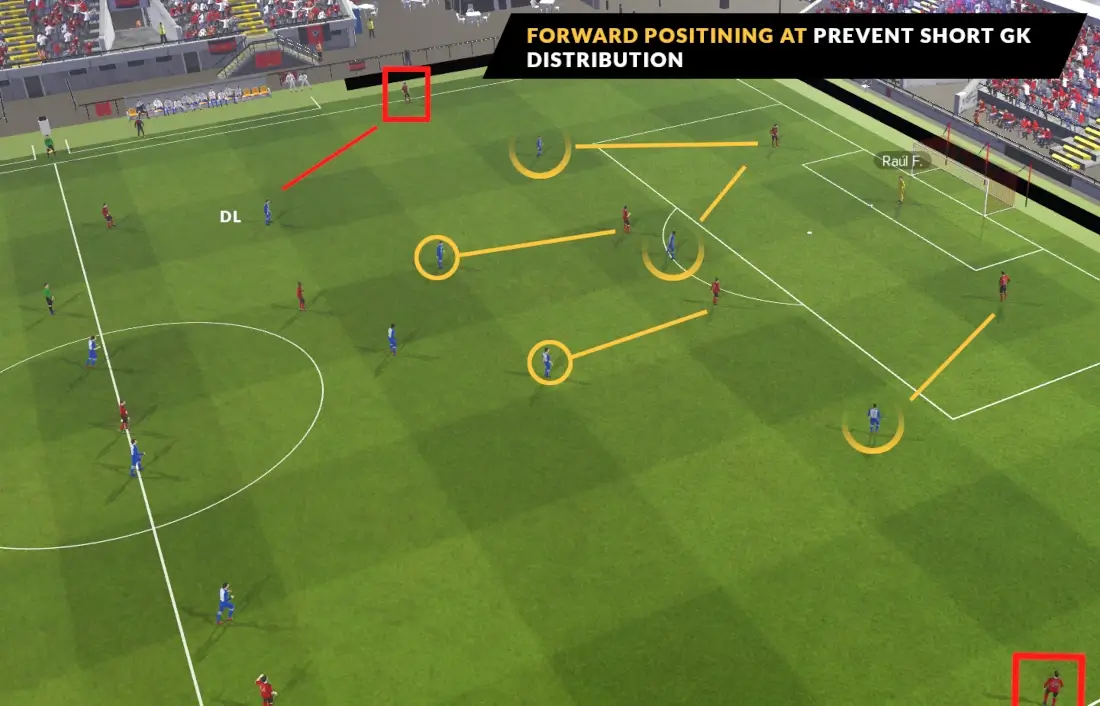
As the images illustrates, he must initiate the press towards a specific side. He will also cover the centre channel and with the wingers positioning force passes towards the wide areas rather than that central penetration through their single playmaker.
The wingers positioning in the half space zones will be essential to press effectively. You want them to press from out to in. This makes the fullback not only in a passing shadow once they close down the centre-backs but also increases the probability of intercepting passes from the CB’s to FB’s, if the ball is played towards the wing.

When pressing at goal-kicks you want to put immediate pressure on the centre-backs. Although they split wide and offer two outlets for the goalkeeper to play out from the back, you must prepare for passes towards the third option – the single holding midfielder or the one within the double pivot who drops deep through the centre channel.
Meanwhile the wingers control the wingbacks by either tight marking them or cover the channel between the centre-backs and the fullbacks by staying on the edge of the penalty area, the role of the centre forward is crucial in the high press.

The body position and angle of the centre forward when pressing will force the goalkeeper to pick a side when playing out from the back. By instructing the team to close down and show the ball onto the goalkeepers’ weaker foot, you will decide which area you should set in the press.
Before deciding, you might want to take an extra look on the technical abilities of the centre backs. Does one of them have poor composure, technique, passing and/or decision-making to progress the ball cleanly, or may he buckle under the pressure?
The strategy to force passes towards a specific foot is a strategy I’ve used for decades.
Personally, I like to take advantage of the weak zones between the centre backs and fullbacks. By showing the ball inwards as soon as the fullback receives the ball, you can increase the probability of intercepting passes from the fullback to the centre back, or FB to defensive midfielder.

For the right back, I might instruct my players to show the ball onto his left foot. For the left back I might show the ball onto his right foot to force passes to be made inwards.
The same can be applied to the centre-back, unless you wish to win possession in a certain area where you give a certain player the freedom to play passes into a specific zone.
The situation may be different for dealing with the wingers as we must consider their crossing abilities, dribbles, vision and finishing, along with the profile of the striker according to his best abilities. If the striker is good in the air, it won’t be beneficial to force the winger to go wide and use his strongest foot to put in crosses. Instead, you want to force the wingers to make inwards passes to avoid the opposition to come to goalscoring opportunities using their strongest abilities.
In fact, it all depends on what’s their weakest foot according to their position and best skills. Then, we also must consider what our team is strong or weak at.
Along with using the show onto foot opposition instruction in a strategic way, I instruct my players to close down certain positions. You could target a specific player with low composure, technique and decisions, or instruct your players to put pressure on key positions.
Closer Insight to My Strategy To Press High
My strategy is to initiate a press against the Goalkeeper, Centre-backs and Defensive Midfielder but in general it all depends where you want to regain possession.
If up against a double pivot, it may be the player who position himself the deepest and where there’s a higher chance of play being progressed through that position. This is done by instructing to close down these positions and is often used alongside tight marking specific players who are strong in ball progression.
My method to use hybrid press provides a better circumstance to set up pressing traps.
Depending on their midfield line-up, I want one of my central midfielders to tight mark their opposing player.
If I’m using a 4-3-3 system and comes up against a 4-2-3-1, I might ask one of the central midfielders to tight mark one of the players within the opposition’s double pivot. If up against an opponent with a single holding midfielder, one of the central midfielders may be tasked with tight marking the DM. This will be the duty of the attacking midfielder to man mark the DM in a bid to reduce his playmaking abilities and capabilities to pull the strings by dictating the tempo.
Marking the defensive midfielder is a necessity to prevent from central ball progression. Limiting the opponent’s chance of playing triangle passes in a quick fashion that aims to leave gaps in the team’s pressing structure.
The question is who shall man mark the defensive midfielder?
If the centre-forward tight mark the single holding midfielder, it gives more space and time for the opposing centre-backs to progress the ball more cleanly. In fact, it puts more demands on the wingers, as they will then be required to defend narrower and push onto the centre backs.
If you instruct one of your central midfielders to push out of their position to tight mark the defensive midfielder, it will leave a hole in the defensive balance on the side he originates from. Once he moves up to screen against passes towards the DM, it puts more defensive duties on the fullback and/or defensive midfielder to protect both their channel from counter-attacking initiatives and roaming midfielders who can try to exploit that gap.
When coming up against teams using a single holding midfielder, a better strategy may be to use an attacking midfielder to cover that area. By asking the AMC to tight mark the DM, we can ask the wingers in our 4-2-3-1 system to occupy the fullbacks – resulting in that all the closest passing options to the centre backs are applied pressure on and may have difficulties to find a forward passing option.
What may be purposeful is the way the attacking midfielder can press the centre backs once on the ball and use his curved movement to screen the holding midfielder from receiving the ball whilst applying pressure.
You can achieve something similar if you decide to tilt your midfield line and instruct one of the midfielders to man mark the opposing holding midfielder.
As I wish to close down the time and space for the centre back when they receive the ball at goal kicks I have two methods in my sleeve.
- Instruct one of the wingers to man mark their closest centre back and use his aggressiveness to try to rush the centre backs decisions. In FM, the winger will push out of his zone as soon as the centre back receives the ball – ensuring the pressure applied can force back passes.
- Let the front trio zonally mark their centre and half space channels and use their positioning to eventually win possession or force mistakes by their pressing intensity.
Another purposeful pressing strategy is to leave the DM free.
You could use a player-to-player marking in the middle with the MCR and MCL occupying each of their designated positions. The central midfielders will then cover each of the half space channels and will stay close to their opponents – making these players act like hybrid players as they can easily push out of their zone to apply pressure both down the flanks or in the quest to win the battle of the midfield.
By leaving the centre forward free to close down any player who receives the ball close to him, he can back press and use his positioning to set up pressing traps in the middle.
When up against a team who uses a single holding midfielder, the lone striker will automatically block off passing options from the centre backs directly to the DM. The way he moves and angles his runs can help the team to limit the playing field and force passes to only one half of the pitch – aiding the defensive team to press as a coherent unit.
However, it gives the opposition team an outlet when building out from the back.
For us, it represents the chance to setup a pressing trap towards that player by instructing any player to close down him down as soon as the ball arrives to him. Recovering the ball will be easier if you apply the Trap Inside instruction.
As we see from this illustration from Football Manager, the positioning of the front trio ensures that the goalkeeper has limited options to play out from the back without passing the ball to a player under pressure.
If he plays to one of the centre backs, the wingers can close them down or try to intercept the pass towards the fullbacks if the ball is progressed that way.
Regardless of how you setup your team’s pressing structure, there must be a synergy in both movements and positioning between your players.
If the winger moves inside to man mark the centre-back or pressurize one of the players within the double pivot, the fullback must follow the run. If the central midfielder pushes up, the other midfielder must be more conservative. Perhaps, moving into the same line as the defensive midfielder – creating an extra line of defence in front of the centre-backs.
Regardless of how you set up your pressing structure, moving an extra player into the high press can limit the opposing team’s chances to build out from the back cleanly.
Whether that player is moved from the fullback position – by instructing him to close down the opposing fullback position, apply specific man marking on the centre back position for the central midfielder, or push the attacking midfielder up so you create a 4-2-4 pressing structure, is something I will leave up to you to decide after thorough analyses of the next opposition.
Now, it’s important to remember that how you set up your pressing structure will depend on your formation and who you are up against.
What’s important is to consider the defensive balance and rest defence. Regardless of how your high pressing structure will look like, you need to keep a defensive solidity.
Considering your rest defence and how you shall protect against counter-attacks if the opposition beats your press will be as important as taking any risks necessary to try to recover the ball. You can’t just push players up front to pressurize the opposing defensive lines at goal kicks.
Pressing in a 3-1-2-4 Structure
Another strategy when utilizing the high press against teams who build out from the back is to rely on a 3-1-2-4 structure.
In this pressing structure you would ask one of your fullbacks to tuck inside by using the Inverted Fullback player role. The IFB is a great option to provide a rest defence of 3vs2 or can help to protect against counter-attacks if the opposing team is using a front four (for instance the 4-2-3-1 system).
In this scenario you’ll have the defensive midfielder covering in front of the back three with either both of the central midfielders taking up advanced positions, or one of the central midfielders and the inverted wingback protecting the centre by applying pressure onto the opposing midfield.
Up front, the fourth midfielder can be the central midfielder, for instance a CM-A, MEZ-S/A or a BBM who can tight mark one of the centre backs.
What’s unfortunate is that you’ll not be able to set up your desired pressing structure at just goal kicks or when they are playing out from the back but hopefully that feature will be featured in the next instalment of Football Manager.
However, this 3-1-2-4 pressing strategy will resemble how Bournemouth are pressing their opponents high.
In their pressing structure, they use a highly player-oriented press. Their man to man press splits their defensive tactics into two units. One pressing unit and the rest defence who awaits deeper on the pitch to intercept longer more risky passes made by the opposing defenders. The aim of this incredible intensive pressing is to force rushed decisions whilst giving their own defenders time to react to those clearances.
It’s the same objective I try to apply in any of my high-intensity pressing tactics.
As I see it, I do not need to win the ball within the first two passes but force the opposition to initiate progressive passes that increased the probability of being intercepted by the defensive unit, or one of the midfielders.

By applying some of these methods, you’ll discover that pressing will become more effective. Some of the tactical instructions I use to press high is incorporated within my tactics, whilst others are applied on a match-by-match basis using opposition instructions.
For now, I’ll leave it at this point as this article became quite lengthy. We hope you enjoyed this insightful piece about pressing and look forward to seeing you return for part 2 where I’ll get deeper into the topic of creating pressing traps on Football Manager.
Conclusion
Mastering the press on Football Manager requires an attention to detail and a match management that goes beyond simply making substitutions or react to unfolding events. It’s necessary to digest statistics and data to determine what’s the best way to recover possession. For a tactical manager, trying to dominate the opposition by controlling their build up through a high press forces micro-management.
Sometimes, you’ll experience that changes to roles or duties is required to combat the opposition, whilst other times altering your pressing strategy by prioritizing a certain pressing trap may help you to clinch a win by scoring a goal from a high turnover.
Regardless of how you wish to win possession, using the high press or counter-pressing strategy can be a useful strategy to apply! Combining everything you now know about pressing in Football Manager will let you be one step closer to dominate your opponent in their own half and score wonderful goals from high turnovers!
Anyways, happy managing and pay attention to details!


